- Yahya (عليه السلام) is mentioned by name 5 times in the Holy Quran. He is the only Prophet whose name was chosen for him exclusively by Allah (ﷻ).
- The Prophet Zakariyyah (عليه السلام) used to go to the temple daily (the current al-Aqsa Sanctuary) to deliver his sermons even though he had grown feeble with age. He was not a rich man, but he was always ready to help those in need. His one disappointment in life was that he had no children, for his wife was barren. This worried him, for he feared there was no one after him to carry out his work. The people needed a strong leader, for it they were left on their own, they would move away from Allah’s teachings and change the Holy Laws to suit themselves.
- During one of his visits to the temple, he went to check on Maryam (عليه السلام) [Mary], who was living in a secluded room of the temple. He was surprised to find fresh out of season fruit in her room. Besides him, no one had entry to her room. When he inquired, she told him that the fruit was from Allah which she found every morning. But why was he so surprised, she asked him. Did he not know that Allah provides without measure for whom He wills? This noble girl had opened his eyes to a startling idea. Could he not ask his Lord to bless him with a child in his old age? Even though his wife was past childbearing age, nothing was impossible for Allah (ﷻ).
- Allah (ﷻ) revealed in the Holy Quran in Surah Maryam:
“Kaf Ha Ya Ayn Sad (These letters are one of the miracles of the Quran, and none but Allah Alone knows their meanings). This is an account of your Lord’s grace towards His servant, Zachariah, when he called to his Lord secretly. saying, ‘Lord, my bones have weakened and my hair is ashen grey. But never, Lord, have I ever prayed to You in vain: I fear [what] my kinsmen [will do] when I am gone, for my wife is barren, so grant me a successor – a gift from You – to be my heir and the heir of the family of Jacob. Lord , make him well pleasing [to you].” [19:1-6] - (Allah said): “Zachariah, We bring you the good news of a son whose name will be John (Yahya). We have chosen this name for no one before him.” [19:7]
- The name Yahya literally means ‘he lives’ . Qatadah (may Allah show mercy on him) says this name was given to him because Allah had given him the inner life through Iman and Nubuwwah (i.e. belief and prophethood). Some say it was because Allah (ﷻ) brought people to life by guiding them through Yahya (عليه السلام). Yet others have said it was due to his mother’s womb being brought back to life after being barren until old age.
- Yahya (عليه السلام) was born six months before Isa (عليه السلام). His mother was the sister of Hanna, who was the mother of Maryam (عليها السلام). When supplicating for a child Zakariyyah had specifically asked for a ‘pure child’ (Quran 3:38). According to his wishes, Allah (ﷻ) granted him an extraordinary son.
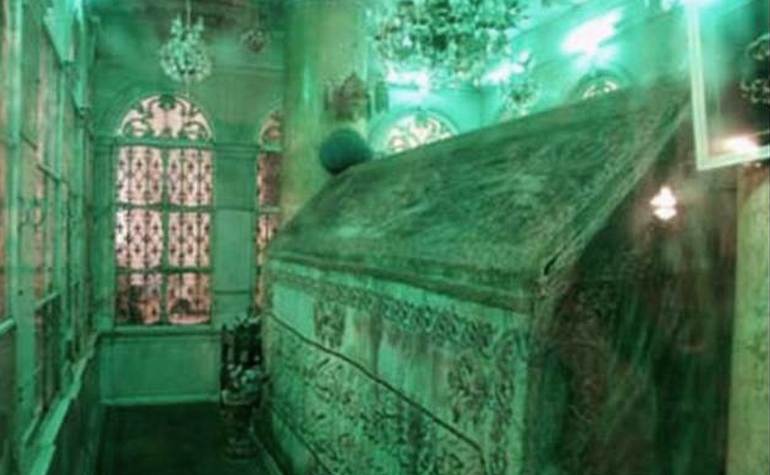
- In infancy, Yahya (عليه السلام) was instructed by Allah (ﷻ) to adhere and abide to the teachings of the Torah. He was also given the duty of propagating and communicating it to the people. Allah (ﷻ) granted him tremendous maturity and wisdom while he was still a child, and according to some historians, he was endowed with prophethood before the age of thirty.
- Yahya (عليه السلام) preferred solitude to company. He ate leaves of trees and sometimes locusts or grasshoppers and drank the water of springs. He wept much from the fear of Allah and was the epitome of chastity, remaining unmarried throughout his life.
- A conflict took place between Yahya (عليه السلام) and the authorities at that time. A tyrant king, Herod Antipas, the ruler of Palestine, was in love with Salome, his brother’s daughter. He was planning to marry his beautiful niece. The marriage was encouraged by her mother and by some of the learned men of Zion, either out of fear or to gain favour with the ruler. On hearing the ruler’s plan, Yahya (عليه السلام) pronounced that such a marriage would be incestuous. He would not approve it under any circumstance, as it was against the Law of the Torah.
- Yahya’s (عليه السلام) pronouncement spread like wildfire. Salome was angry, for it was her ambition to rule the kingdom with her uncle. She plotted to achieve her aim. Dressing attractively, she sang and danced before her uncle, arousing Herod’s lust. Embracing her, he offered to fulfill whatever she desired. At once she told him: “I would love to have the head of Yahya, because he has defiled your honour and mine throughout the land. If you grant me this wish, I shall be very happy and will offer myself to you.” Bewitched by her charm, he submitted to her monstrous request. Yahya (عليه السلام) was executed and his head was brought to Salome. The cruel woman gloated with delight. But the death of Allah’s beloved prophet was avenged. Not only she, but all the children of Israel were severely punished by invading armies which destroyed their kingdom. According to Biblical sources, Yahya (عليه السلام) died in the year 36 CE aged 42.
References: Atlas of the Quran – Dr. Shauqi Abu Khalili, Stories of the Prophets – Ibn Kathir, HUMA Travel guide to Palestine.
Note that this entry has been shown for information purposes only. On no account should anybody pray to a grave or seek supplication through them as this is tantamount to committing shirk, associating partners with Allah (ﷻ)
]]>- Salahuddin Ayyubi’s real name was Yusuf ibn Ayyub, the title of Salahuddin which he was given due to his extraordinary qualities means ‘the Righteousness of the Faith’. He was born in Tikrit, in modern-day central Iraq, His family was of Kurdish background and ancestry, Between 1187 and 1189 CE Salahuddin Ayyubi took 50 Crusader castles and much of the Crusader kingdom. However, even his enemies thought him chivalrous and honourable. During the siege of Kerak castle he refused to bombard a tower in which a honeymoon couple were staying.
- Baha ad-Din, one of Salahuddin’s officials wrote, “…Everyone who appeared before him was treated with honour, even an infidel … Once a Frankish prisoner was brought before him in whom the Sultan aroused such fear that the marks of terror and agitation were visible in his face. The interpreter asked him: ‘What are you afraid of?’ God inspired him to reply, ‘At first I was afraid of seeing that face, but after seeing it and standing in his presence, I am sure that I shall see only good in it.’ The Sultan was moved, pardoned him, and let him go free…”
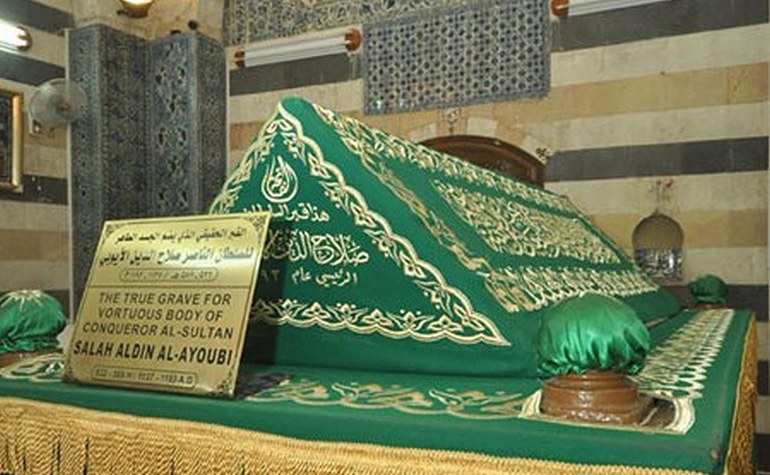
- He and Richard (the Lionheart) grew to respect one another as military leaders. When Salahuddin Ayyubi heard that Richard had fallen ill in Ascalon, he sent peaches and pears to help restore him to health. He also sent packs of snow from Mount Hermann to cool the King’s fever. At Arsuf, when Richard lost his horse, Salahuddin sent him two replacements. The Jewish philosopher Maimonides was one of Salahuddin Ayyubi’s personal physicians. When Jerusalem was recaptured, Salahuddin invited the Jews, who had been excluded by the Crusaders to come back, in particular the Jews of Ashkelon responded to his request. Salahuddin died of a fever on March 4 1193, at Damascus, not long after Richard’s departure. Since Salahuddin had given most of his money away for charity, when they opened his treasury they found there was not enough money to pay for his funeral.
References: Crusades – (Chris and Melanie Rice), A history of Jerusalem – Karen Armstrong, The Crusades – Christine Hatt, Wikipedia
Note that this entry has been shown for information purposes only. On no account should anybody pray to a grave or seek supplication through them as this is tantamount to committing shirk, associating partners with Allah (ﷻ)
]]>- Bilal (رضي الله عنه) was an Abyssinian (Ethiopian) slave of a disbeliever in Makkah. His conversion to Islam was, naturally, not liked by his master and he was, therefore, persecuted mercilessly. Ummayah-bin-Khalaf, who was the worst enemy of Islam, would make him lie down on the burning sand at mid-day and would place a heavy stone on his breast, so that he could not even move a limb. He would then say to him, “Renounce Islam or swelter and die.”
- Even under these afflictions, Bilal (رضي الله عنه) would exclaim: “Ahad” – The One (Allah), “Ahad” – The One (Allah).
- He was whipped at night and, with the cuts thus received, made to lie on the burning ground during the day to make him either forsake Islam or to die a lingering death from wounds. The torturers would get tired and take turns (Abu Jahl, Ummayah and others) and vie with one another in afflicting more and more painful punishment, but Bilal (رضي الله عنه) would not yield. At last Abu Bakr (رضي الله عنه) bought his freedom, and he became a free Muslim.
- Allah (ﷻ) rewarded his steadfastness. He was to have the honour of becoming the Prophet’s Muezzin. He was to always remain with him at home and abroad to call out the Azaan for his Salat. After the Prophet’s death it became very hard for him to continue his stay in Madinah where he would miss him at every step and in every corner. He therefore left Madinah, and decided to pass the rest of his life striving in the path of Allah. Once he beheld the Prophet (ﷺ) in his dream saying to him: “O Bilal! How is it that you never visit me?” .
- No sooner did he get up that he set out for Madinah. On reaching there, Hassan and Hussain (رضي الله عنهم), the Prophet’s grandsons, requested him to call out the Athan. He could not refuse them, for they were very dear to him. But as soon as the Athan was called, the people of Madinah cried openly out of their anguish at the memory of the happy old days of the Prophet’s time. Even the women came out of their houses weeping. Bilal (رضي الله عنه) left Madinah again after a few days and died in Damascus in 20 AH.
Note that this entry has been shown for information purposes only. On no account should anybody pray to a grave or seek supplication through them as this is tantamount to committing shirk, associating partners with Allah (ﷻ)
References: Fazail-e-Aamal – Sheikh Zakariyya Kandhalvi
]]>- Kathir bin Qais narrates: “I was sitting with Abu Darda (رضي الله عنه) in a masjid in Damascus, when a person came to him and said, ‘O, Abu Darda (رضي الله عنه), I have come all the way from Madinah to learn one Hadith from you, as I understand you have heard it directly from the Prophet (ﷺ)’.”
- Abu Darda (رضي الله عنه) asked: “Have you any other business in Damascus?”. The person:“No.” Abu Darda (رضي الله عنه):“Are you sure that you have no other work in Damascus?”. The person: “I have come to this place with the sole purpose of learning this Hadith”. Abu Darda (رضي الله عنه) responded:“Listen. I have heard the Prophet (ﷺ) saying, ‘Allah eases the way to Paradise for one who traverses some distance to seek knowledge.The angels spread their wings under his feet, and all things in heavens and earth (even the fish in the water) pray for his forgiveness. The superiority of a person possessing knowledge over a person doing worship is as the superiority of the moon over the stars. The Ulama are the inheritors of the Prophet (ﷺ). The legacy of Prophets (Alaihis-salaam) is neither gold nor silver. Their legacy is knowledge. A person who acquires knowledge acquired a great wealth.”
The entrance to the tomb:

- Abu-Darda (رضي الله عنه) is foremost among the Sahabah who possessed very sound knowledge in religion. He is called ‘Hakeem-ul-Ummah’ (The Sage of Islam). He once said: “Before Islam, I lived on trade. After accepting Islam, I tried to combine the service of Allah with my business,but I could not do so. I therefore gave up business and devoted myself solely to the service of Allah. Now if I have a shop at the gate of a masjid and have no fear of losing a single salah thereby, and even if the shop gives me a daily profit of 40 dinars to spend the whole lot in the path of Allah, even then I am not willing to turn to business.” Somebody inquired the reason. He replied: “Because of the fear of reckoning.”
- Abu-Darda (رضي الله عنه) narrated 179 ahadith.
- He passed away in 32 AH.
Note that this entry has been shown for information purposes only. On no account should anybody pray to a grave or seek supplication through them as this is tantamount to committing shirk, associating partners with Allah (ﷻ)
Reference: Wikipedia
]]>- Prior to him accepting Islam, Khalid-bin-Waleed (رضي الله عنه) fought on the side of the Quraysh in the Battle of Uhud and it was his military manoeuvres that led to the deaths of 70 Sahabah.
- After embracing Islam, Khalid (رضي الله عنه) first took charge of a Muslim army at the Battle of Mu’ta after the three leaders appointed by the Prophet (ﷺ) had been martyred. He successfully commanded a protective withdrawal. Khalid (رضي الله عنه) broke 9 swords during combat in the battle and after the Battle of Mu’ta he was given the title ‘Saifullah‘ (Sword of Allah).
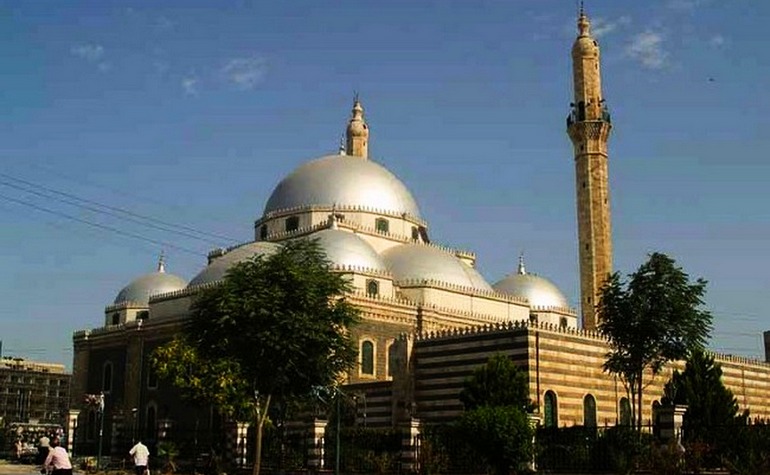
- He was one of the most successful military commanders of all time. He is noted for his military prowess, commanding the forces of the Prophet (ﷺ) and those of his immediate successors of the Rashidun Caliphate; Abu Bakr and Umar ibn al-Khattab. He has the distinction of being undefeated in over a hundred battles, against the numerically superior forces of the Byzantine Roman Empire, the Sassanid Persian Empire, and their allies. His greatest strategic achievements were his swift conquest of the Persian Empire’s Iraq and conquest of Roman Syria within three years from 633 to 636 CE, while his greatest tactical achievements were his successful double envelopment manoeuver at Walaja and his decisive victories at Yamamah, Ullais and Yarmouk.
- In 631 CE he participated in the farewell Hajj of the Prophet (ﷺ). According to a narration, when the Prophet (ﷺ) shaved his head, Khalid (رضي الله عنه) took some of his hairs. When asked by the Prophet (ﷺ) the reason for this, he replied, “I will keep these hairs with me forever as a relic so that they will help me be victorious in battles.“ Later he sewed those hairs in his cap, which he always wore under his turban.
- The tragedy of Khalid-bin-Waleed (رضي الله عنه) was to die on his bed. He himself narrates, “ I attended such-and-such a battle, and such-and-such a battle, proceeding (towards the enemies); and there is no spot of my body but that it has either a sword’s strike, a spear’s pierce or an arrow’s throw. And now I’m dying on my bed, in the same way as the camel dies. May the eyes of the cowards never sleep.”
- Scholars have commented that the reason he died a natural death was that he was ‘The Sword of Allah’ and thus it was not possible for him to be killed by another man.
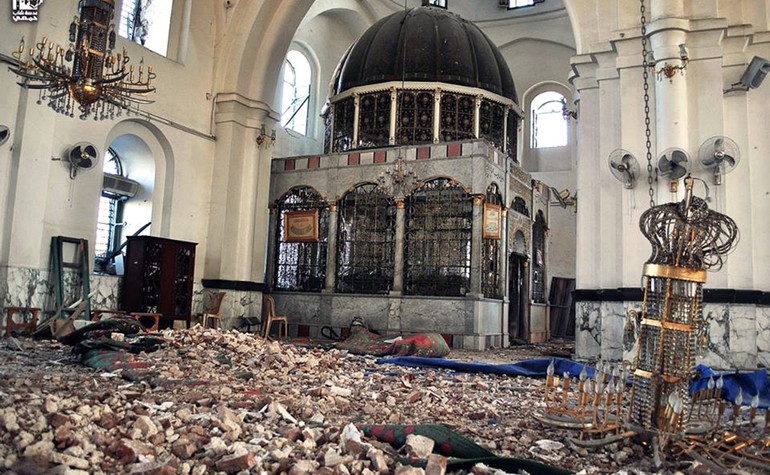
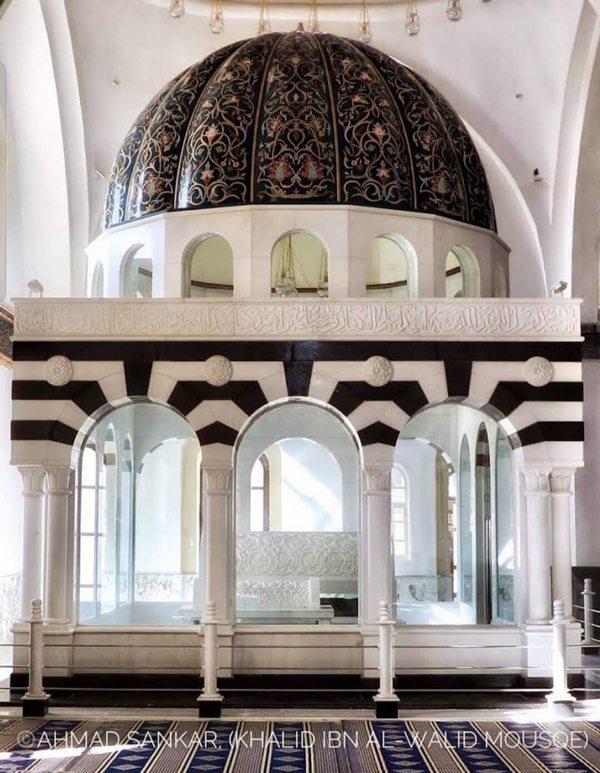
- The Mosque of Khalid-bin-Waleed has been bombed during the Syrian civil war. This video shows the aftermath of the bombing of the mosque (in arabic):
- The mosque has now been renovated:
References: Men around the Messenger – Khalid Mohammed Khalid, Wikipedia.
Note that this entry has been shown for information purposes only. On no account should anybody pray to a grave or seek supplication through them as this is tantamount to committing shirk, associating partners with Allah (ﷻ)
]]>
- The Prophet Adam (عليه السلام) and Hawwa (Eve) were blessed with two sons, Habil (Abel) and Qabil (Cain). When they grew up, Habil, the younger brother, became a shepherd. He herded sheep, goats and other animals. The elder brother Qabil, worked as a farmer, tilling the fields.
- One day both decided to make a sacrifice to please their Lord. Habil took the best of his flock, while Qabil brought his crops. Suddenly a spark of light came down and burnt Habil’s offering to ashes. Thus Allah (ﷻ) accepted Habil’s sacrifice, but rejected Qabil’s sacrifice. Qabil felt hurt at being disgraced and insulted. His face darkened with anger and his heart became hardened: “No,” cried Qabil, “I will kill you!” At this treat from his elder brother, Habil did not shout back. He just said calmly: ”Even if you raise your hand to kill me, I will not fight back, for I fear Allah, the Lord of the Worlds.”
- But Qabil’s anger got the better of him and he killed his innocent brother Habil. But soon Qabil’s anger cooled down and he felt very sorry: ”Now I have killed my brother,” said Qabil to himself in deep sorrow. Then Allah sent a raven, which landed on the ground near the body. The raven began to scratch the ground to tell Qabil that he should bury his brother’s dead body under the earth. “Woe is me!” Cried Qabil helplessly. “I am worse even than this raven, for I cannot hide my brother’s dead body.” Qabil felt his meanness all the more so, because even a raven could teach him a lesson. Narrating the story of the two brothers, the Quran reminds us in Surah al Ma’idah:
“On account of [his deed], We decreed to the Children of Israel that if anyone kills a person – unless in retribution for murder or spreading corruption in the land – it is as if he kills all mankind, while if any saves a life it is as if he saves the lives of all mankind…”
[Quran 5:32]
References: Stories from the Quran – Saniyasnain Khan
Note that this entry has been shown for information purposes only. On no account should anybody pray to a grave or seek supplication through them as this is tantamount to committing shirk, associating partners with Allah (ﷻ)
]]>- Aslam (رضي الله عنه) narrates that he was once accompanying Umar bin Al-Khattab (رضي الله عنه) on his patrol of Madinah at night, it so happened that he leaned against a wall to rest when he felt tired. It was midnight, and we heard a woman say to her daughter, “O my daughter, get up and mix that milk with some water.”
The girl said, “O mother, did you not hear the decree of Amir Al-Mu’minin (chief of the believers) today?”
The mother said, “What was that?”
The girl, “He ordered someone to announce in a loud voice that milk should not be mixed with water.”
The mother, “Get up and mix the milk with water; you are in a place where Umar cannot see you.”
The girl told her mother, “I cannot obey Him (Allah) in public and disobey Him in private.”
Umar heard this, and told me: “O Aslam, go to that place and see who that girl is, and to whom she was speaking, and whether she has a husband.” So I went to that place, and I saw that she was unmarried, the other woman was her mother, and neither of them had a husband. - I came to Umar and told him what I had found out. He called his sons together, and said to them: “Do any of you need a wife, so I can arrange the marriage for you? If I had the desire to get married, I would have been the first one to marry this young woman.”
Abdullah said: “I have a wife.” Abdur-Rahman said: “I have a wife.” ‘Asim said: “I do not have a wife, so let me marry her.” So Umar arranged for her to be married to ‘Asim. The woman gave birth to a daughter (named Fatima), who grew up to be the mother of Umar bin Abdul-Aziz.
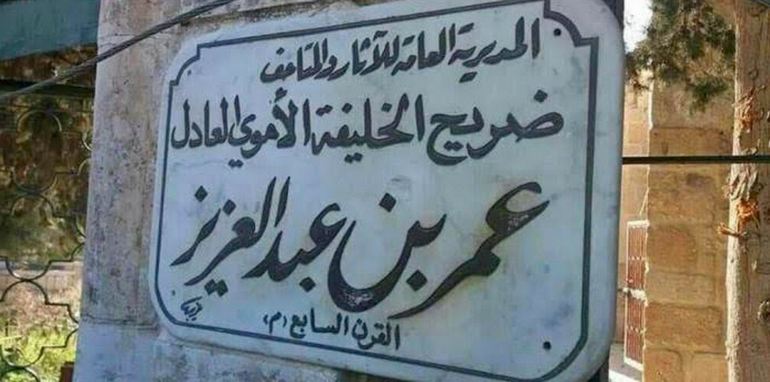
- Umar bin Abdul Aziz was extremely pious and disdainful of worldly luxuries. He preferred simplicity to the extravagance that had become a hallmark of the Umayyad lifestyle, depositing all assets and finery meant for the caliph into the public treasury. He abandoned the Khalifal palace and instead preferred to live in modest dwellings. He wore rough linens instead of royal robes, and often went unrecognised.
- Though he had the people’s overwhelming support, he publicly encouraged them to elect someone else if they were not satisfied with him (an offer no one ever took him up on). Umar confiscated the estates seized by Umayyad officials and redistributed them to the people, while making it a personal goal to attend to the needs of every person in his empire. Fearful of being tempted into bribery, he rarely accepted gifts, and when he did he promptly deposited them in the public treasury. He even pressured his own wife – who had been daughter, sister and wife to three separate caliphs – to donate her jewellery to the public treasury.
- While Umar’s reign was very short, he is very highly regarded in both Shi’a and Sunni Muslim memory. Indeed, he is considered one of the finest rulers in Muslim History, second only to the Four Rightly Guided Caliphs, and is affectionately referred to by some as the Fifth and last Rightly Guided Caliph.
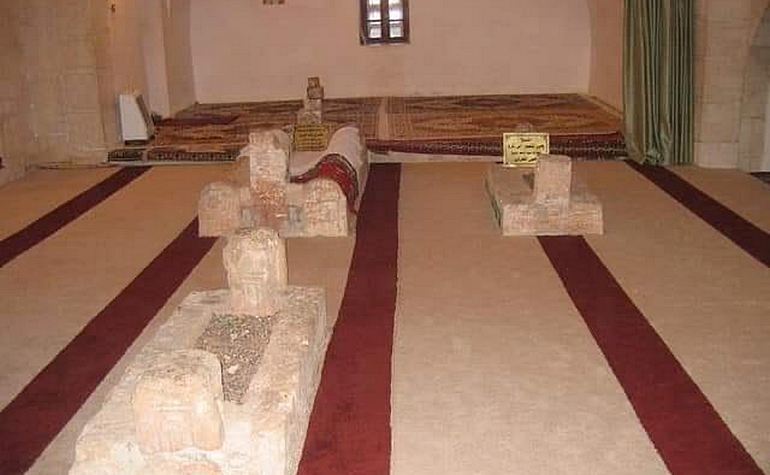
- According to most historians, Caliph Umar died in Aleppo, Syria, on the 5th or 6th of Rajab, 101 AH. (some have mentioned the 20th) when he 39 or 40 years old. He was buried in Dair Siman in a plot purchased from a Christian.
- The cause of his death is attributed to the reforms he initiated, which greatly angered the Umayyad nobility. It is reported that they bribed a slave of his to administer a deadly poison. The Caliph having felt the effect of the poison sent for the slave and asked him why he had poisoned him. The slave replied that he was given one thousand dinars for the purpose. The Caliph deposited the amount in the public Treasury and freeing the slave asked him to leave the place immediately, lest anyone should kill him.
- He reportedly left behind only 17 dinars with a will that out of this amount the rent of the house in which he died and the price of the land in which he was buried would be paid.
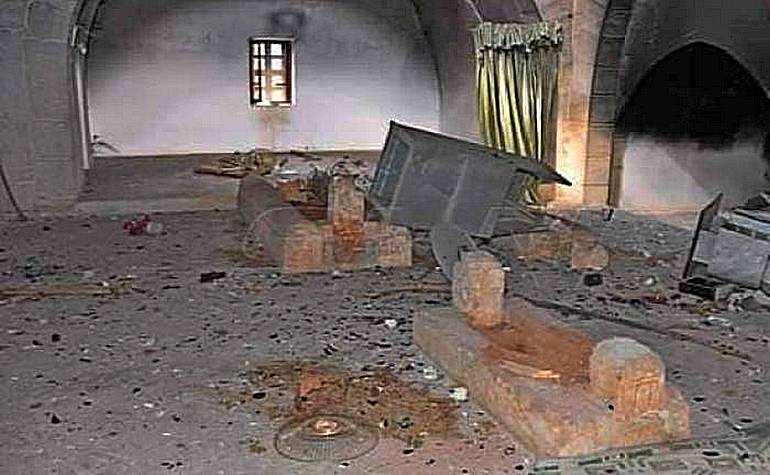
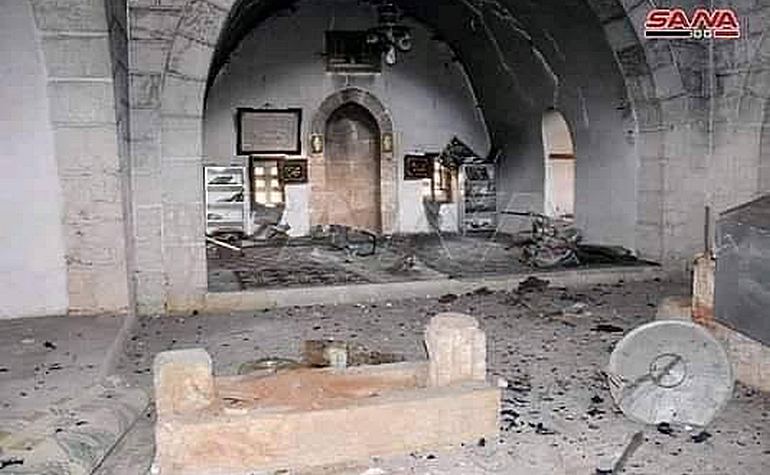
- In January 2020, when pro-Assad forces took the area in the ongoing Syrian civil war, the graves were burnt and desecrated from the outside. In May 2020 video footage emerged which shows what appears to be the emptied graves of Caliph Umar bin Abdul Aziz, his wife Fatima and his servant. The footage was posted on a pro-Assad website, it is not known what became of the bodies. May Allah (ﷻ) elevate the ranks of the deceased and punish the perpetrators of this savage act.
References: Abqari.com, Sifat Al-Safwah
Note that this entry has been shown for information purposes only. On no account should anybody pray to a grave or seek supplication through them as this is tantamount to committing shirk, associating partners with Allah (ﷻ)
]]>- The Prophet (ﷺ) was challenged by the Quraysh of Makkah who did not believe in his message to answer three questions passed onto them by the Jews. One of the questions was, “Who were the youth who disappeared, and how many were they?” The Jews knew that the Prophet (ﷺ) would only be able to tell the story if he was indeed a prophet.
- The Prophet (ﷺ) had no clue and said that he would answer them tomorrow, hoping for the answer to be revealed to him through Jibraeel (عليه السلام) but forgetting to say ’Inshallah’ (if Allah wills). No revelation came to the Prophet (ﷺ) for 15 days, leading the Quraysh to greatly abuse and revile him.
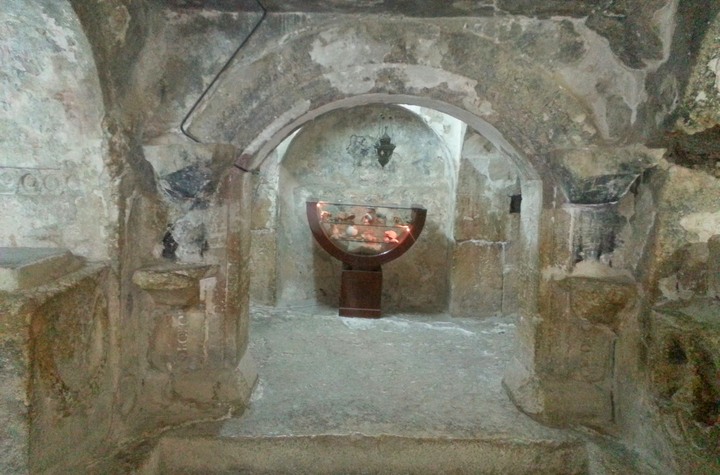
- The answer, however, was eventually revealed to the Prophet (ﷺ) in a Surah named after the cave (Al-Kahf) of the sleepers. The Quran revealed the exact story that the Jews knew of, and it answered the questions similarly to the information they had. The Quran confirmed that they slept for 309 years, which the Jews knew of. The Quran however did not give an exact answer as to how many they were. Allah (ﷻ) revealed: “[Some] say, ‘The sleepers were three, and their dog made four,’ others say, ’They were five, and the dog made six’- guessing in the dark – and some say,’ They were seven, and their dog made eight.’ Say [Prophet], ‘My Lord knows best how many they were.’ Only a few have real knowledge about them, so do not argue, but stick to what is clear, and do not ask any of these people about them.” [18:22]
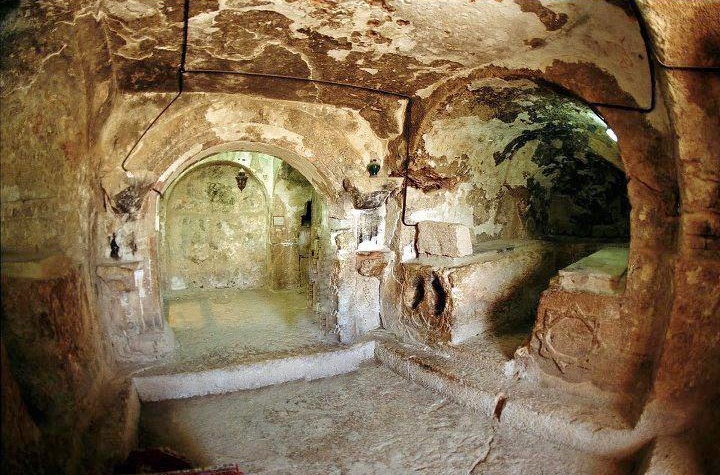
- The Jews themselves did not know exactly how many there were (whether 3,5 or 7) and were astonished when the Quran gave all the possible numbers they had suspected for the number of sleepers.
References: Stories of the Prophets – Ibn Kathir, Wikipedia
]]>Warning: Undefined array key "file" in /home/wtim8wecc6jt/public_html/overhaul.islamiclandmarks.com/wp-includes/media.php on line 1763
Deprecated: preg_match(): Passing null to parameter #2 ($subject) of type string is deprecated in /home/wtim8wecc6jt/public_html/overhaul.islamiclandmarks.com/wp-includes/media.php on line 1763
- Zaid (رضي الله عنه) was the first to embrace Islam after Ali (رضي الله عنه). He was the first slave to accept Islam.
- When still a small child he was travelling in a caravan when it was attacked by the tribe of Banu Qais. He was taken as a slave and sold in Makkah to Hakim-bin-Hizam who purchased him for his aunt Khadijah (رضي الله عنه), who offered him as a present to the Prophet (ﷺ) at the time of her marriage to him.
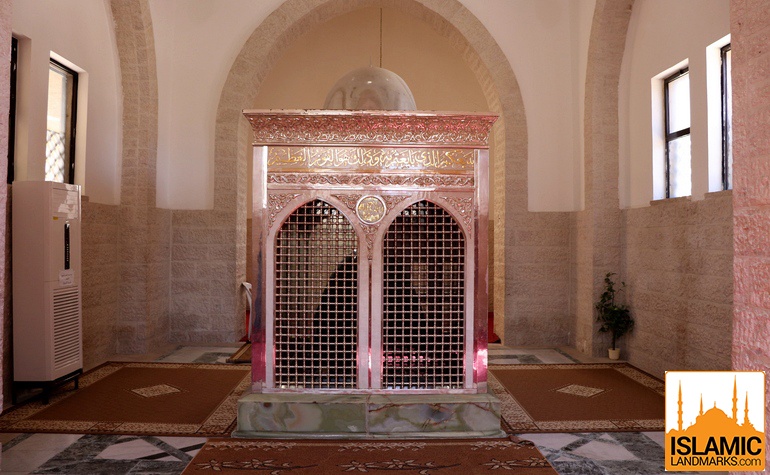
- Zaid’s father was in immense grief at the loss of his son and roamed about in search of him. Zaid met some people of his clan during their pilgrimage to Makkah and sent a letter to his father assuring him that he was quite well and happy with his noble master. Zaid’s father and uncle came to Makkah with sufficient money to ransom Zaid and approached the Prophet (ﷺ) to free him so they could take him back. The Prophet (ﷺ) gave Zaid the free choice to go back with his father but he refused saying, “How can I prefer anybody else to you? You are everybody for me, including my father and uncle.” On this the Prophet (ﷺ) took Zaid in his lap and said, “From today, I adopt Zaid as my son.” Zaid’s father and uncle were quite satisfied with the situation and gladly left Zaid with the Prophet (ﷺ).

- Zaid (رضي الله عنه) is the only companion (Sahabi) of the Prophet (ﷺ) mentioned by name in the Quran which concerned his divorce from Zainab (رضي الله عنها): “When Zaid no longer wanted her, We gave her to you in marriage.” [33:37]
- Zaid (رضي الله عنه) died at the age of 55.
References: Fazail-e-Aamal – Sheikh Zakariyya Kandhalvi, The Holy sites of Jordan – TURAB Publishing, In the Blessed Lands: Jamiatul Ulama KZN
Note that this entry has been shown for information purposes only. On no account should anybody pray to a grave or seek supplication through them as this is tantamount to committing shirk, associating partners with Allah (ﷻ)
]]>
- Jafar (رضي الله عنه) was the paternal cousin of the Prophet (ﷺ) and the older brother of Ali (رضي الله عنه).
- He had a special love for the poor and often mingled and associated with them.
- He was amongst the first of the companions to emigrate to Abyssinia (Ethiopia) during the persecution of the Quraysh. He was the spokesman of the Muslims who successfully defended the emigrants in the court of the King Negus against the Quraysh who had come to force them back to Makkah.
- He returned to Madinah at the occasion of Khaybar. The Prophet (ﷺ) came out to welcome him and kissed him on his forehead and mentioned, “I am not sure whether I am happier with the arrival of Ja’far or with the conquest of Khaybar.” This took place in 7 AH, one year before the battle of Mu’ta.
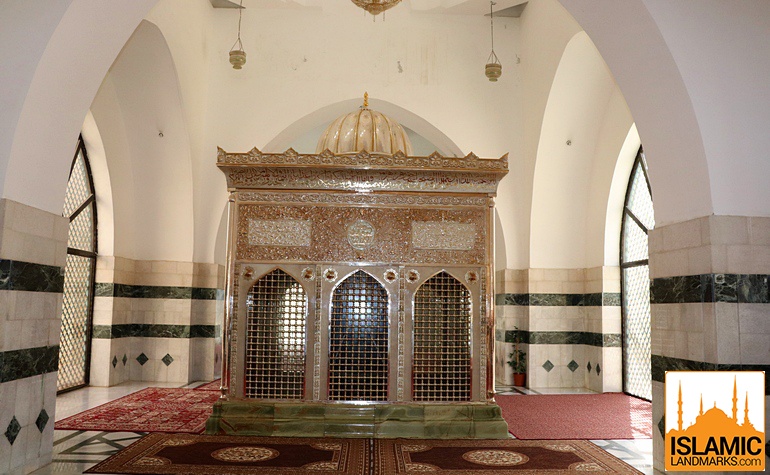
- When Zaid (رضي الله عنه) had been killed, the flag of the Muslims was taken by Jafar (رضي الله عنه). He intentionally disabled his horse to dispel any idea of returning home from the battlefield. With flag in one hand and sword in the other, he jumped into the enemy lines. The enemy cut his right hand, which held the flag. He at once transferred it to his left. When that was cut off, he held the flag in his teeth and supported it with his bleeding arms. His body was cut into two by somebody from behind and he fell dead, he was around 33 at the time.
- On hearing the news of his death, the Prophet (ﷺ) went to his house to condole with his family. Asma bint-e-Umais (رضي الله عنها), the wife of Jafar (رضي الله عنه) mentions that she was at home bathing and changing her children when the Prophet (ﷺ) entered and hugged the children. She saw tears streaming down his mubarak eyes and asked him, “O Prophet of Allah, may my parents be sacrificed for you, why are you crying like this? Has information regarding Jafar and his companions reached you?” The Prophet (ﷺ) replied, “Yes, today Jafar has been martyred.” Asma (رضي الله عنها) says, “When I heard this I shrieked and all the women began gathering at my home to console me” The Prophet (رضي الله عنها) then left the house, went home and instructed his family to prepare food for the household of Jafar (رضي الله عنه).
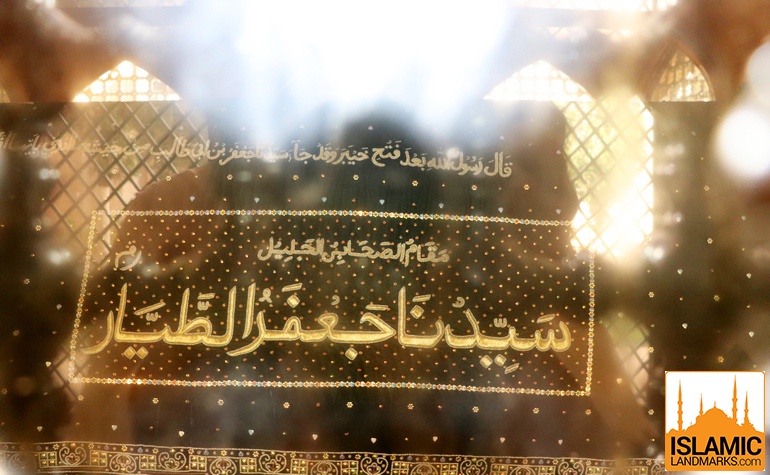
- It was on this occasion, the Prophet (ﷺ) mentioned, “In Jannah, Allah Ta’ala has given Jafar wings in place of his hands with which he flies around as he wishes and where he wishes”. It is for this reason that he became famously known as Jafar ‘al-Tayaar’ (One who flies).
References: Fazail-e-Aamal – Sheikh Zakariyya Kandhalvi, In the Blessed Lands: Jamiatul Ulama KZN
Note that this entry has been shown for information purposes only. On no account should anybody pray to a grave or seek supplication through them as this is tantamount to committing shirk, associating partners with Allah (ﷻ)
]]>