
Masjid al-Manaratain is named due to being located between two yellow hills which once existed here. It is reported that the Prophet (peace and blessings of Allah be upon him) prayed in this location.
a

References:
]]>- The spot where the mosque now stands was originally a temple dedicated to the idol Hadad in the Aramaean era about 3000 years ago. When the Romans ruled Damascus a temple was built for the worship of Jupiter. It then became a Christian church dedicated to John the Baptist in the Byzantine era towards the end of the fourth century.
- Following the Battle of Yarmouk in 636 CE, Damascus was conquered by the Muslims under the leadership of Khalid-bin-Waleed (رضي الله عنه). The Muslims shared the church building with the Christians for worship. The Muslims prayed in the eastern section of the structure and the Christians in the western side.
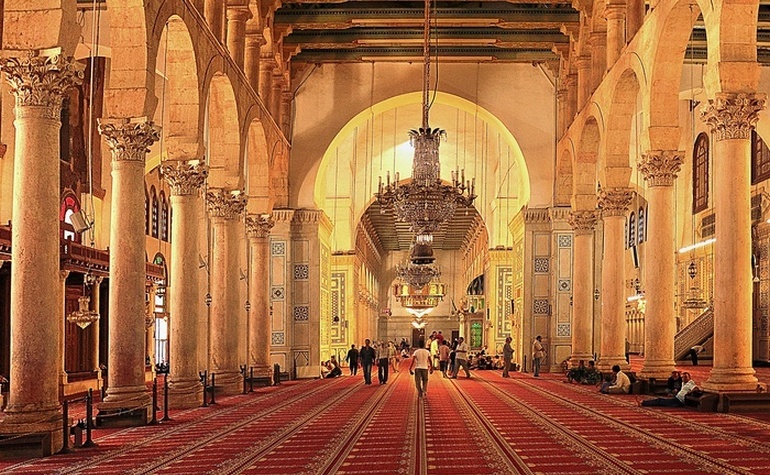
- This collective use continued until the reign of the Umayyad caliph al-Walid I, when the prayer space became inadequate both in terms of capacity and the need for an architectural monument to represent the new religion. The caliph negotiated with Christian leaders to take over the space, and in return al-Walid promised that all the other churches around the city would be safe, with the addition of a new church dedicated to the Virgin granted to the Christians as compensation. The church was purchased from the Christians before being demolished and between 706 and 715 CE the current mosque was built in its place.
- Construction of the mosque was based on the mosque of the Prophet Muhammad (ﷺ) in Madinah, which had many functions: it was a place for personal and collective prayer, religious education, political meetings, administration of justice, and relief of the ill and homeless. The caliph asked and obtained from the Emperor of the Byzantine Empire for 200 skilled workers to decorate the mosque, as evidenced by the partly Byzantine style of the building. The new mosque was the most impressive in the Islamic world at the time, and the interior walls were covered with fine mosaics. The building became one of the marvels of the world, because it was one of the largest of its time. The exterior walls were based on the walls of the temple of Jupiter and measure 100 by 157.5 m.
- The Umayyad Mosque holds special significance to Shi‘ah Muslims, as this was the destination of the descendents of the Prophet (ﷺ), made to walk here from Iraq, following the battle of Karbala.
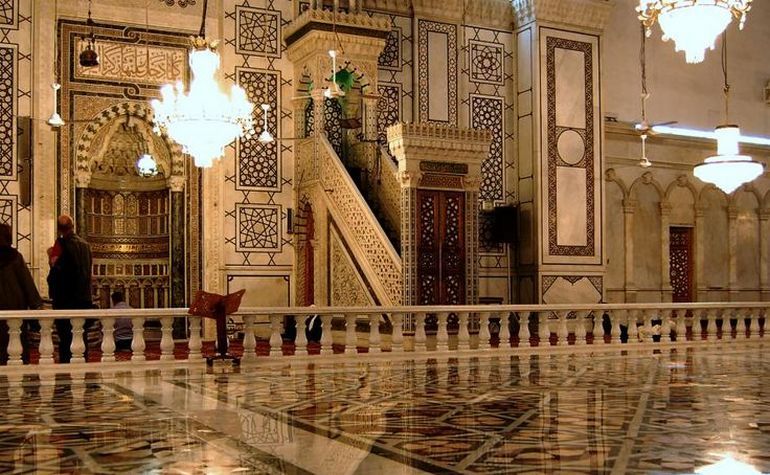
- The prayer hall consists of three aisles, supported by columns in the Corinthian order. It was one of the first mosques (the other being al-Aqsa Mosque in Jerusalem) to have such a shape and in this way, the visitors could see the mihrab, the alcove indicating the direction of Makkah, and each other more easily.
- In 2001 Pope John Paul II visited the mosque, primarily to visit the relics of John the Baptist. It was the first time a pope had paid a visit to a mosque.
References: Wikipedia, Archnet.org
]]>
References: ClassicalIslam.com by graduate of Darul-Uloom London, Wikipedia
]]>Masjid al-Aqsa is no ordinary masjid. The Prophet (ﷺ) dedicated a great deal of his life nurturing the Sahabah (Companions) to appreciate the excellent qualities of Masjid al-Aqsa. Some of the reasons why Masjid al-Aqsa should form an important aspect of a believer’s dedication is that it is:
- The first qiblah for Muslims;
- The station of al-Isra and al-Mi’raj;
- The second house of Allah built on earth;
- The place where hundreds of Messengers of Allah (ﷻ) are buried;
- The place where many Sahabah are buried;
- A place where miracles were shown by Allah’s will;
- A place which Allah (ﷻ) Himself calls a ‘blessed place’;
- Referred to directly and indirectly, 70 times in the Quran;
- The place where angels have descended with Allah’s message;
- The only place on earth where all the Messengers of Allah prayed at the same time led by the Prophet Muhammed (ﷺ)
- The only Masjid mentioned by name in the Quran apart from the Ka’bah
- Most religious Jews regard entry into the al-Aqsa compound (which they call the Temple Mount) as a violation of Jewish law. This restriction is based on the belief that even though the Temple (of Solomon) was destroyed centuries ago, the precise location of the Holy of Holies, the sanctuary that was once entered by the High Priest, is not known. Hence the restriction is applied to the entire compound. They believe that the Temple should only be built after the coming of their Messiah, and it is their belief that it would be presumptuous of people to force God’s hand. However, there are several Jewish groups who differ from this opinion. Many Evangelical Christians consider it to be a prerequisite to Armageddon and the Second Coming (of Jesus), and both are actively encouraging the rebuilding of the Temple on the Aqsa ground.
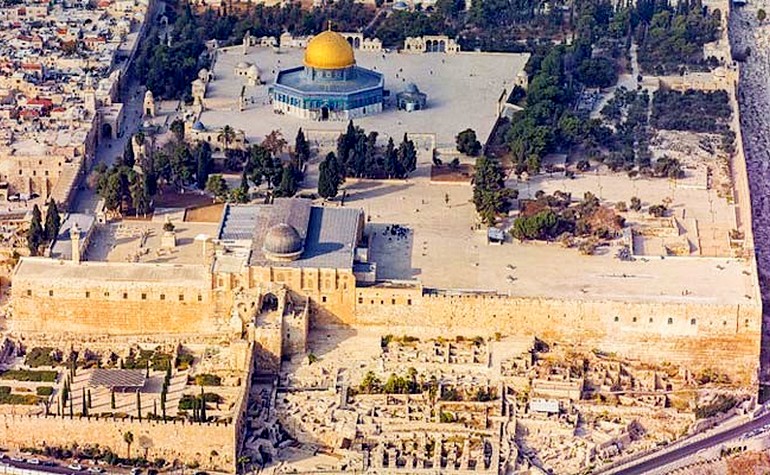
Infographic showing the key areas of Masjid al-Aqsa (click to open larger image):
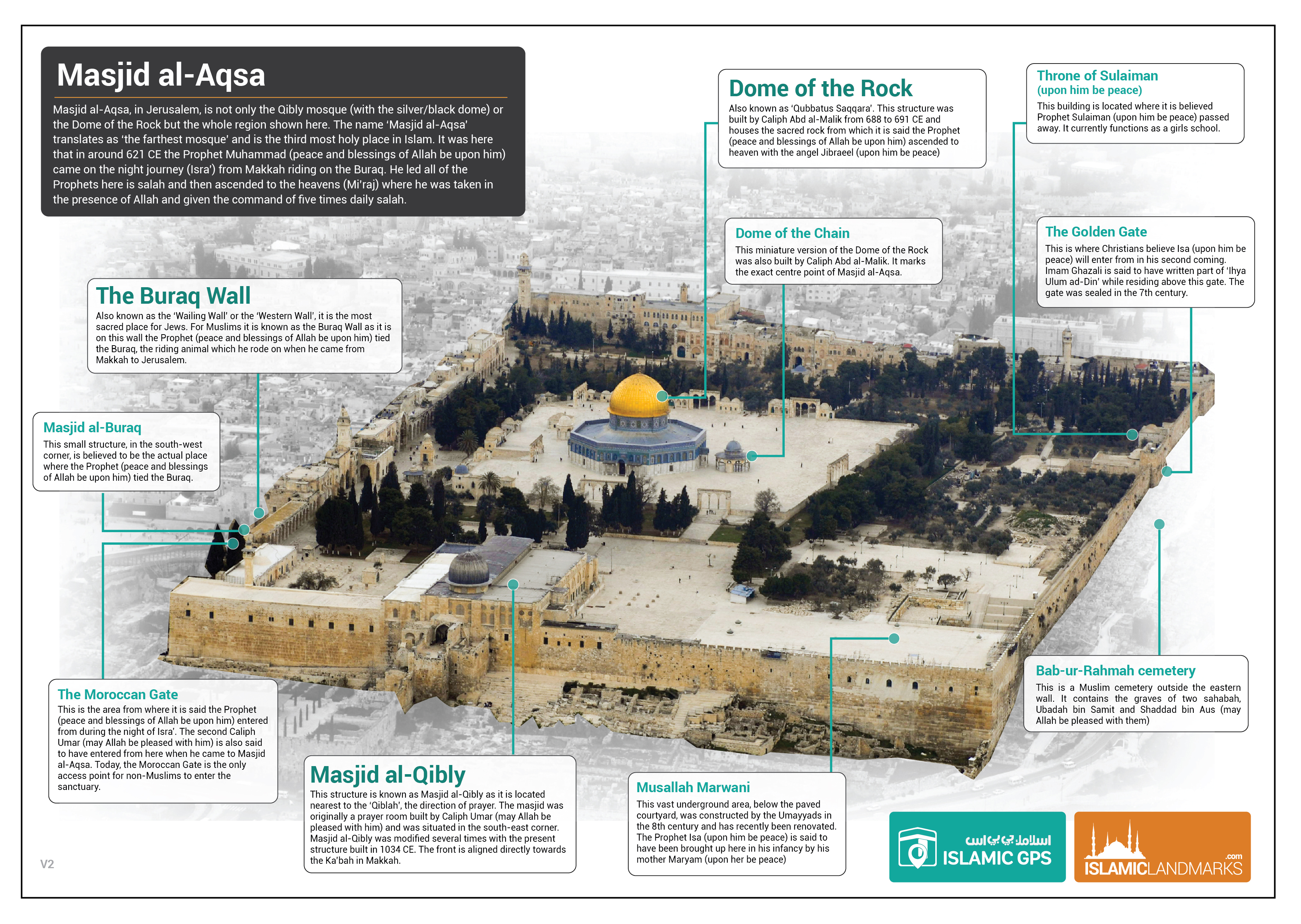
- There are ten open gates leading in and out of Masjid al-Aqsa. Nine of these are can be used by Muslims, the exception is the Moroccan Gate (Bab al-Magharib) which is solely for non-Muslims to enter from.
- Masjid al-Aqsa has 25 wells within its compound.
References: Forty Ahadith concerning Masjid al-Aqsa – Ismail Adam Patel, Wikipedia
]]>- The event of the night journey to Jerusalem is mentioned in Surah al-Isra (also known as Surah Bani-Israeel) in the Quran: “Glory be to the One who took His Slave for a journey by night from the Sacred Mosque to the furthest Mosque, whose precincts we have blessed.“ [17:1]
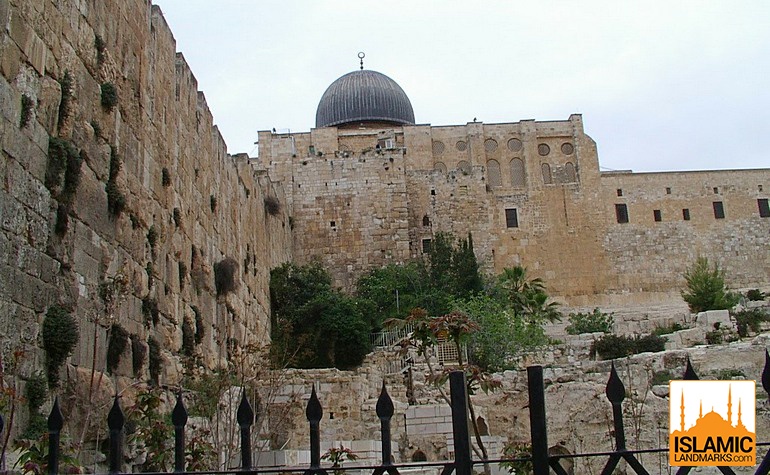
- When Umar (رضي الله عنه) entered the al-Aqsa sanctuary in 638 CE he was shocked to find it covered with rubbish as the Romans had been using the area as a rubbish tip. The Caliph knelt down immediately and with his own hands began to clear the area. When the Muslims saw what he was doing, they followed suit and soon the whole area was cleansed. They then walked further, near to the niche of Dawud (عليه السلام), and offered two rak’ah prayers in the first of which Umar (رضي الله عنه) recited Surah Sa’d (38) and in the second of which he recited Surat al-Isra (17), containing reference to the Isra’ and Mi’raj.
- Then he asked Ka’b al-Ahbar (a former Jewish rabbi who had embraced Islam), “Where should I build the mihrab (prayer niche)?”, “Behind the Rock,” replied Ka’b, “so that you will offer it behind the two qiblahs,” i.e. the qiblah of Musa and the qiblah of Muhammed. Umar (رضي الله عنه) said to Ka’b, “You speak like the Jews. We will build the niche in front of the Rock. The entire site is part of the mosque. Therefore, our niche should be in the best part, which is in the front portion.”
- Umar (رضي الله عنه) thereafter commissioned the construction of a wooden mosque (which could accommodate 3,000 worshippers) on the southern end of the compound where the present Qibly masjid stands. By doing so he returned the sanctuary to the purity of its past worship, which had been abandoned both by Christianity and Judaism.
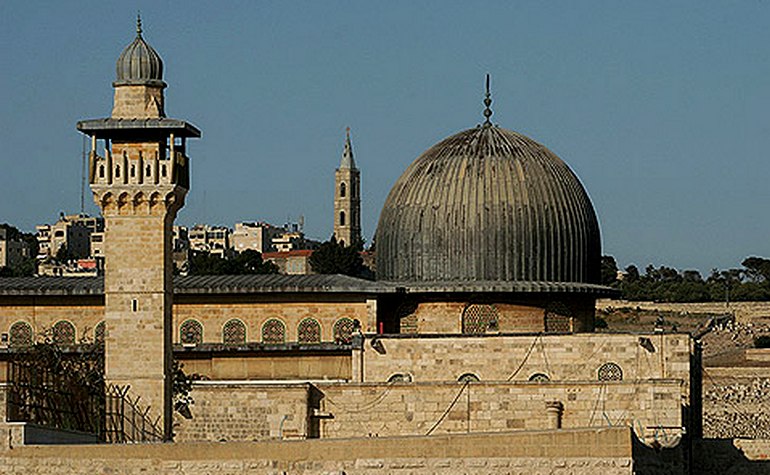
- Several earthquakes through the centuries severly damaged the mosque, necessitating complete renovations. The construction of the current building was done by the Umayyad Caliphs Malik bin Marwan and his son, Walid bin Abdul Malik. When the Crusaders occupied Masjid al-Aqsa, they converted this building as their headquarters. It was renovated again by Salahuddin Ayyubi after he reconquered Jerusalem and returned to its former state.
Great virtue of praying in Masjid al-Aqsa:
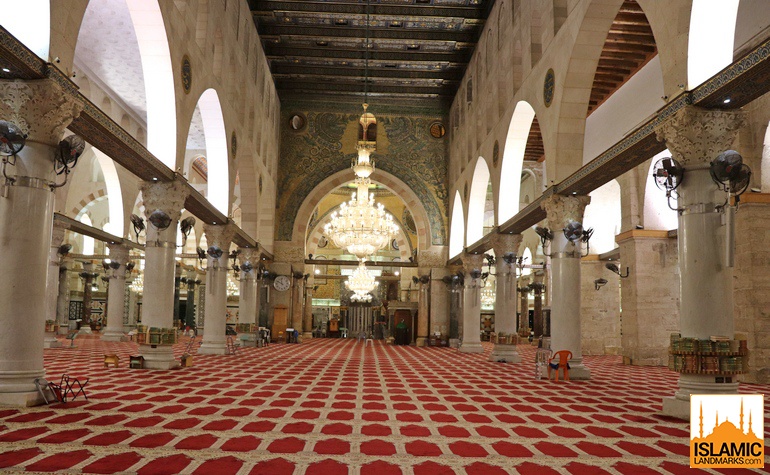
- Abu Darda (رضي الله عنه) relates that the Prophet (ﷺ) said, “ A prayer in Makkah is worth 100,000 times, a prayer in my Masjid (Madina) is worth 1,000 times, and a prayer in al-Aqsa is worth 500 times more than anywhere else”. [Al-Tabarani, al-Bayhaqi and al-Suyuti]
References: Palestine: Beginner’s guide – Ismail Adam Patel, Forty Ahadith concerning Masjid al-Aqsa – Ismail Adam Patel, Al-Quds – Mohammed Abdul Hameed Al-Khateeb
]]>- Masjid al-Aqsa is the second house of Allah created on earth: Abu Dharr (رضي الله عنه) reported that he asked the Prophet (ﷺ), “O Prophet of Allah, which Masjid was built first on earth?“ The Prophet (ﷺ) replied, “The Sacred Masjid of Makkah”. Abu Dharr (رضي الله عنه) again asked, “Which was next?” The Prophet (ﷺ) said, “The Masjid al-Aqsa”. Abu Dharr (رضي الله عنه) further asked “How long was the period between the building of the two Masajid?” The Prophet (ﷺ) said, “Forty years. Apart from these, offer your prayers anywhere when it is time to pray, although excellence is in praying in these Masajid”. [Sahih al-Bhukari]
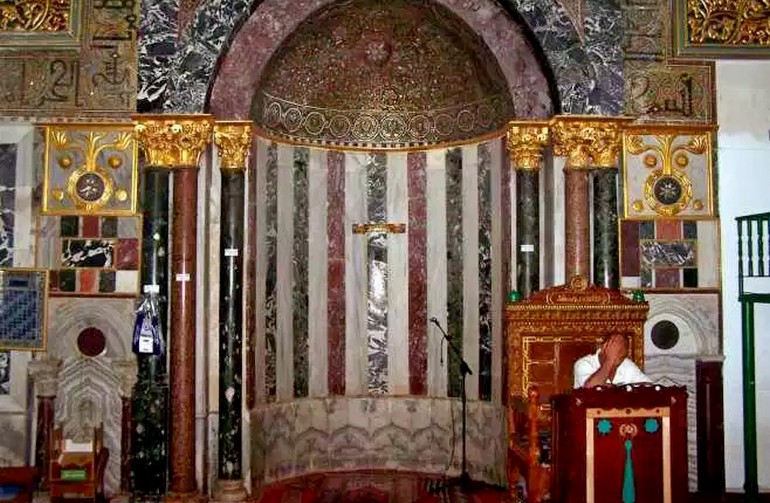
- When the Crusaders captured Jerusalem in 1099 CE, Masjid al-Aqsa was desecrated. Pigs were installed in the mihrab and a church was erected in place of one of it’s oratories. Imad Eddin (Salahuddin’s biographer) speaks of the mihrab of the mosque being full of pigs and excrement.
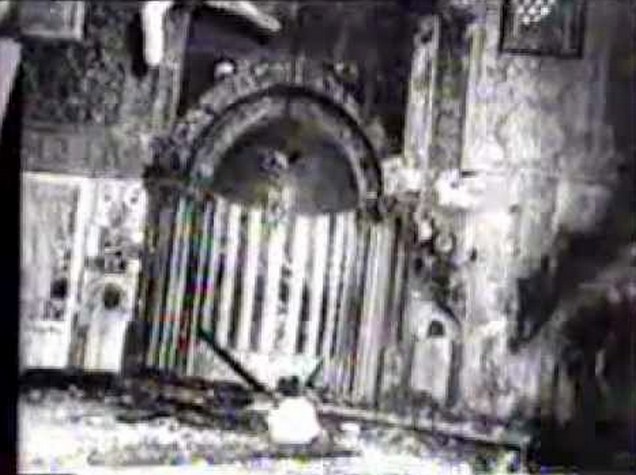
- In around 1119 CE, King Baldwin II of Jerusalem granted one wing to the newly formed Knights Templar order and the building became their headquarters.
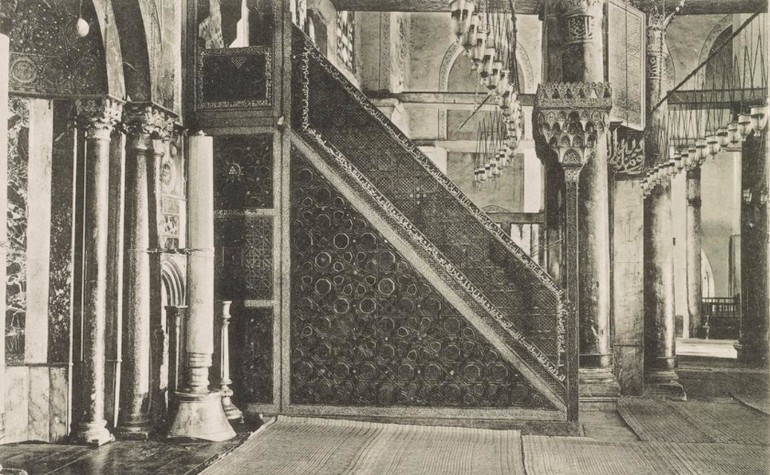
- The original mimbar, considered one of the most beautiful in the world, was made of over 10,000 interlocking pieces of Cedar and other wood, ivory and mother of pearl affixed without a drop of glue or a single nail. After the reconquest of Jerusalem Masjid al-Aqsa was filled for Jumma prayers for the first time in 88 years, people wept with emotion as the Qadi of Jerusalem, Muhyi ad-Din al-Qurashi mounted the new pulpit.
References: AtlasTours.com, Wikipedia, A history of Jerusalem – Karen Armstrong, The Crusades – S.E. Al-Djazairi
]]>- In the time of Umar (رضي الله عنه), the Muslim armies had liberated most of ash-Sham, which today comprises Syria, Jordan, Lebanon and Palestine. They had reached the gates of Jerusalem and were poised to take the city.
- The Christian inhabitants barricaded themselves and demanded that they would only surrender if the Caliph, who was in Madinah, came and took the keys to the city. Although the Muslim army was powerful enough to have taken over the city by force, they wished to minimise casualties and obliged with the Christians’ request.
- Accordingly, Umar (رضي الله عنه) travelled from Madinah to Jerusalem where Sophronius, the Christian Patriarch of Jerusalem, offered him the ‘keys’ to the city. Umar (رضي الله عنه) entered the city of Jerusalem on foot with no bloodshed or harassment of the inhabitants.
- Once in the city, he asked Sophronius to take him to the al-Aqsa sanctuary. When they reached there, Umar (رضي الله عنه) was shocked to find it covered with rubbish as the Romans were using the area as a rubbish tip. Umar (رضي الله عنه) immediately knelt down and with his own hands began to clear the area. When the companions saw this, they followed suit and soon the whole area was cleared.
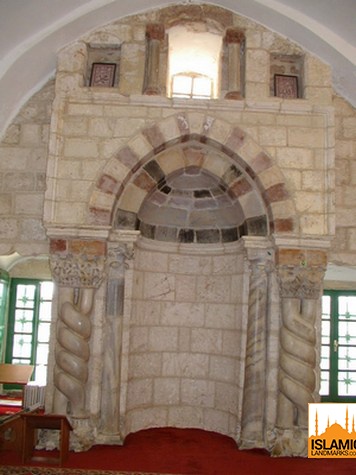
- The small room shown above is believed to be the area where Umar (رضي الله عنه) started clearing away the rubbish. It was in his honour that this small room was built by previous Muslim rulers and named Masjid Umar. It is regarded as part of Masjid al-Qibly.
- Today, part of the mosque is used as an emergency clinic.
References: HUMA’s travel guide to Palestine, Sheikh Sulaiman Ghani
]]>- In Surah Saba’ of the Quran Allah (ﷻ) mentions: “There were jinn that worked under his supervision by the leave of his Lord, and if any of them deviated from Our command, We made him taste of the Penalty of Blazing Fire. They worked for him as he desired, (making) arches, statues, basins as large as reservoirs, and (cooking) cauldrons fived (in their places): ‘Work , family of Dawud, with thanks! But few of My slaves are grateful!” [34:12-13]
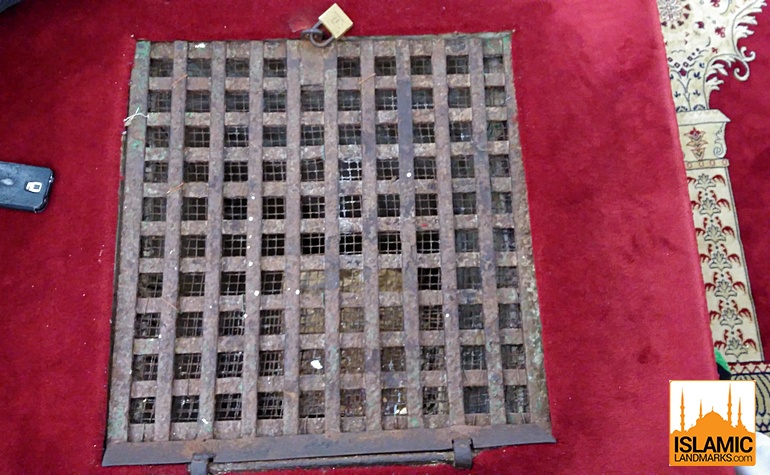
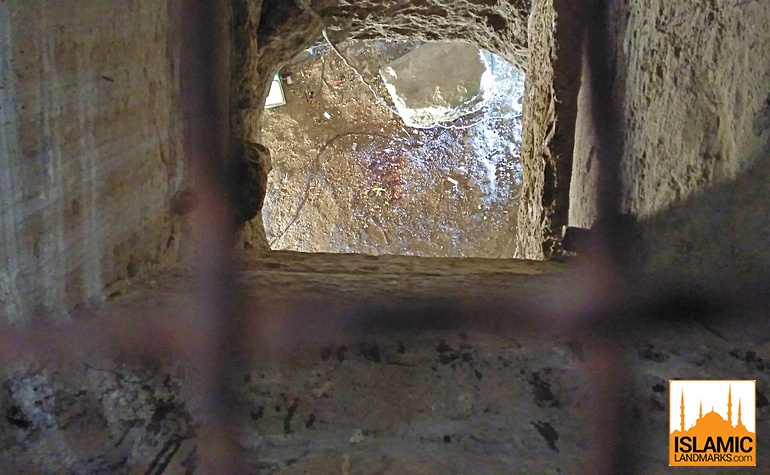
- There is an adjacent room which contains a grille (above) through which you can see the floor below where oil was burnt to heat the mosque.
- Maymunah bint Sa’d (رضي الله عنه) relates that she asked the Prophet (ﷺ), “O Prophet (ﷺ)! Inform us about Bayt al-Maqdis”. He said, “Visit it for prayer”. She further asked, “If one of us cannot visit it, what shall we do?” He (ﷺ) said, “If you cannot go for prayer then send some oil to be used in its lamps; whosoever gives oil for its lamps, it will be as if he has prayed in it”. [Imam Ahmad, Ibn Majah, Sunan Abu Dawud and al-Tabarani]
- Jewish tradition holds that the site upon which Masjid al-Aqsa was constructed originally housed the Temple of Jerusalem. The destruction of the First Temple, known as the Temple of Solomon, is attributed to the Babylonians in 587 BCE., and there are no physical remains attesting to its presence or structure. Building of the Second Temple began during the rule of the Persian king Cyrus the Great, but this temple was destroyed by the Roman Emperor (then General) Titus in 70 CE. All that remains of it is the Western Wall, which is thought to be a remnant of this second temple’s platform.
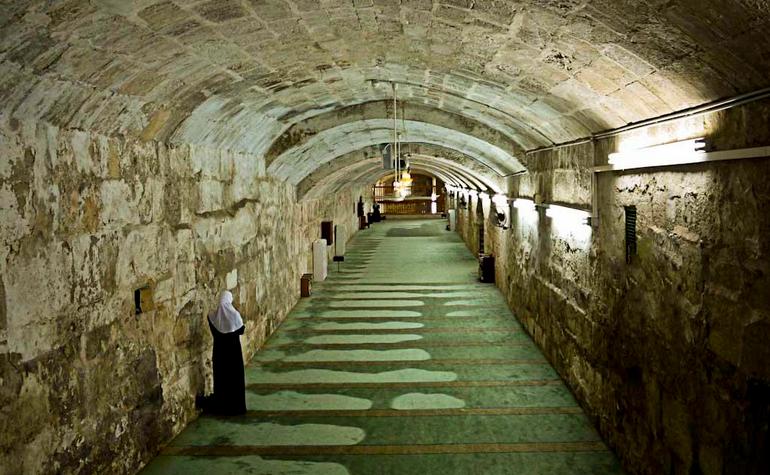
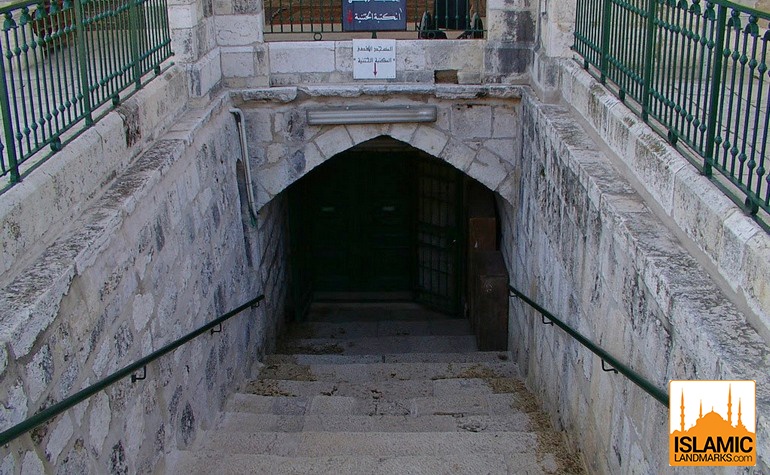
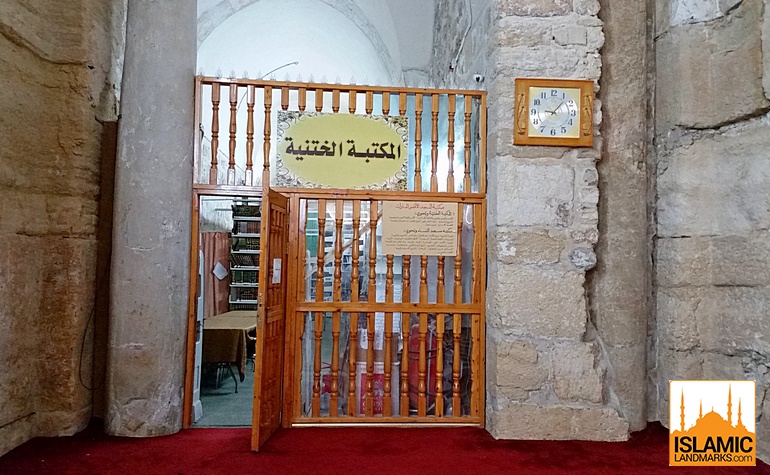
- The basement also houses a library containing around 130,000 books. There are also some 4,000 manuscripts, which were donated from the private collections of Jerusalem families. UNESCO says the library contains “one of the world’s most important collections of Islamic manuscripts”.
- This video shows a walk through the basement of Masjid al-Aqsa:
References: Forty Ahadith concerning Masjid al-Aqsa – Ismail Adam Patel, Al-Quds – Mohammed Abdul Hameed AL-Khateeb,
]]>- The octagon shaped building was the cutting edge of design at the time, built on a marble base with the remainder being made out of wood rather than stone. The two planners were Raja ibn Haywah, a Muslim scholar and Yazid ibn Salam, a non-Arab Muslim native of Jerusalem.
- Four of the eight sides have doors and there are seven windows on each side. The dome itself is 25 meters high and covered with gold. The interior is decorated with mosaic, marble and verses from the Quran. The architecture is regarded as a masterpiece due to the mathematical rhythm of its proportions. For example, each of the outer walls is 67 feet long, which is exactly the same as the dome’s diameter and which is also the height from the base to the drum.
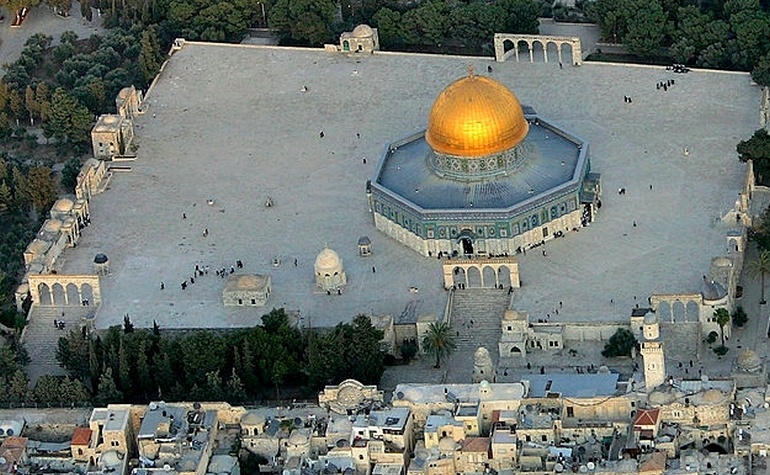
- When the Crusaders took over Jerusalem, the Dome of the Rock mosque was re-named Templum Domini and had a cross placed on top of the golden dome. The rock inside was covered to make an altar and the Quranic inscriptions were covered with Latin texts. The Qibly mosque was re-named Templum Solomonis. This kingdom was to last 87 years, during which time neither Jew nor Muslim was allowed to dwell within the walls of the city.
- Ali Ibn al-Athir (رحمه الله) writes in his book Kamil at-Tawarikh (The Perfect History) of the scene when the Muslims recaptured Jerusalem from the Crusaders: “…At the top of the cupola of the Dome of the Rock there was a great gilded cross. When the Muslims entered the city on the Friday, some of them climbed the top of the cupola to take down the cross……a great cry went up from the city and from outside the walls, the Muslims crying ‘Allahu-akbar’ in their joy, the Franks groaning in consternation and grief. So loud and piercing was the cry that the earth shook. …Salahuddin ordered that the shrines should be restored to their original state. The Templars had built their living quarters against al-Aqsa, with storerooms and latrines…This was all restored to its former state. The Sultan ordered that the Dome of the Rock should be cleansed of all pollution, and this was done…”.
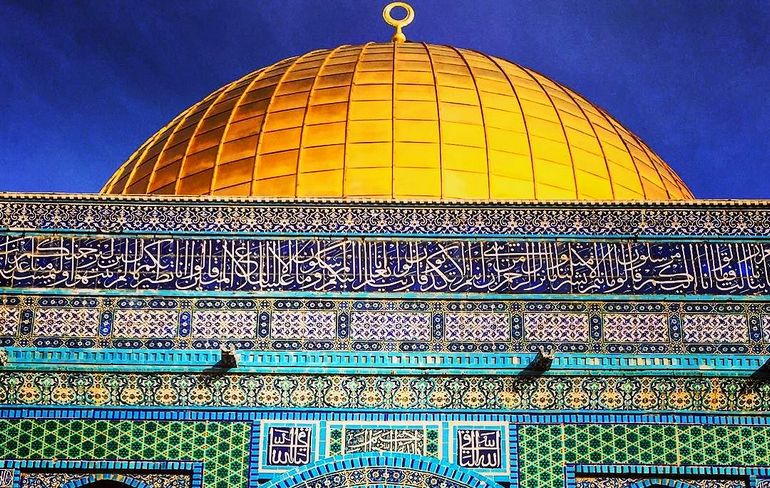
- When the Dome of the Rock was first built the outside was covered in mosaics. The beautiful external tile work which can be seen today was commissioned by Sulayman II Qanuni (the Lawgiver), known throughout Europe as Sulayman the Magnificent. With the incomparable skills of Persian master ceramicists, 40,000 tiles were fired and put into place. The inscription surrounding the top is Surah Yasin, regarded as the heart of the Quran. This was commissioned by Sultan Abdul Hamid II.
- Inside the Dome, the major Quranic inscription over the arches of the inner arcade is addressed to the “Followers of the Gospel”, i.e. Christians, denying the shocking notion that God had sired a son. It warns them against inaccurate and dangerous statements about God (in Surah An-Nisa):“O People of the Scripture! Do not exaggerate in your religion nor utter aught concerning Allah save the truth. The Messiah, Jesus son of Mary, was only a Messenger of Allah, and His word which He conveyed unto Mary, and a spirit from Him. So believe in Allah and His messengers, and say not “Three” – Cease! (it is) better for you! – Allah is only One God. Far is it removed from His transcendent majesty that he should have a son. His is all that is in the heavens and all that is in the earth. And Allah is sufficient as Defender.” [4:171]
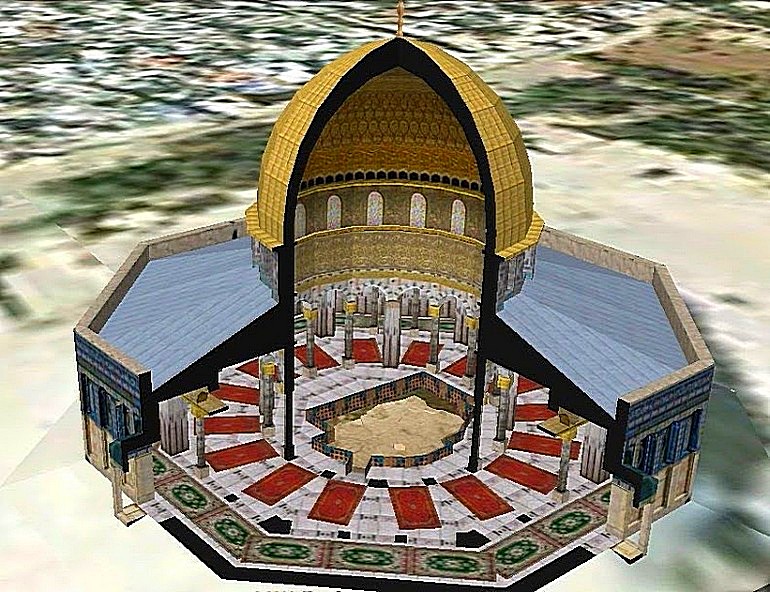
- When the Dome of the Rock was originally built, there was a surplus of 100,000 gold dinars left from the budget. Caliph Abd al-Malik decided to have these dinars melted down and turned into plates to cover the dome. Almost 400 years later, the dome was severely damaged by an earthquake and the plates were replaced by blackened lead. From 1955 major restoration work, lead by King Hussein of Jordan, was carried out during which the dome was covered with a durable aluminium bronze alloy. In 1994 King Hussein donated the money to have it replaced with the gold plated metal we see today.
- The dome is topped by a full moon decoration which is aligned so that if you could look through it, you would be looking straight towards Makkah.
- Jews and Christians believe this is the place where the Prophet Ebrahim (عليه السلام) was prepared to sacrifice his son Ishaq (عليه السلام) after seeing a dream indicating for him to do so. This is a fundamental difference to the Muslim belief that it was actually his elder son Ismail (عليه السلام) who he was prepared to sacrifice and that this happened in Mina, Saudi Arabia.
- Orthodox Jews believe the Dome of the Rock to be the centre of the world.
References: Palestine: Beginner’s guide – Ismail Adam Patel, Al-Quds – Mohammed Abdul Hameed Al-Khateeb, The Crusades – Christine Hatt, HUMA’S travel guide to Palestine.
]]>- The rock was most likely the Qiblah (direction towards where Muslims pray) before the change to the Ka’bah in Makkah. It measures approximately 18 meters in length by 8 meters width.
- When the Crusaders took over the site they covered the Rock with a marble facing to make an alter and choir, and the interior Quranic inscriptions were covered with Latin texts, all aimed to blot out Muslim presence. Salahuddin Ayyubi had the building restored after the Muslims reconquered it.
- Jews and Christians believe this is the place where the Prophet Ebrahim (عليه السلام) was prepared to sacrifice his son Ishaq (عليه السلام) after seeing a dream indicating for him to do so. This is a fundamental difference to the Muslim belief that it was actually his elder son Ismail (عليه السلام) who he was prepared to sacrifice and that this happened in Mina, Saudi Arabia.
- Inside the Dome, the major Quranic inscription over the arches of the inner arcade is addressed to the “Followers of the Gospel”, i.e. Christians, denying the shocking notion that God had sired a son. It warns them against inaccurate and dangerous statements about God (in Surah An-Nisa):
“O People of the Scripture! Do not exaggerate in your religion nor utter aught concerning Allah save the truth. The Messiah, Jesus son of Mary, was only a Messenger of Allah, and His word which He conveyed unto Mary, and a spirit from Him. So believe in Allah and His messengers, and say not “Three” – Cease! (it is) better for you! – Allah is only One God. Far is it removed from His transcendent majesty that he should have a son. His is all that is in the heavens and all that is in the earth. And Allah is sufficient as Defender.” [4:171]
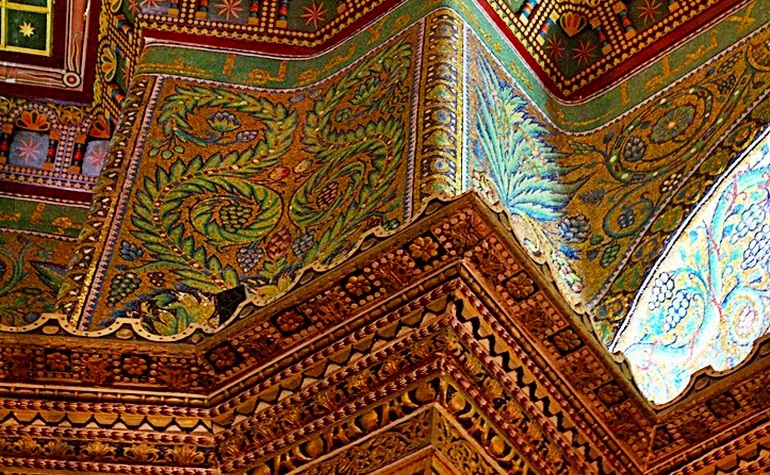
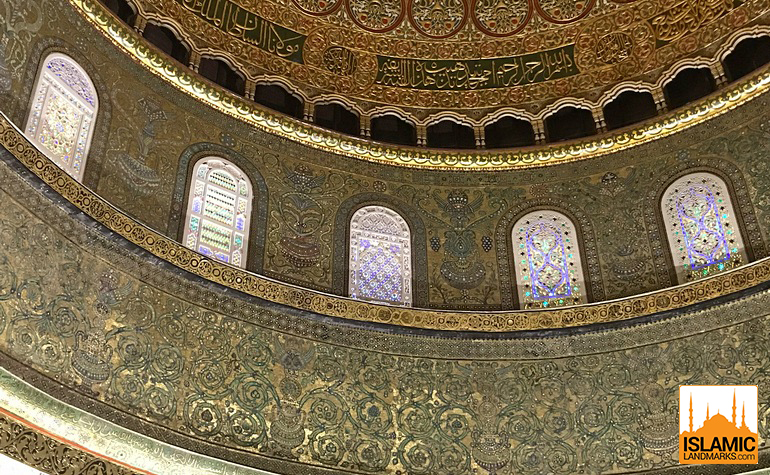
- Many of the mosaic decorations are originally from the time the Dome of the Rock was first built, such as in the photo below. Surah Ikhlas can be seen inscribed at the top.
Characteristics of the interior:
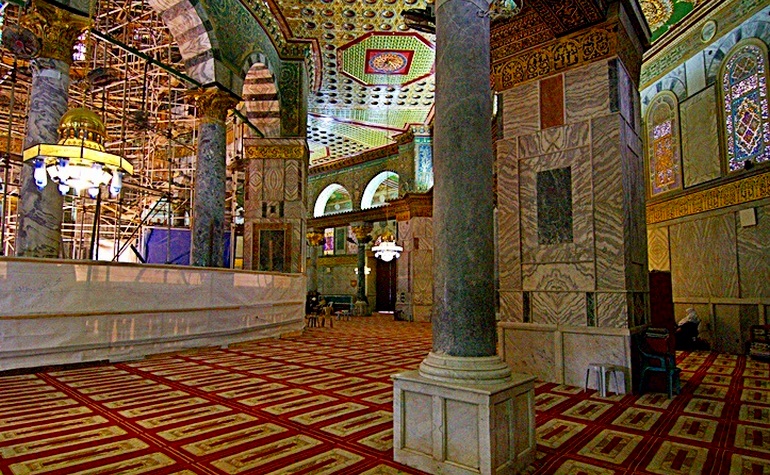
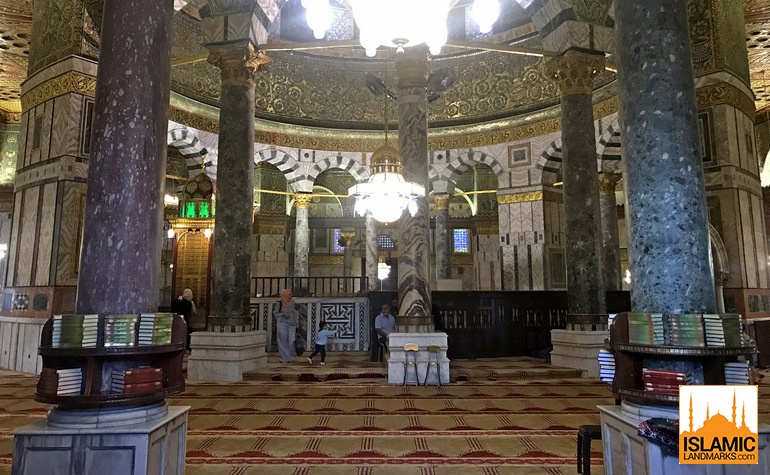
- There are eight main pillars holding up the building on each corner. These are akin to the eight angels holding up the throne of Allah (ﷻ) as mentioned in Surah al-Haqqah: “…And there will bear the Throne of your Lord above them, that Day, eight (of them).” [69:17]
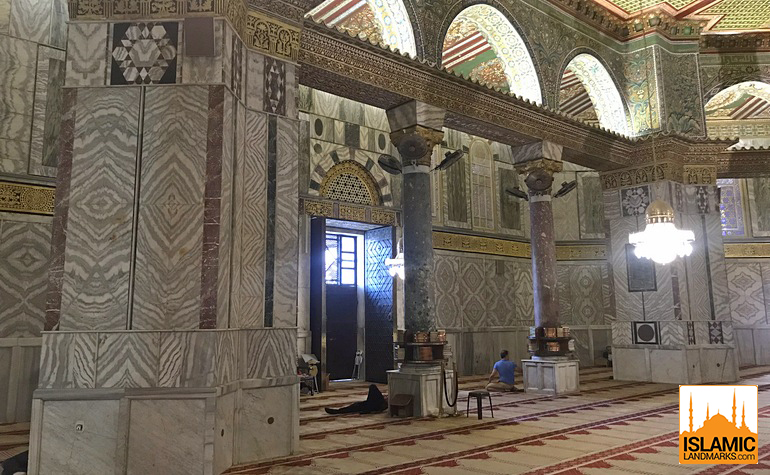
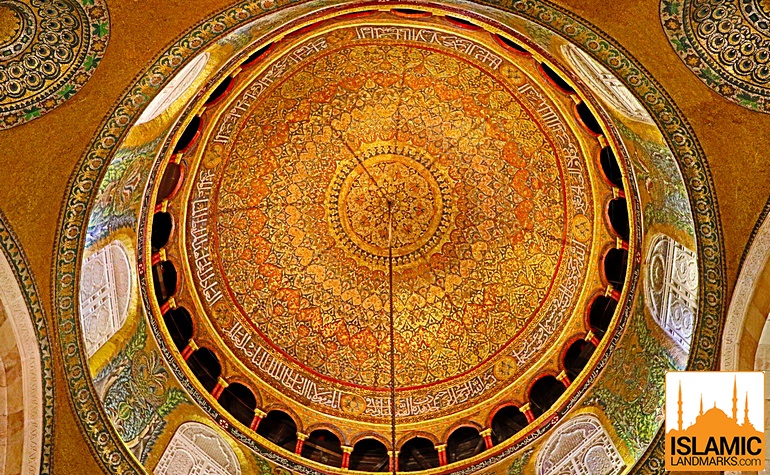
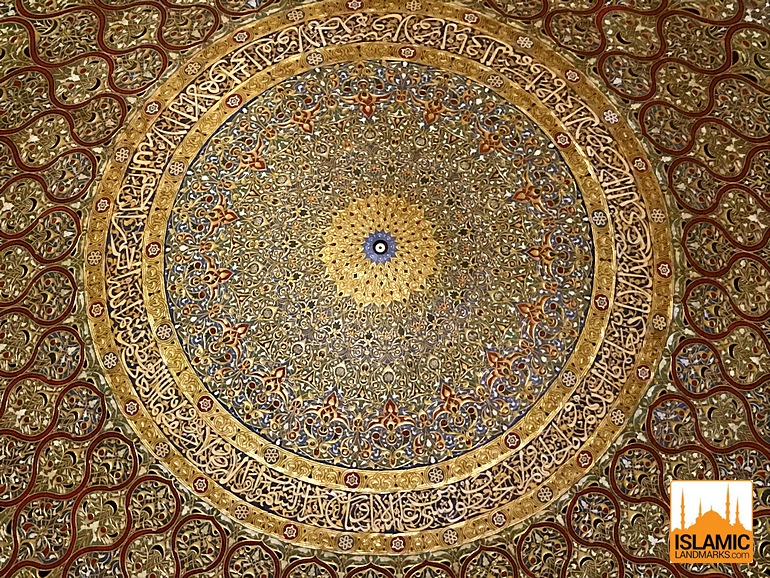
- Ayatul Kursi [2:255], meaning the ‘Verse of the Throne’ is written in the interior of the dome. The whole ceiling structure is held up by the eight supporting pillars shown above.
- There are four large supporting pillars around the neck of the dome, representing the four seasons in the year.
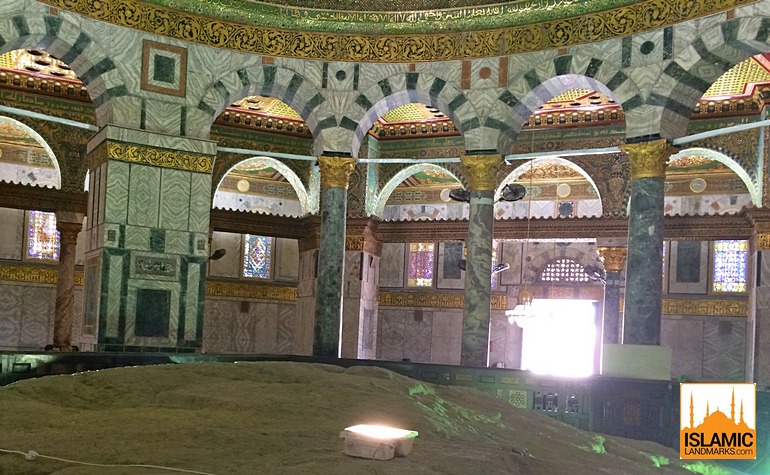
- There are 12 columns around the neck of the dome, representing the 12 months in the year.

- There are 52 windows around the building, representing the 52 weeks in the year.
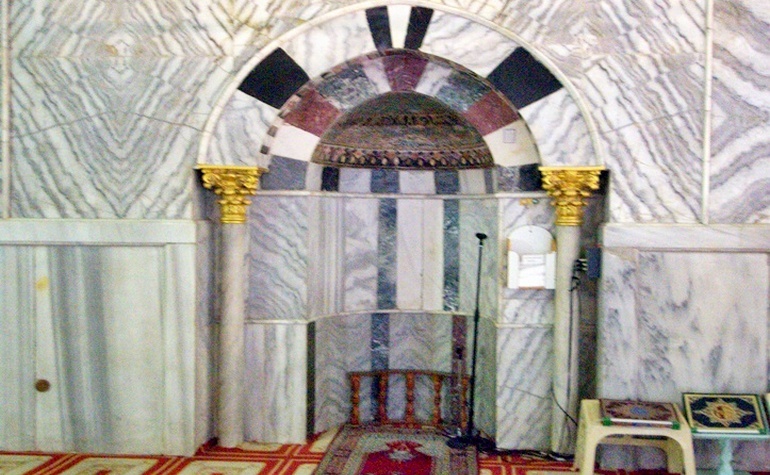
- There are seven mehrabs (prayer niches) situated together close to the northern entrance, representing the seven days of the week.
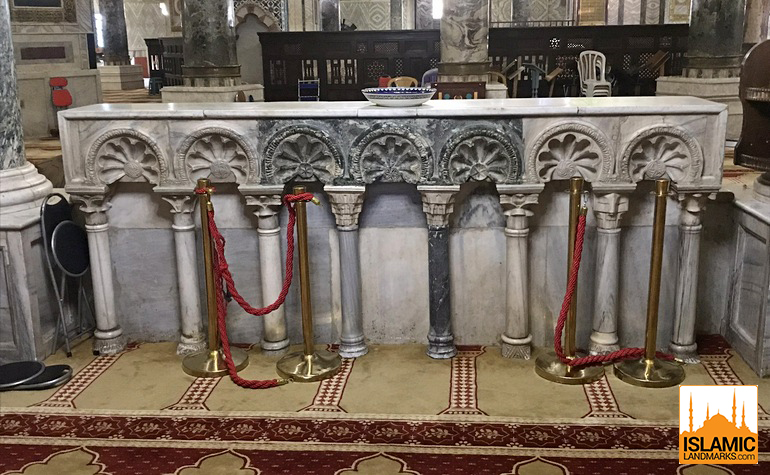
- Five columns can be seen from any entrance, representing the five salahs prayed in the day. Two are closer to the entrances which makes them lighter than the other three at the back. This reflects the times when salah is prayed; Zohar and Asar are prayed during light hours, Fajr, Maghrib and Isha are prayed during darkness.
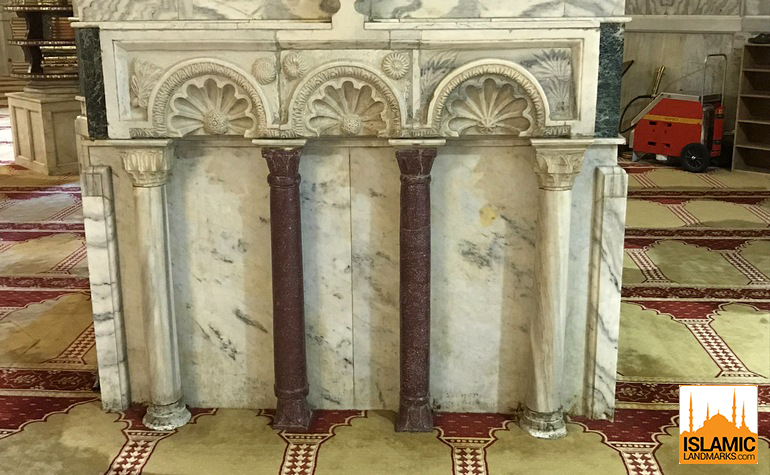
- Also situated inside the Dome of the Rock are three mehrabs together. They represent the three holiest places in Islam, the Ka’bah, Masjid-e-Nabwi and Masjid al-Aqsa.
- Video of the interior:
References: A history of Jerusalem – Karen Armstrong
]]>