These are some of the personalities said to be buried here. This is based on knowledge passed down and has not been independently verified, Allah (ﷻ) knows best:
- Umm Kulthum, daughter of Ali (رضي الله عنه) and Fatima (رضي الله عنها)
- Bilal-bin-Rabah, the Muezzin (caller to prayer) of the Prophet (ﷺ)
- Muawiyah (رضي الله عنه)
- Tomb of Fidha, the maid of Fatima (رضي الله عنها), the daughter of the Prophet (ﷺ)
- Asma, wife of Jafar Tayyar (رضي الله عنه)
- Kamaid bin Aswad al-Kindi, companion of Ali (رضي الله عنه)
- Tomb of Obay ibn Ka’b (رضي الله عنه), husband of Halima, nursing mother of the Prophet (ﷺ)
Note that the tombs of two of the wives of the Prophet (ﷺ), Umm Salama and Ramlah bint Abi-Sufyan (aka Umm Habeebah) are present here but it is highly doubtful that they contain the actual bodies. The structures were likely to have been created to encourage ziyarat to the area. The vast majority of scholars are of the opinion that they are buried in Jannatul-Baqi in Madinah, along with most of the remaining wives (Ummahatul Mu’mineen) of the Prophet (ﷺ).
References: Local guide, Wikipedia.
Note that this entry has been shown for information purposes only. On no account should anybody pray to a grave or seek supplication through them as this is tantamount to committing shirk, associating partners with Allah (ﷻ)
]]>- The cemetery contains the tombs of two of the companions (Sahabah) of the Prophet (peace and blessings of Allah be upon him), Ubadah-bin-Samit and Shaddad-bin-Aus (رضي الله عنهم).
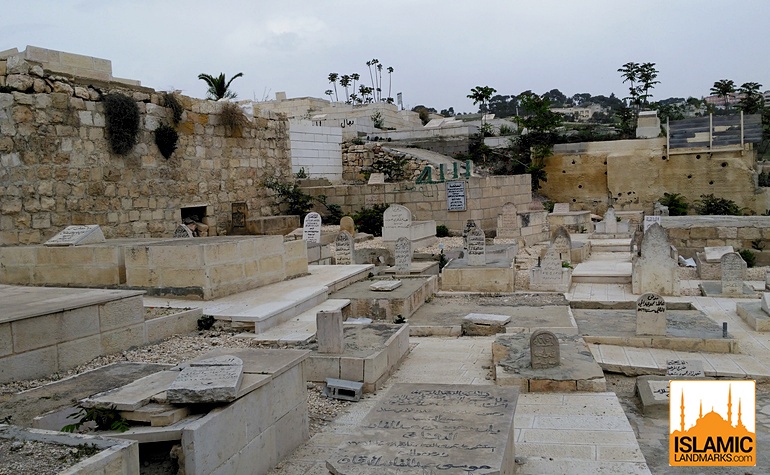
Reference: Local guides
]]>- The cemetery is located just outside the Old City of Jerusalem, on the western side. It contains a large pool, known as the Mamilla pool which originally served as a drinking water reservoir.
- It features diverse styles of graves and tombs, which bear testament to the vibrant nature of Jerusalem’s Muslim communities over the centuries.
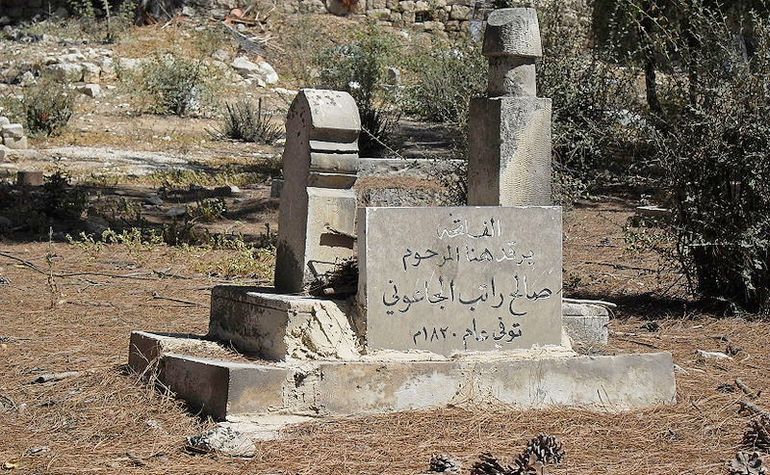
- The cemetery is also said to contain the following graves:
– Muslim soldiers who fought the Byzantines for control over Jerusalem in 636 CE
– Up to 70,000 soldiers of Salahuddin Ayyubi who fought against the Crusaders
– Thousands of Christians buried in pre-Islamic times, including many who were killed by Persian forces of the Sassanid Empire - The largest tomb is of Aidughdi Kubaki who died in 1289 CE. He was said to have originally been a Syrian slave who rose to prominence to become governor of Safed and Aleppo during the Mamluke sultanate.
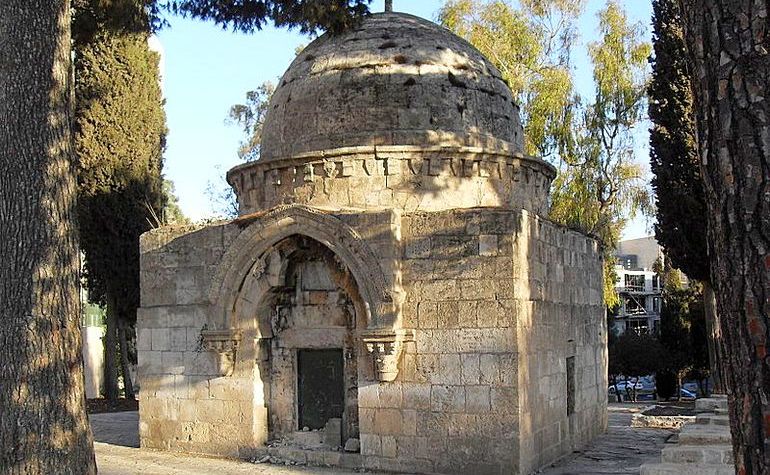
- The Mamilla cemetery was used for Muslim burials up until 1948, when forces from the newly declared State of Israel occupied the west part of Jerusalem. This included the cemetery.
- At it’s peak the cemetery covered around 50 acres but today only 5 acres is visible. In 1964, a large part of the cemetery was bulldozed and made into a parking lot. A hotel and cafe have also been built on the land, diminishing the sanctity of this place, especially as the cafe serves alcohol.
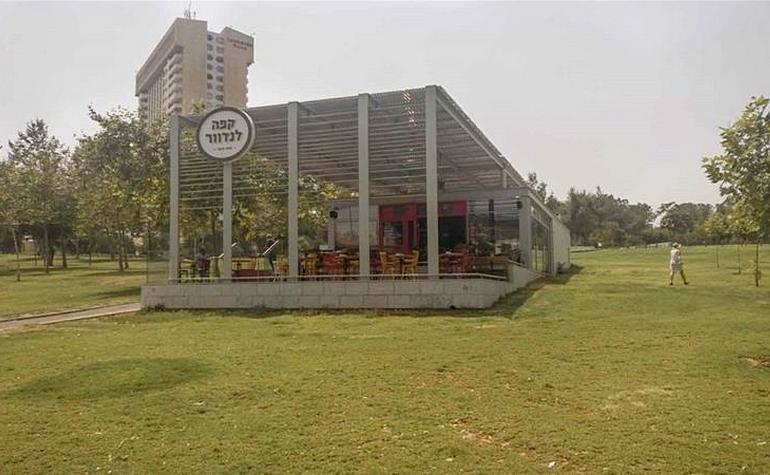
References: alt-arch.org, Wikipedia, aljazeerah.com
]]>The following personalities are buried in this graveyard:
- Ummul Mu’mineen Khadija (رضي الله عنها), the first wife of the Prophet (ﷺ)
- Qasim, the eldest son of the Prophet (ﷺ) from his wife Khadija (رضي الله عنها); he died in infancy.
- Abdullah, the second son of the Prophet (ﷺ) from his wife Khadija (رضي الله عنها); he was also known as Tahir and Tayyab.
- Abu Talib – the uncle of the Prophet (ﷺ)
- Abdul Muttalib – the grandfather of the Prophet (ﷺ)
References: Wikipedia
Note that this entry has been shown for information purposes only. On no account should anybody pray to a grave or seek supplication through them as this is tantamount to committing shirk, associating partners with Allah (ﷻ)
]]>The practice of femicide in pre-Islam Makkan society
- One of the evil practices of pre-Islamic society was the burying alive of the firstborn child if it was a girl. The elite did not do this, because their women had a lot more status than even men in middle/lower class society This happened in mainly middle to lower class society.
- If their firstborn child was a girl, they would bury her alive as an offering to their pagan gods. She was seen as a liability, to be raised up and then given away in marriage. Allah (ﷻ) mentions in the Qur’an the reaction of such fathers upon hearing of the birth of a daughter:
Whenever one of them is given the good news of a baby girl, his face grows gloomy, as he suppresses his rage. He hides himself from the people because of the bad news he has received. Should he keep her in disgrace, or bury her ˹alive˺ in the ground? Evil indeed is their judgment!”
Surah an-Nahl 16:58-59
- On the Day of Judgement the innocent girl will be asked the reason for being slain. She will tell her story how cruelly she had been treated by her barbaric parents and buried alive:
And when the girl [who was] buried alive is asked for what sin she was killed”
Surah At-Takwir 81:8-9
The ‘Hanif’ Zayd Ibn Amr ibn Nufail
- Among the Makkan society was an elderly man called Zayd ibn Amr ibn Nufail who, although regarded as being eccentric, was respected among the Quraysh. He was among the ‘Hunafa’, people who rejected idol worship and believed in the one, true God. Zayd would often say, “My God is the God of Ebrahim. My deity is the deity of Ebrahim. My religion is the religion of Ebrahim. That’s all I know.”
- Zayd would go around trying to prevent these girls from being buried alive. If he heard of a couple that recently gave birth to a firstborn girl and the parents were intending on killing the baby, Zayd would step in and say to the parents, “Listen, if you want no part of this girl, just hand her over to me. You don’t have to worry about her anymore. You can consider her dead or buried or whatever you want. Just let me take care of her. Please don’t kill this innocent child.”
- Zayd would take care of the girls himself or find someone else to take care of the girls. In this manner he is said to have saved hundreds of girls.
Sumayyah Bint Khabbat (رضي الله عنها)
- Sumayyah Bint Khabbat (رضي الله عنها) was one of the earliest converts to Islam. Born into slavery, she later gained freedom and married Yasir Ibn Amir (رضي الله عنه) who had come from Yemen.
- Their son Ammar accepted Islam through Abu Bakr (رضي الله عنه) and would sneak out at night to sit with the Prophet (ﷺ) and pray with him in Daarul Arqam. His parents noticed his absences and became very worried about the repercussions if his accepting Islam was discovered. Ammar (رضي الله عنه) used the opportunity to give them da’wah. He shared with them the Qur’an and the message of the Prophet (ﷺ), both were deeply affected and also accepted islam at the hands of the Prophet (ﷺ). Sumayyah (رضي الله عنها) was one of the first to openly display her Islam.
The family endure torture for their acceptance of Islam
As a former slave, she did not enjoy tribal protection, Sumayyah (رضي الله عنها) faced brutal oppression from the Quraysh for her conversion to Islam. When Abu Jahl found out that this little family of three, whom his tribe had given protection, had the audacity to accept this new religion, he set out to torture them. He tied up the family to poles and left them standing there for days and would torture them in front of each other to try and force them to apostate. This went on for a very long time. The Prophet (ﷺ) would walk by with tears in his eyes and would say, “Patience, O family of Yasir! Congratulations, O family of Yasir, you will all be reunited in Jannah.”
Martyrdom of Sumayyah and Yasir (رضي الله عنهم), the first martyrs in Islam
- One day, Sumayyah (رضي الله عنها) told Abu Jahl, “No matter what you do Abu Jahl, you can’t deter us from our faith. We will not disbelieve. You can’t do anything to us.” Abu Jahl became so infuriated from this display of courage from Sumayyah (رضي الله عنها), that he threw her down in front of her husband and son and thrust his spear into the most private part of her body, killing her. She became the first martyr in Islam, a woman. She is believed to be buried in the Al-Shabeka Graveyard.
- Some narration says that Yasir (رضي الله عنه) eventually died from prolonged torture, while others say that he was so beside himself at the sight of his wife being murdered in front of him, that he started to scream, fight, & squirm to free himself. Abu Jahl became enraged; he threw Yasir (رضي الله عنه) to the ground & began to kick him until he was also killed.
- Ammar (رضي الله عنه) saw both of his parents murdered in front of him. He was tied to a pole, so was helpless to do anything. He was eventually freed and would later migrate to Madinah where he established Masjid Quba, the first mosque built in Islam. Ammar (رضي الله عنه) also later died as a martyr in the Battle of Siffin in 657 CE.
Maqbarah al-Shabeka
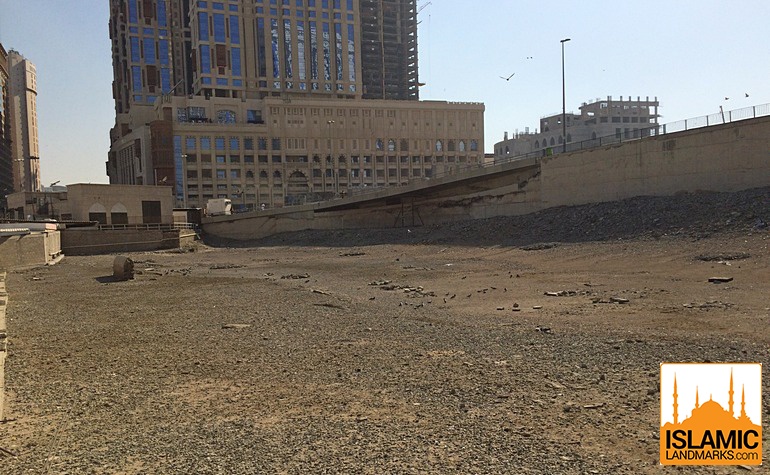
- The Al-Shabbeka Graveyard is known locally as ‘Maqbarah al-Shabeka’
References: Local Makkan guide
]]>- Aisha (رضي الله عنها) reported (that whenever it was her turn for the Prophet (ﷺ) to spend the night with her) he would go out towards the end of the night to al-Baqi and say: “Peace be upon you, abode of a people who are believers. What you were promised would come to you tomorrow, you receiving it after some delay; and God willing we shall join you. O Allah, grant forgiveness to the inhabitants of Baqi al-Gharqad.” [Muslim]
- Baqi means the land in which the roots of different trees are embedded, Gharqad is the name of a thorny tree (Boxthorn) which were abundant in Baqi. Hence the cemetery also came to be known as Baqi al-Gharqad.
- The first person to be buried in al-Baqi was As’ad Bin Zararah (رضي الله عنه), an Ansari companion who died soon after the Prophet ‘s (ﷺ) migration to Madinah. The Prophet (ﷺ) chose the spot to be a cemetery. The first of the Muhajirun (Emigrants) to be buried there was Uthman bin Mazoun (رضي الله عنه) who died shortly after the Prophet (ﷺ) returned from the Battle of Badr.
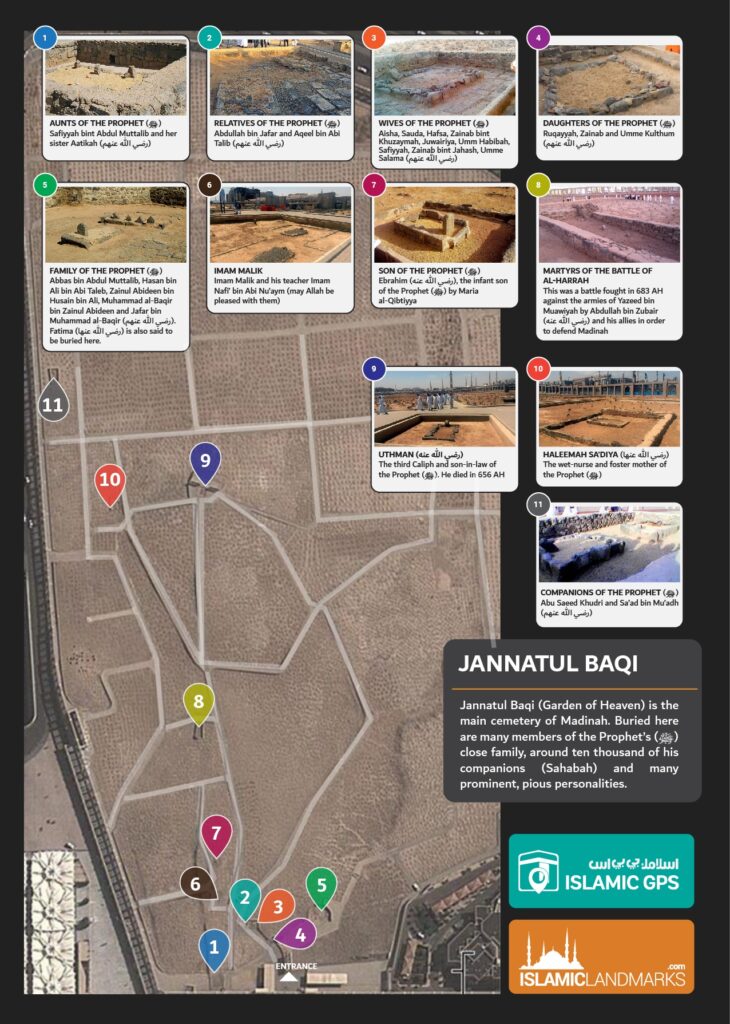
Some of the blessed personalities resting in Jannatul Baqi are:
- The aunts of the Prophet (ﷺ), Safiyyah bint Abdul Muttalib and her sister Aatikah (رضي الله عنهم)
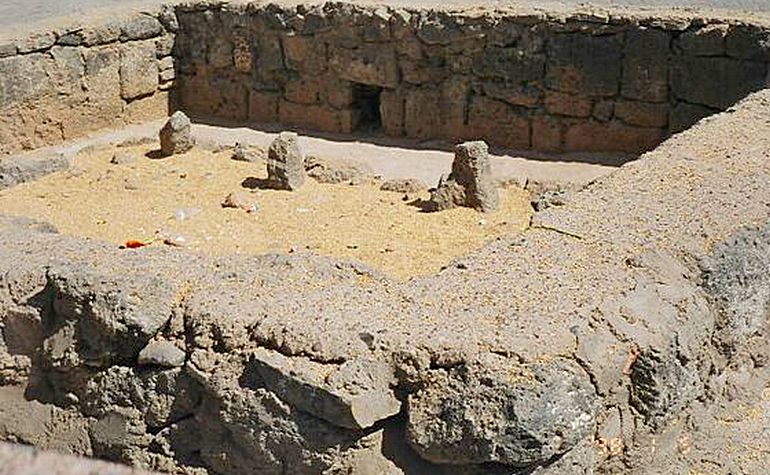
- Relatives of the Prophet (ﷺ), Abdullah bin Jafar and Aqeel bin Abi Talib (رضي الله عنهم)
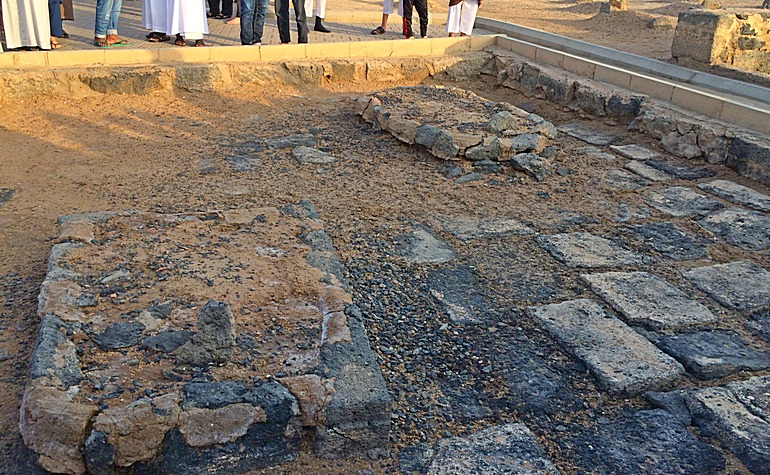
- The wives of the Prophet (ﷺ), also known as the Mothers of the Believers. They are Aisha bint Abu Bakr, Sauda bint Zamaa, Hafsa bint Umar, Zainab bint Khuzaymah, Juwairiya bint Harith, Umm Habibah bint Abu Sufyan, Safiyyah bint Hayy al Akhtab, Zainab bint Jahash, Umme Salamah bint Abu Umama (رضي الله عنهم). The two wives that are not buried here are Khadijah bint Khuwaylid (رضي الله عنها) who is buried in Makkah and Maymuna bint al-Harith (رضي الله عنها) who is buried in Sarif.
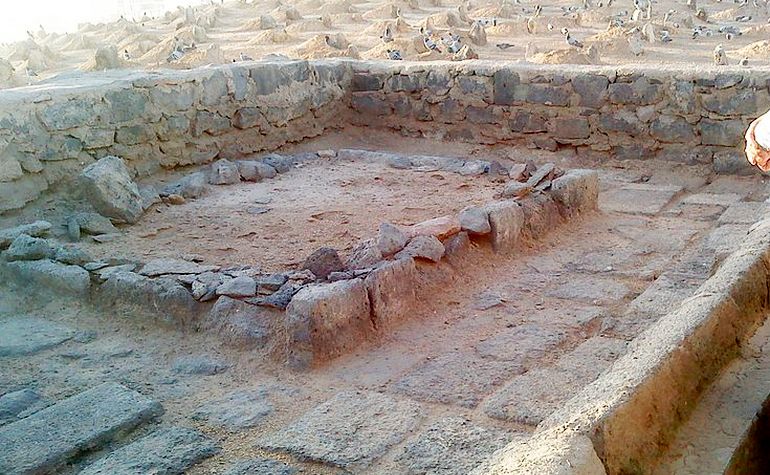
- The daughters of the Prophet (ﷺ), Fatima, Ruqayyah, Zainab and Umme Kulthum (رضي الله عنهم)
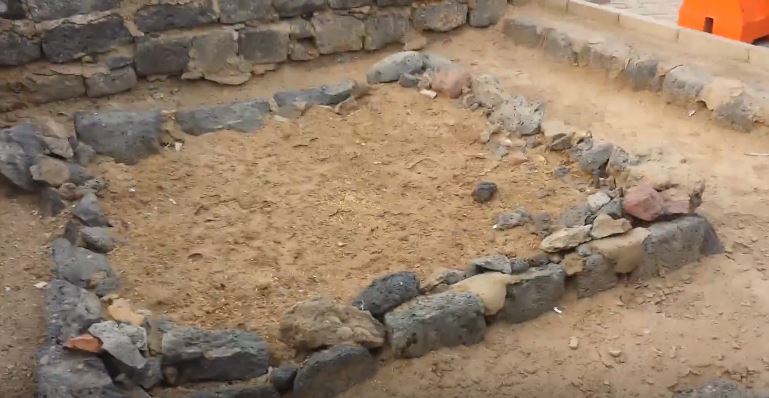
- Other close family members of the Prophet (ﷺ) buried in Jannatul Baqi include his uncle Abbas bin Abdul Muttalib, Hasan bin Ali bin Abi Taleb, Zainul Abideen bin Husain bin Ali, Muhammad al-Baqir bin Zainul Abideen and Jafar bin Muhammad al-Baqir (رضي الله عنهم). They are buried close together along with Fatima (رضي الله عنها).
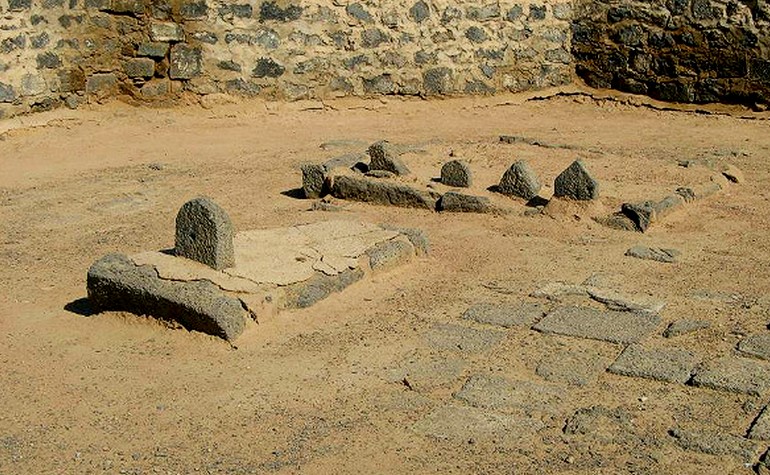
- Imam Malik and his teacher Imam Nafi’ bin Abi Nu’aym (رضي الله عنهم)
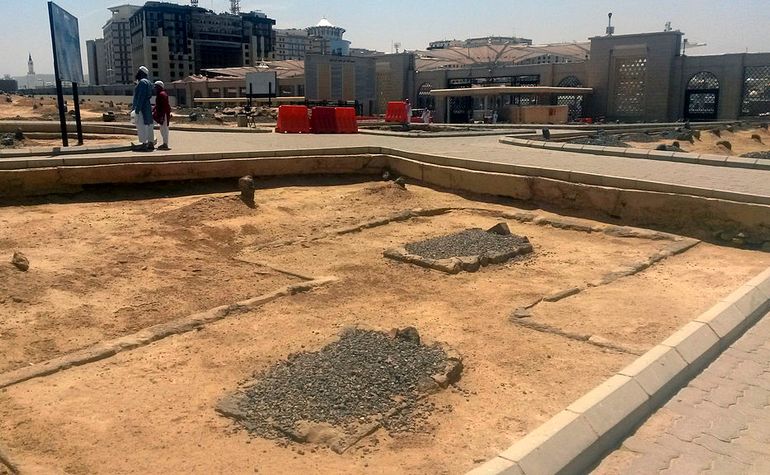
- Ebrahim (رضي الله عنه), the infant son of the Prophet (ﷺ) by Maria al-Qibtiyya (رضي الله عنها)
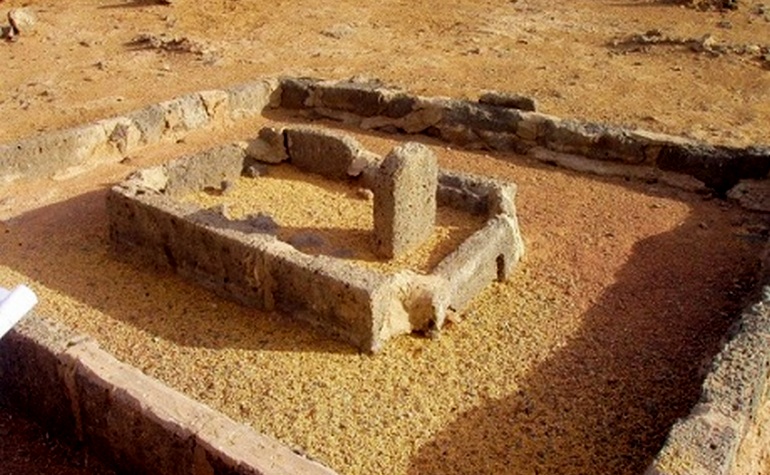
- The martyrs of the Battle of Harrah. This was a battle fought in 683 CE against the armies of Yazeed bin Muawiyah by the army of Abdullah bin Zubair (رضي الله عنه) and his allies in order to defend Madinah. This battle happened after the demise of the Prophet (ﷺ).
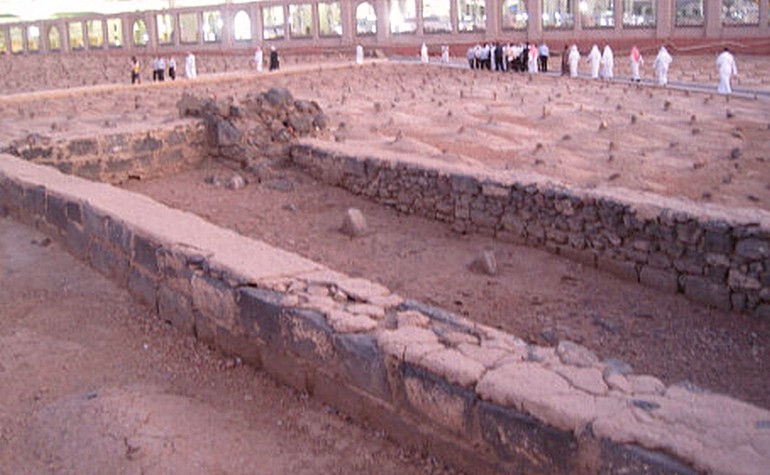
- Uthman (رضي الله عنه), the third Caliph and son-in-law of the Prophet (ﷺ). He died in 656 AH.
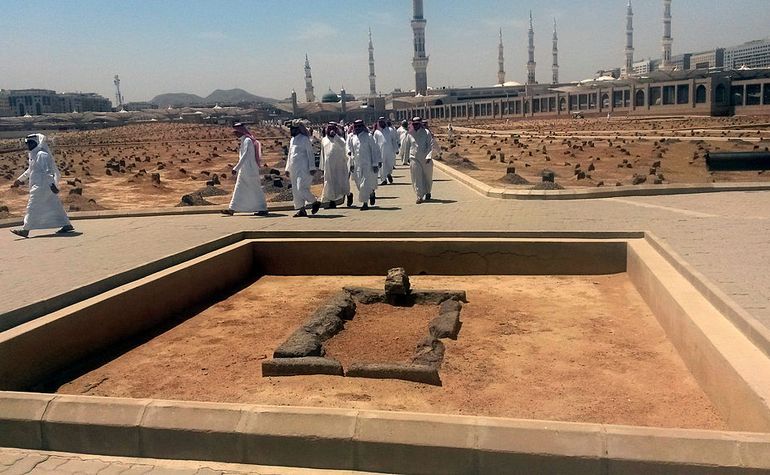
- Haleemah Sa’diya, the wet-nurse of the Prophet (ﷺ)
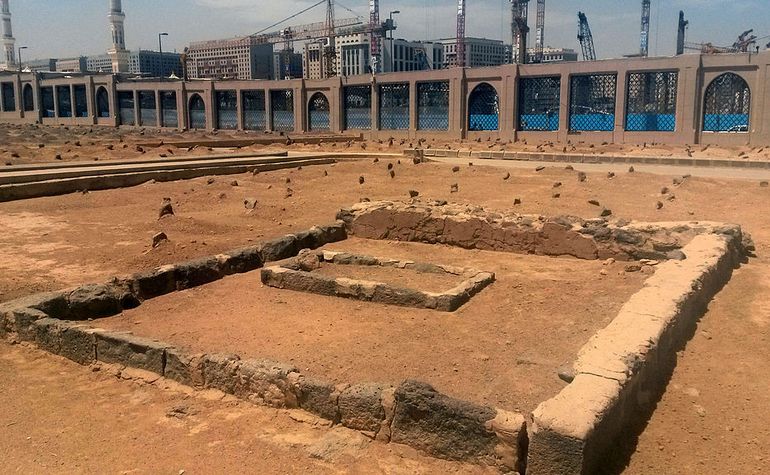
- There are many other companions of the Prophet (ﷺ) buried in unmarked graves in Jannatul Baqi. These include Sa’ad bin Abi Waqqas, Abdur-Rehman bin Auf, Abdullah bin Mas’ood, Arqam bin Arqam, Abu Sufyan bin Harb, Hakeem bin Hizam, Hassan bin Thabit, Ka’ab bin Malik, Muhammad bin Maslamah, Miqdad bin Aswad, Ubai bin Ka’ab, Sohaib Rumi and Usama bin Zaid (رضي الله عنهم). Abu Saeed Khudri and Sa’ad bin Mu’adh (رضي الله عنهم) are buried within the small structure below:
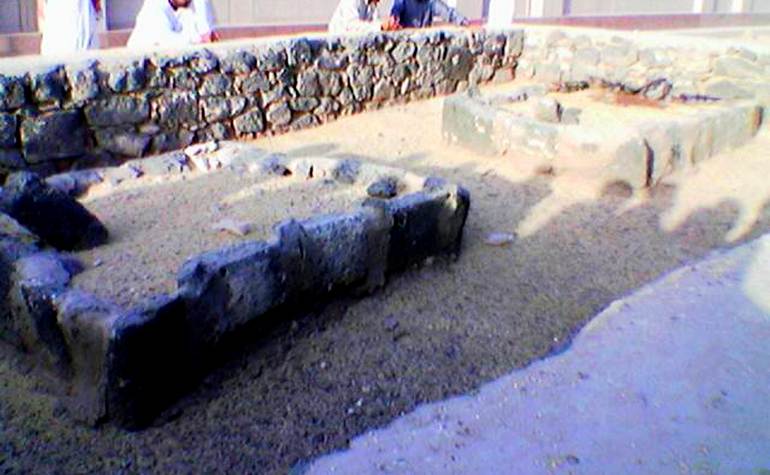
- The Prophet (ﷺ) said, “On the day of Qiyamah my grave shall be opened first and I shall step forth. Then shall Abu Bakr (رضي الله عنه) step forth and then Umar (رضي الله عنه). Then shall I proceed to Baqi and take all its inmates with me. Then shall we await the inmates of the graveyard of Makkah, who shall meet me halfway between Makkah and Madinah.” [Tirmidhi]
- During different times of history many domes and structures were built or rebuilt over many famous graves in Al-Baqi in order to identify the inhabitants. On April 21, 1925, mausoleums, domes and structures in Jannatul Baqi were demolished by the order of King Abdul Aziz Al Saud with the objective of complying with the hadith of the Prophet (ﷺ) to not cover or build structures over any grave and to prevent people from seeking help from the dead.
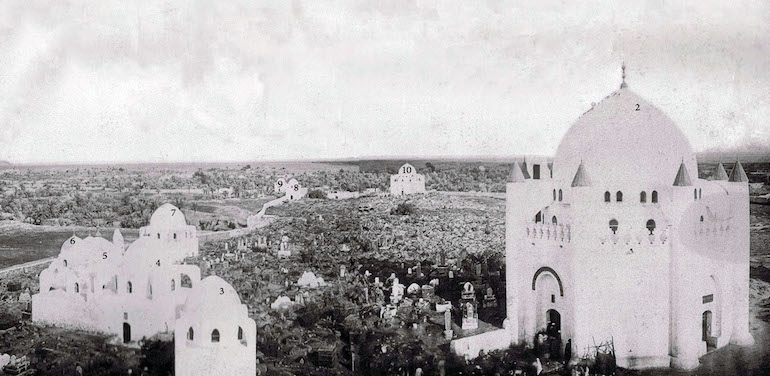
- It is virtuous to visit Jannatul Baqi (preferably on a Friday) and supplicate to Allah (ﷻ) for all those buried in its noble earth.
Infographic of Jannatul Baqi:
References: History of Madinah Munawwarah – Dr. Muhammad Ilyas Abdul Ghani, Wikipedia, Virtues of Hajj – Sheikh Muhammad Zakariyya Kandhalvi, Jannatul Baqie – Abu Tariq Hijazi
]]>