The enlightening period didn’t only introduce Spain to Islam, but it also inspired many cultural, agricultural, scientific, and architectural formations and discoveries.
Among these destinations, the Alhambra in Granada and the Great Mosque of Cordoba stand as masterpieces, representing the brilliance of the Arab mind.
Keep reading to learn about fifteen Islamic historical places in Spain.
History of Muslim Spain

The Islamic history of Muslims in Spain is a rich and complex tale that spans several centuries. Beginning in 711 CE, Muslim forces led by Tariq ibn Ziyad crossed the Strait of Gibraltar and quickly established their presence on the Iberian Peninsula.
The Muslim-led area was called Al-Andalus. Over the subsequent centuries, Al-Andalus flourished as a centre of cultural exchange, intellectual innovation, and architectural marvels.
It wasn’t only an area where the native Jews, Christians, Muslims, Arabs, and Amazighs (Berbers) connected, but it also bore witness to the rise of important religious personalities, pivotal urban centres, and the ascent and decline of several ruling dynasties.
The Umayyad Caliphate in Cordoba reached its zenith in the 10th century, showcasing advanced developments in fields like science, art, and philosophy.
However, the region eventually fractured into smaller states, which were later conquered by Christian forces during the period known as the Reconquista.
In 1492, the fall of Granada marked the end of Muslim rule in Spain, leading to the expulsion of Muslims who chose to remain steadfast in their faith.
Despite the end of their political dominance, the legacy of Muslims in Spain endures through architecture, language, and cultural influences that have left an indelible mark on the country’s history.
The Great Mosque of Cordoba (Mosque-Cathedral of Córdoba)
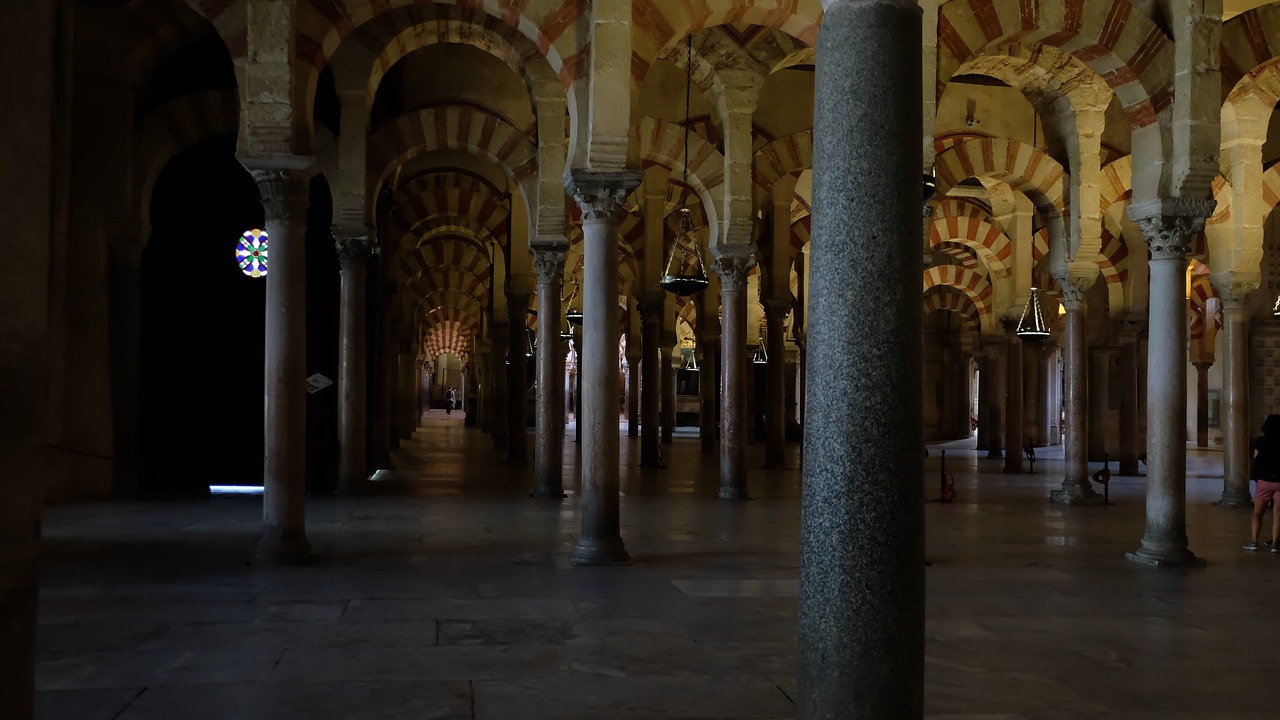
Constructed between 785 and 897 CE, the Great Mosque of Cordoba is one of the iconic and historically significant landmarks in Spain.
Situated in the southern Andalusia region within the boundaries of the city of Cordoba, Mosque-Cathedral of Cordoba features an expansive 856-column hypostyle prayer hall of onyx, porphyry, granite, marble, and jasper, and a beautiful Mihrab that is decorated with calligraphy and mosaics.
Over the centuries, the mosque underwent several expansions and modifications under different rulers.
The most notable expansion occurred under the rule of Abd al-Rahman II in the 9th century.
Additional sections, including new prayer halls and courtyards, were added to accommodate the growing Muslim population.
The mosque was converted into a cathedral after the Christian Reconquista of Córdoba in 1236.
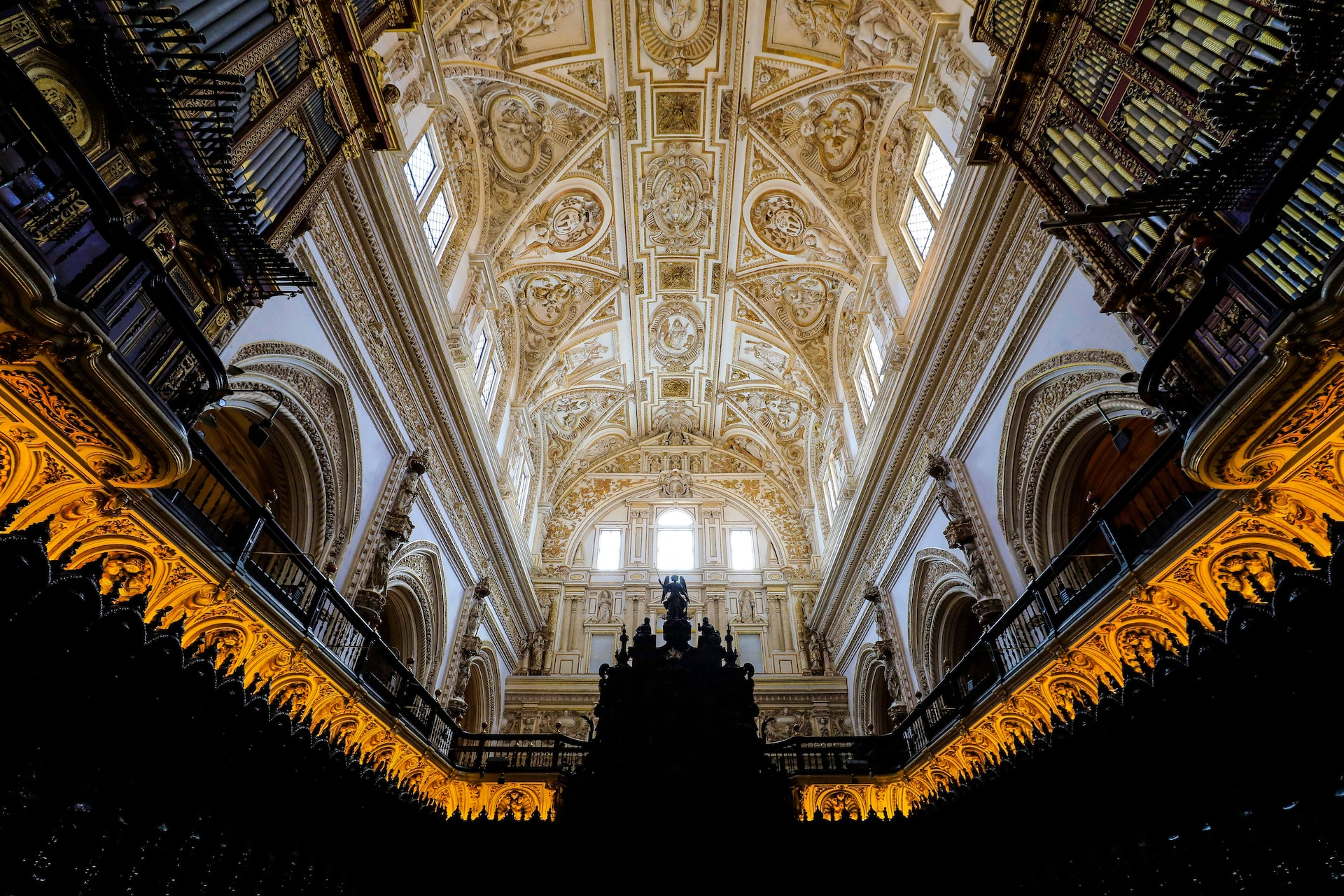
This transition involved the construction of a Renaissance-style cathedral nave within the existing mosque structure.
Today, The Great Mosque of Cordoba offers exceptional Cordoba experiences. It is recognised as a UNESCO World Heritage Site.
The ticket price is 13 € per person. The perfect time to visit the Mosque-Cathedral of Cordoba is between 11 a.m. to 3 p.m.
Ancient Mosque in Spain
The Great Mosque of Cordoba is amongst the oldest, largest, and most special religious sites in the world after Masjid al-Haram (Makkah), Masjid al-Nabawi (Madinah), and the Blue Mosque (Istanbul).
The majestic architecture at this place symbolises Muslim empowerment during the Umayyad Era and the unique relationship between the Christians, Jews, and Muslims.
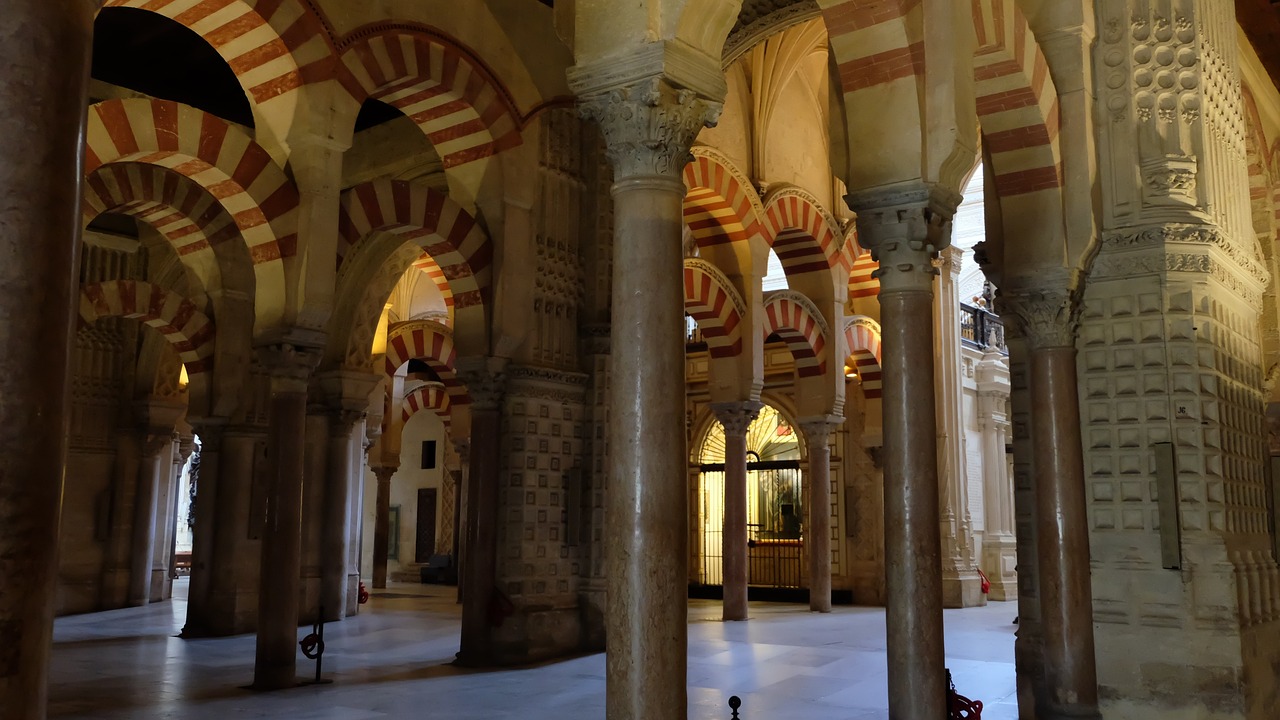
Mosque-Cathedral of Cordoba is known for its horseshoe arches, a red stone and brick column-filled prayer hall, a fountain-centred courtyard, and a minaret converted into a bell tower.
What Was the Capital of Muslims in Spain?
Originally ruled by Romans, Cordoba of Al-Andalus became the capital of Muslims (the Umayyad Caliphate) in Spain after the conquest.
The rich and diverse culture of Cordoba greatly contributed to establishing a flourishing Muslim civilisation.
Which City Was a Centre of Islamic Culture in Spain?
The city of Cordoba was a prominent centre of Islamic culture in Spain during the medieval period.
It reached its cultural zenith during the Islamic rule of the Iberian Peninsula, which lasted from the 8th to the 15th centuries.
Alhambra Palace
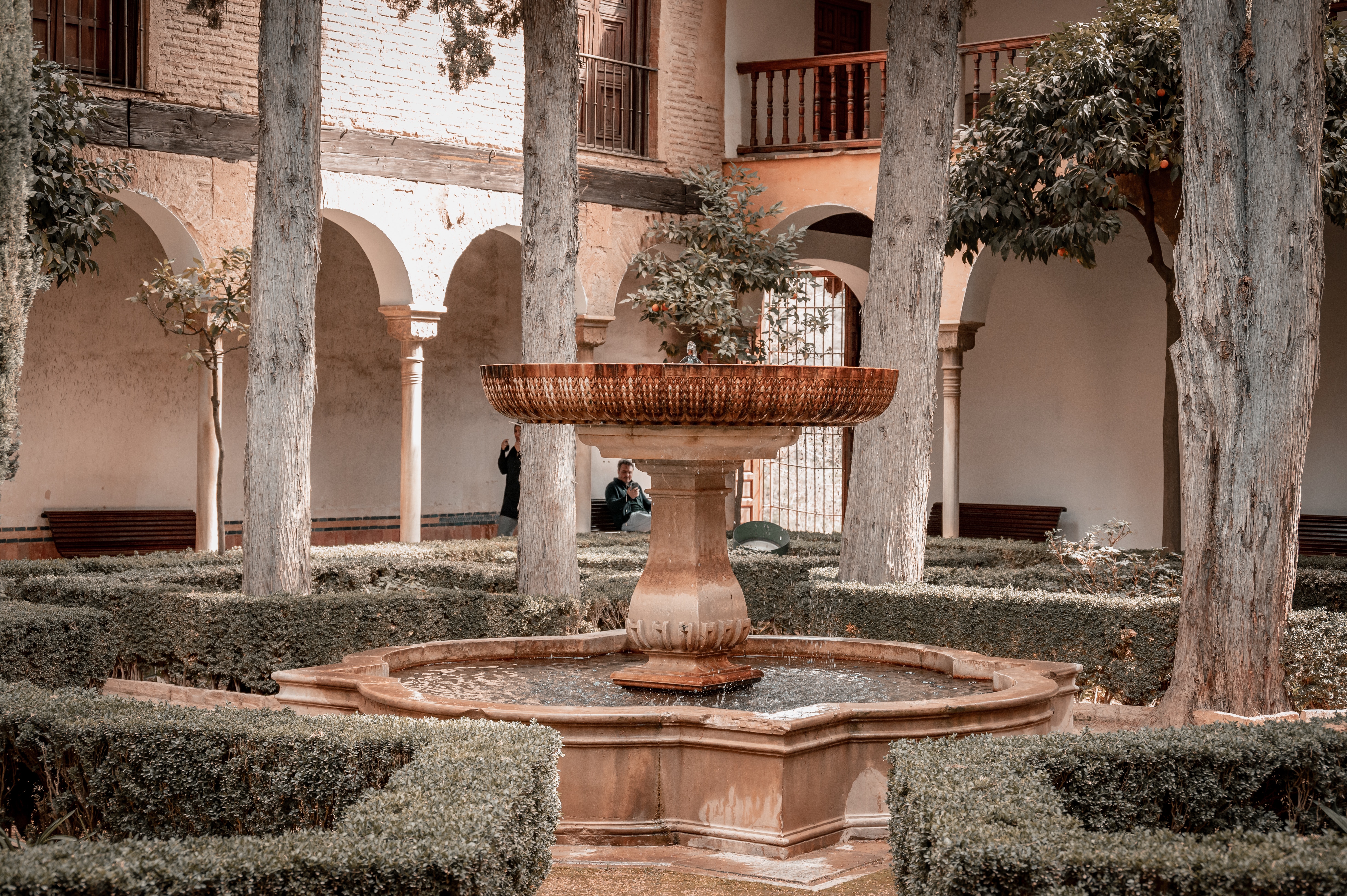
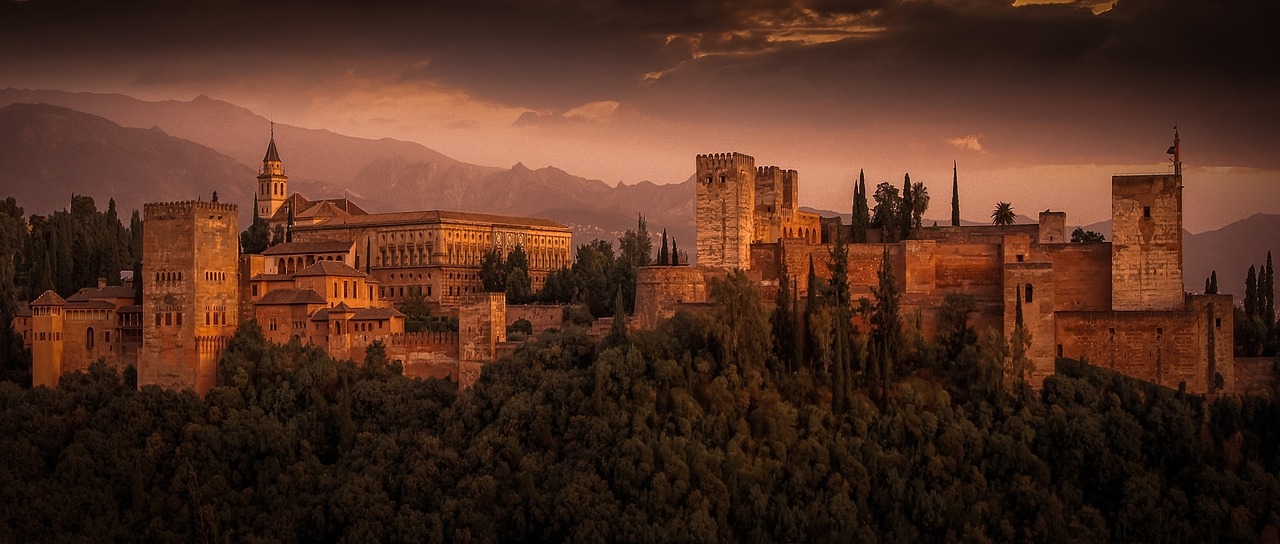
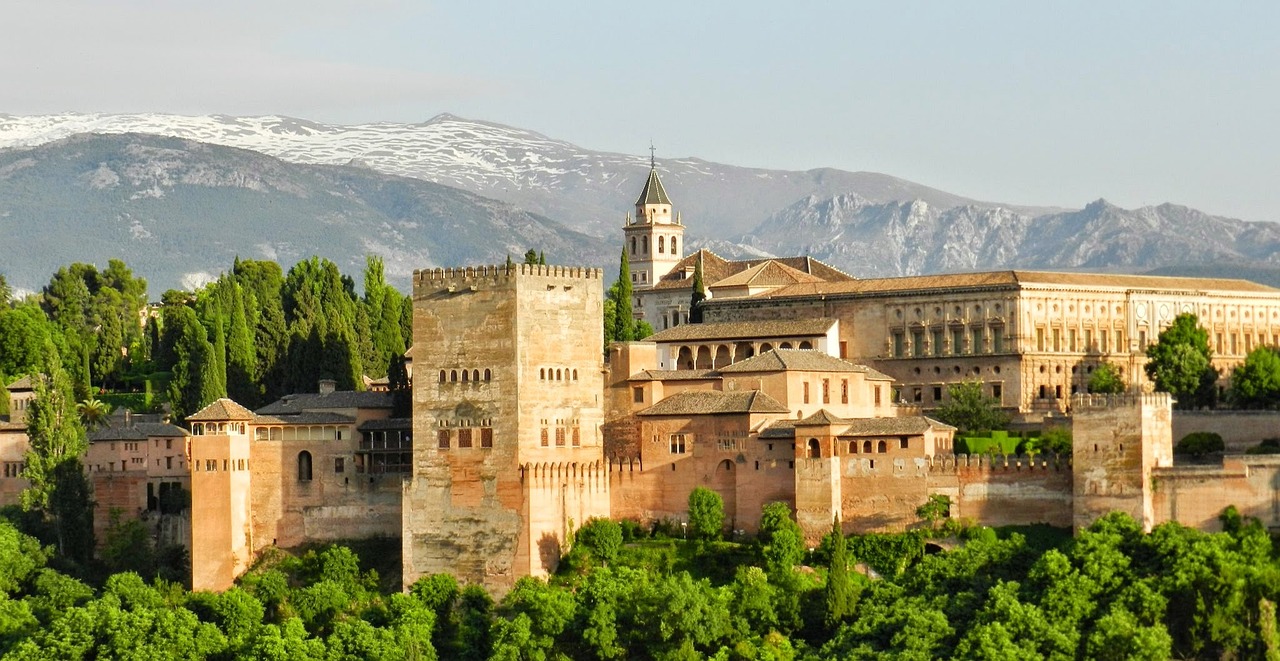
Situated in Granada, Spain, the Alhambra Palace is a 26 acres complex of gardens and fortifications originally built during the mid-13th century by the Nasrid Dynasty.
The name “Alhambra” is rooted in the Arabic words “al-qal’a al-hamra.” They translate to “the red fortress,” which likely references the reddish hue of the palace’s walls.
Featuring delicate geometric patterns, calligraphy, arabesques, and stunning decorative elements, the Alhambra Palace is a harmonious blend of different architectural styles, including Andalusian, Islamic, and Moorish influences.
In addition, the Alhambra Palace was a strategically important place as it allowed the rulers to have a bird’s eye view of the entire city.
It is a must-visit site. The ticket price is 19.09€ for adults. Some key sites of the Alhambra Palace that you must tour include:
- Nasrid Palaces: These palaces serve as the heart of the Alhambra complex. They feature well-decorated courtyards, stunning stucco work, colourful tiles, and beautifully carved wooden ceilings. The most famous of these courtyards is the Court of the Lions, known for its central marble fountain supported by twelve lion statues.
- Generalife Gardens: The Generalife Gardens are a series of terraced landscapes with lush greenery, vibrant flowers, and flowing water features. These gardens provide a peaceful retreat within the palace complex and offer stunning views of the surrounding area.
- Alcazaba: The Alcazaba is the oldest part of the Alhambra and serves as a fortress with defensive walls and towers. It offers panoramic views of Granada and the Sierra Nevada mountains.
- Palace of Charles V: This Renaissance-style palace was built within the Alhambra complex by the Holy Roman Emperor Charles V in the 16th century. Its architecture contrasts with the Islamic design of the Nasrid Palaces and showcases the evolving cultural influences in the region.
Which City of Arab Islamic Heritage Is in Spain?
Cordoba, a city located in the southern region of Islam, was an important centre of Arab Islamic heritage during the medieval period.
It was the capital of the Islamic Emirate and later the Caliphate of Córdoba, a significant cultural, intellectual, and economic hub in the Iberian Peninsula.
The city’s Great Mosque of Córdoba (also known as the Mezquita) is one of Spain’s most famous examples of Islamic architecture.
The Islamic influence is still visible in the architecture and layout of the city today.
Catedral De Sevilla
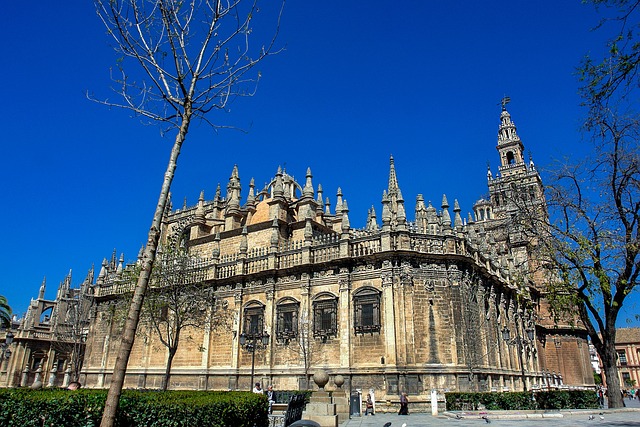
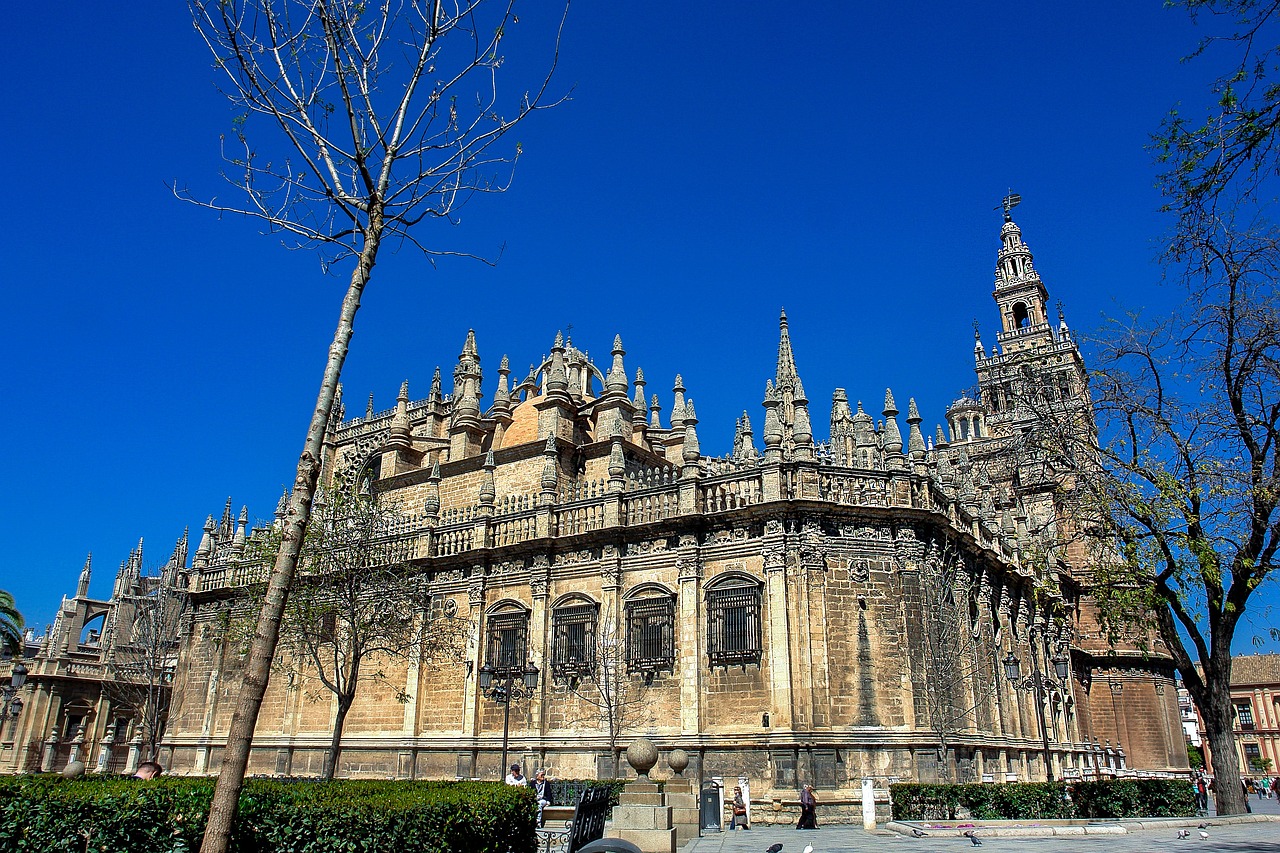
With an impressive architectural structure covering a total area of about 124000 square feet (11520 square metres), Catedral De Sevilla is the third-largest church in the world.
Nestled in the heart of Seville, Spain, Catedral De Sevilla is renowned for its grand, ornate interior, meticulously crafted glass windows, altarpieces, and numerous chapels.
The 341-foot (104 metres) tall Giralda Tower and the Tomb of Christopher Columbus are the most notable features of Catedral De Sevilla.
Beyond the entrance, within the grand monument is La Capilla Real, an area dedicated to the royal family of Spain that features beautiful sculptures, altarpieces, and tombs of various monarchs. The regular ticket price is 8 €.
The construction of the Seville Cathedral began in the 15th century after the Reconquista (the Christian reconquest of Spain) from the Moors.
It was built on the site of a former mosque. The cathedral’s construction incorporated elements of both Gothic and Renaissance architectural styles.
Which City in Spain Has the Most Islamic History?
Andalusia, a region in southern Spain, has the richest Islamic history in Spain due to its association with the Alhambra and Nasrid Dynasty.
Cities like Granada, Cordoba, and Seville have a rich Islamic heritage and offer opportunities for Muslim travellers to explore historical Islamic places in Spain.
Andalusia is home to some of the most iconic and well-preserved examples of Islamic historical places in Spain, specifically the Alhambra Palace.
Seville Islamic History
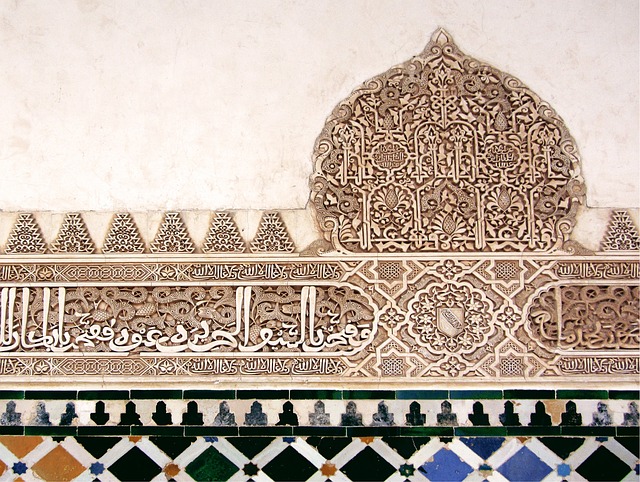
Commonly referred to as “Ishbiliyah” in Arabic, Seville, the inaugural capital of Al-Andalus, is one of the most Islamic historic places and holds significant importance in Islam.
During the Islamic rule of the Iberian Peninsula (711-1492), Seville became a centre of intellectual and cultural exchange.
Scholars from the Muslim world gathered in the city’s universities and libraries, translating ancient Greek, Roman, and Persian texts into Arabic.
In addition, Seville was known as a place of high religious tolerance as all religions (Jewish, Christianity, and Islam) co-existed peacefully.
Some fascinating Islamic heritage sites in the Spanish city include The Alcazar, The Giralda, and Torre Del Oro.
Royal Alcázar of Seville
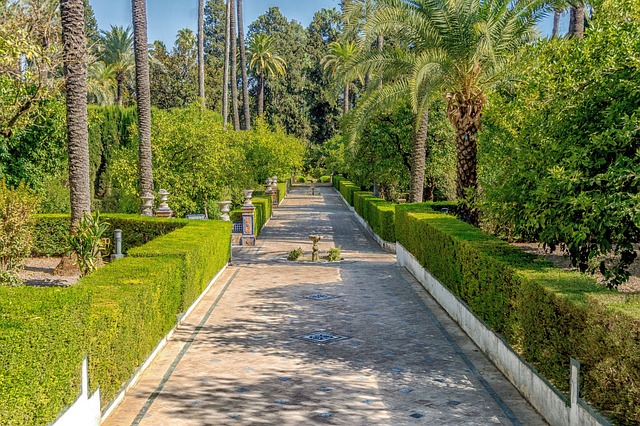
Royal Alcázar of Seville is a historic palace complex developed for the Castilian King Peter in 913 CE.
Over the centuries, it underwent various expansions, renovations, and additions by different rulers, resulting in a blend of architectural styles, including Moorish, Gothic, Renaissance, and Mudejar influences.
This makes the Alcázar a unique testament to the cultural interactions and architectural evolution that have shaped the history of Andalusia and Spain.
Some unique features of the Royal Alcázar comprise decorative plasterwork, beautiful courtyards, lush green orchards, and exquisite tilework.
The “Patio de las Doncellas” (Patio of the Maidens) is a particularly famous courtyard known for its stunning Mudejar architecture and the reflecting pool at its centre.
Today, the Royal Alcázar serves as a residence to the royal family of Spain.
Which Part of Spain Is Best for Muslims?
When it comes to Muslim-friendly travel in Spain, look beyond the famous Madrid experiences.
Cities like Cordoba, Granada, Seville, and Barcelona provide believers with a rich cultural experience, historical sites, and opportunities for prayer and halal dining.
Medina Azahara
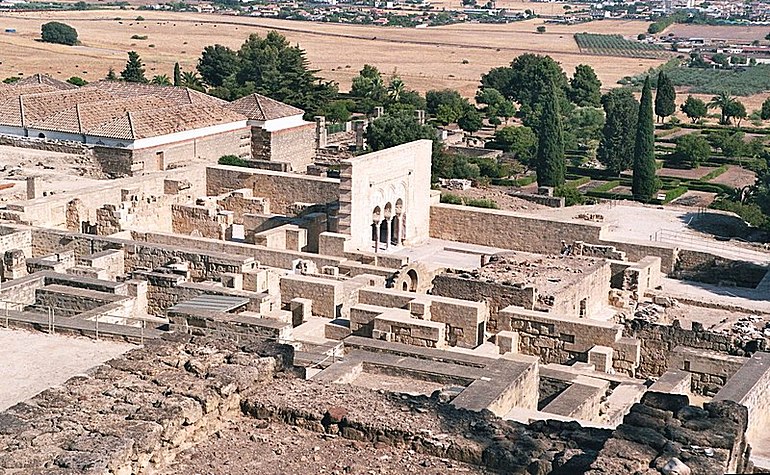
The “Shining City,” Medina Azahara, is an archaeological site situated on the outskirts of Cordoba, Spain. The fortified palace is one of the most prominent Islamic monuments.
It was constructed by Abd ar-Rahman III and served as a political, administrative, and cultural centre of the Umayyad Caliphate of Córdoba.
It featured palaces, administrative buildings, gardens, and other artistic structures that reflected the cultural fusion of the time’s Islamic, Byzantine, and Visigothic influences.
However, due to the persisting economic challenges and political instability, Medina Azahara fell into a decline.
The site was then rediscovered in the early 20th century and was preserved by the UNESCO World Heritage Site. Today, thousands of visitors to the Shining City every year.
Aljafería Palace
The Aljafería Palace (Palacio de la Aljafería) is a historic palace in Zaragoza, Spain. The palace’s construction began in the 11th century during the period of Muslim rule in the Iberian Peninsula.
It was built during the Taifa era, when the region was divided into various small Muslim kingdoms.
The Aljafería Palace was constructed as a fortified residence for the Banu Hud dynasty, specifically for Al-Muqtadir, the ruler of the Taifa of Zaragoza at the time.
The architectural design of Aljafería Palace reflects the Mudejar, Moorish, and Islamic cultures. The palace has thick walls, battlements, and sky-touching towers.
After the Christian Reconquista of Zaragoza in the 12th century, the Aljafería Palace underwent modifications to adapt it to the needs and preferences of the Christian rulers.
In subsequent centuries, the palace served various purposes, including as a royal residence, military barracks, and government building.
Primate Cathedral of Saint Mary of Toledo
The Primate Cathedral of Saint Mary of Toledo is a Roman Catholic Church in the city of Toledo in Spain. Toledo Cathedral’s construction began in 1227 CE.
The 60-metre-wide and 120-metre-long architectural structure featured Gothic, Renaissance, and Baroque elements.
Toledo Cathedral was built on the site of a former Visigothic church and a later Islamic mosque, symbolising the religious history and transitions of the city.
Toledo Cathedral houses numerous artistic and architectural treasures. Crossing the entrance, you will witness exquisite stained glass windows, elaborate altars, sculptures, paintings, carvings, 72 vaults, and 88 pillars.
The interior is known for its grandeur and remarkable acoustics, making it a venue for various religious ceremonies, cultural events, and musical performances.
One of the most famous features of the cathedral is its ornate High Altar, created by sculptor Alonso Berruguete and architect Enrique Egas.
Madinat al Zahra
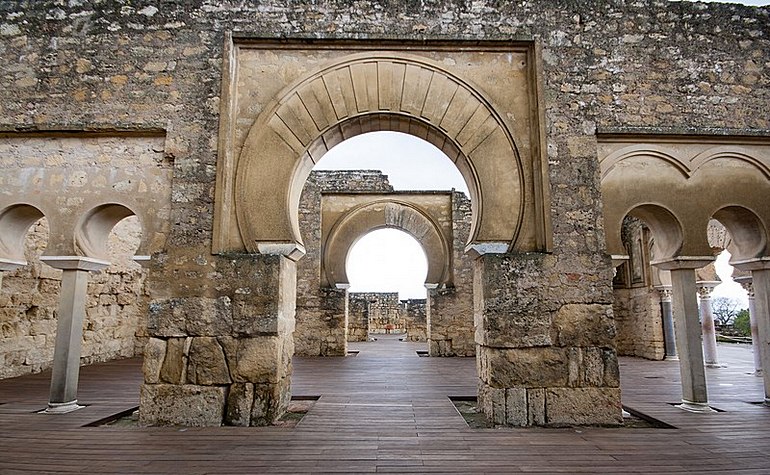
Also called Medina Azahara, Madinat al-Zahra is a fortified historical site in the western region of Cordoba, Spain. It was a royal palace city and the administrative centre of the Umayyad Caliphate in the 10th century.
The site was constructed during the reign of Caliph Abd al-Rahman III (912–961 AD) and symbolised the caliphate’s power and opulence.
Madinat al-Zahra was intended to be a grand city that showcased the wealth, culture, and authority of the Umayyad rulers.
The city featured impressive architecture, expansive gardens, administrative buildings, residential areas, and lavish palaces, all built on a terraced hillside overlooking Córdoba.
The construction of Madinat al-Zahra started around 936 AD and continued for decades.
Unfortunately, the grandeur of Madinat al-Zahra was short-lived. The city was largely destroyed during the civil wars and conflicts that followed the fall of the Umayyad Caliphate.
Over time, the site was buried under layers of earth and forgotten. It wasn’t until the 20th century that archaeological excavations began, and researchers discovered the impressive remnants of the once-splendid city.
Castillo Arabe
Castillo Arabe translates to “Arab Castles built in Spain.” Having a distinctive architecture, Castillo Arabe served as a defensive structure, cultural symbol, and centre of governance during the medieval period. A few of the popular Castillo Arabe are listed below:
- Castillo Arabe in Alora: Perched atop a hill in Alora, the Castillo Árabe was developed in the 9th Offering beautiful views of the countryside, the fortress is also called “Cerro de las Torres.”
- Castillo Arabe in Motril: The palace is located in Motril. Even though not the original structure, the coastal fortress was built in resemblance to the real Arab palace.
- Castillo Arabe in Siurana: This was developed in the 12th century in Tarragona province. The castle’s remains narrate stories of a time when cultures converged, leaving an indelible mark on the region.
- Castillo Arabe in Constantina: Tucked away in the heart of Andalusia, the Castillo Árabe in Constantina stands as a silent guardian of Islamic history. Tourists can climb to the castle’s top and see the breathtaking view of the city.
- Castillo Arabe in Olvera: It is located in the province of Cadiz and was constructed in the late 12th century in the Nasrid-era. The castle
What City in Spain Is Arab Influenced?
Not one but several cities in Spain are Arab influenced, including Cadiz, Toledo, Malaga, Granda, Seville, Zaragoza, and Cordoba.
The Arab influence can be seen in Spain’s music style and instruments, technological innovations, literature, Maths, use of chickpeas, rice, spices, herbs, language, and architectural patterns and designs.
The Viana Palace
The Viana Palace, also known as the Palacio de Viana, is a historical palace located in the Santa Marina neighbourhood of Cordoba, Spain.
Surrounded by a marvellous garden and 12 stunning patios, the Viana Palace is a mix of Morish, Gothic, Renaissance, and Baroque architecture.
One of the most notable features of the Viana Palace is its stunning interior, with intricately decorated rooms, grand halls, and various art collections, including paintings, sculptures, and furniture from different periods.
Mosque of Christ of the Light (Mezquita Del Cristo De La Luz)
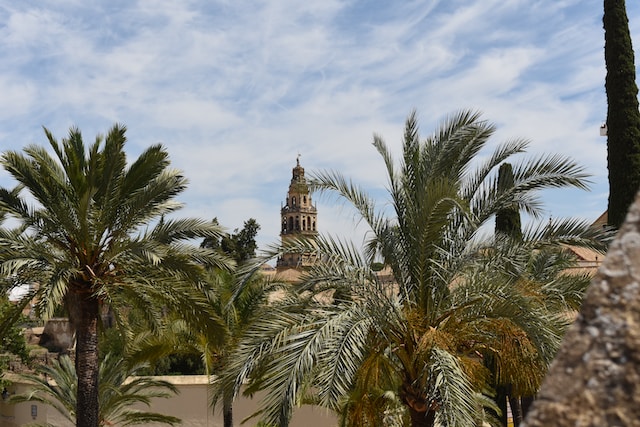
The Mosque of Christ of the Light (Spanish: Mezquita Del Cristo De La Luz) can be found in Toledo, Spain. The mosque was originally built in the year 999 AD during the Islamic Caliphate of Córdoba, the reign of Caliph Al-Hakam II.
The mosque was initially known as the “Mosque of Bab al-Mardum” (Mezquita de Bab al-Mardum or Mezquita del Salvador) due to its location near the Bab al-Mardum gate of Toledo.
The architectural style of the mosque reflects the distinctive features of Islamic design, with horseshoe arches, geometric patterns, and decorations.
After Toledo was recaptured by Christian forces in the 11th century, the mosque was consecrated as a Christian church.
During this conversion, some Christian elements were added to the building while maintaining its original Islamic architectural features.
A small apse was added to the Mihrab to create a more Christian-style sanctuary. The mosque’s name was changed to the “Mosque of Christ of the Light” (Mezquita Del Cristo De La Luz) to emphasise its new religious identity.
Calahorra Tower
Calahorra Tower is a fortified gate tower in Cordoba, Spain. The tower’s name, “Calahorra,” is derived from the Arabic word “Qal’at al-Hurra,” which means “Fortress of the Christian Lady.”
The tower was constructed in the 12th century by the Almohad dynasty.
The tower is an iconic landmark of Córdoba and consists of several levels, including fourteen chambers that once served various purposes, such as housing military personnel and prisoners.
La Madraza Granada
Built in 1349, La Madraza, Granda, served as an Islamic educational institution. It was established by Sultan Yusuf I and was designed to provide advanced education in various disciplines of Islamic knowledge, including theology, law, medicine, and literature.
The building is a beautiful example of Nasrid architecture, characterised by intricate stucco decoration, colourful tile work, and architectural elements that showcase exquisite craftsmanship.
It features a central courtyard, classrooms, a fountain, and prayer halls.
La Madraza Granada is currently open to the public as a museum, offering unique Granada experiences and allowing tourists to explore and learn about its religious significance.
The Generalife Palace
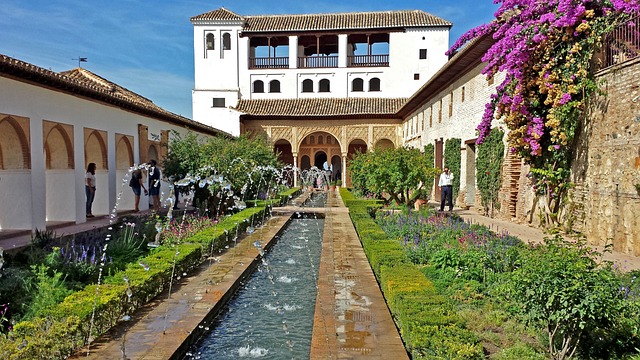
The Generalife Palace (Palacio de Generalife) is a historic architectural complex in the Alhambra, a renowned palace and fortress in Granada, Spain.
The Generalife was originally utilised as a leisure retreat for the Nasrid rulers. The Generalife Palace comprises exquisite gardens, courtyards, and fountains.
Patio de la Acequia is one of the most iconic areas of the Generalife. It features a long central water channel, fountains, and maintained horticultural elements. “Acequia” refers to the irrigation channels that bring water to the gardens.
The name “Generalife” is said to have originated from the Arabic words “Jannat al-Arif,” meaning “Garden of the Architect” or “Architect’s Garden.”
Gormaz Castle
Renowned as Castillo de Gormaz or Fortaleza de Gormaz, the grand palace was developed in 965 CE. Overlooking the Duero River, the Gormaz Castle consists of 1.2 kilometres of walls, countless towers, and defensive structures.
Over time, the strategic importance of the castle diminished, and it eventually fell into disuse. However, efforts have been made to preserve and restore the castle.
Today, tourists can travel to the Gormaz Castle while enjoying the panoramic views of the surrounding countryside.
Arabic Cities in Spain
Spain’s Arabic cities offer immersive glimpses into the country’s past, celebrating the art, architecture, and culture of Al-Andalus.
While Granada’s Alhambra showcases Nasrid dynasty artistry and stunning views, Mezquita of the inaugural capital, Cordoba, represents Islamic and Christian design.
Furthermore, the Alcázar in Seville blends Moorish and Gothic styles, whereas Toledo’s “City of Three Cultures” label reflects its fusion of Islamic, Jewish, and Christian influences.
Zaragoza has the famous Aljaferia Palace, and Cadiz’s maze-like streets narrate tales of the Umayyad era.
Summary – Islamic Historical Places in Spain
The Islamic civilisation’s presence in Spain for eight centuries left behind rich artistic and architectural heritage.
This legacy includes palaces, mosques, and fortresses that showcase that era’s advanced development and artistic sophistication.
These structures continue to adorn Spanish cities and are among Europe’s most visited monuments for halal travel, serving as a reminder of the shared history and cultural connections with Arabs
]]>Despite the Christian reconquest of the Iberian Peninsula (the Reconquista), during which numerous Islamic structures, particularly places of worship, were either demolished or repurposed as churches, a handful managed to survive, standing tall as reminders of the Muslim rule.
Continue reading to learn about the ten majestic mosques in Spain.
Which Spanish City Has a Famous Mosque?
The Spanish city that has a famous mosque is Cordoba. Also called Mezquita-Catedral de Cordoba, the Great Mosque of Cordoba is one of the greatest monuments in Spain and a prime example of Islamic architecture.
The culture and food of Cordoba are a mixture of all three religions: Christianity, Islam, and Roman paganism.
What Is the Biggest Mosque in Spain?
Mezquita-Catedral de Cordoba or the Great Mosque of Cordoba is the biggest Masjid in Spain.
The Great Mosque of Córdoba
Mezquita-Catedral de Cordoba is a magnificent historical monument located in the city of Cordoba, Spain.
The Great Mosque of Cordoba is renowned for its rich history, stunning architecture, and the interplay of various cultural influences.
Here is an overview covering the history, facts, design and architecture, location, capacity, and the current status of Mezquita-Catedral de Cordoba:
History
The religious heritage of the Great Mosque of Cordoba dates back to the 8th century. It was initially constructed as a small mosque during the rule of the Umayyad dynasty.
However, under the reign of Abd al-Rahman I, the Mosque was expanded and developed into one of the most significant Islamic architectural wonders in the world.
The construction took several phases and rulers over centuries, resulting in a structure that reflects a blend of Islamic, Moorish, and Christian elements due to the region’s complex history.
Facts
- The grave of Abd al-Rahman can be found under the site of the Great Mosque of Cordoba.
- Abd al-Rahman I constructed the Masjid in honour of his beloved wife and originally named it “Aljama Mosque.”
- The Mosque comprises a 180-metre by 130-metre complex and an enclosed courtyard.
- 1984 Mezquita-Catedral de Cordoba was enlisted as an UNESCO World Heritage Site.
- The Great Mosque of Cordoba was built on the site of the Visigoth church.
- The prayer hall of the Mezquita consists of 856 columns.
Design and Architecture
The design of the Great Mosque of Cordoba exhibits a harmonious blend of Islamic and Western architectural styles.
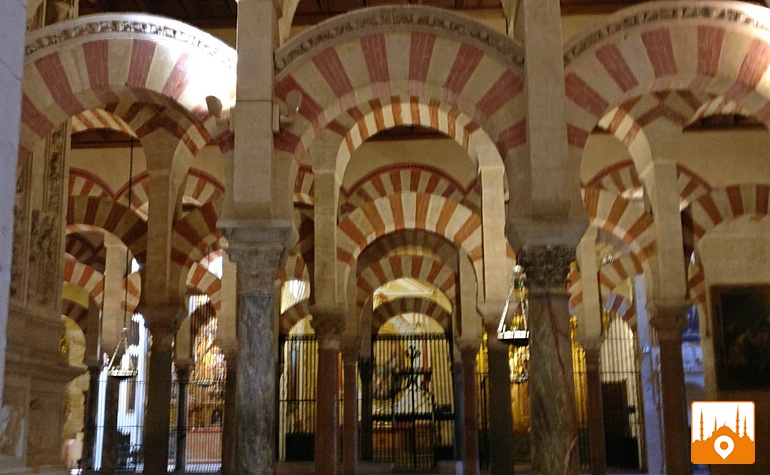
It features a large hypostyle prayer hall with a forest of columns and horseshoe arches supporting the roof.
The arches are alternately coloured red and white, creating a mesmerising visual effect. The mihrab (prayer niche) is exquisitely decorated with intricate mosaics and inscriptions.
The structure also includes a beautiful courtyard with orange trees and a reflecting pool, adding to its serene vibe.
Location/Address
Calle del Cardenal Herrero, 1, 14003 Córdoba, Spain. Click here to view the location of the Great Mosque of Córdoba.
Capacity
While the exact number isn’t known, Mezquita-Catedral de Cordoba can accommodate thousands of worshipers during prayer times.
Its large prayer hall, with its multitude of columns and arches, provides ample space for visitors, tourists, and worshipers.
Is It Still a Mosque, or Has It Been Converted into a Church?
After the Christian Reconquista of Cordoba in the 13th century, the Mosque was converted into a Christian cathedral.
As a result, the Mosque’s Islamic features were preserved, while Christian elements such as chapels and the choir were integrated into the structure.
The cathedral was constructed at the heart of the Mosque’s prayer hall, creating an intriguing fusion of architectural styles and spiritual traditions.
Opening Hours
Monday – Saturday: 10 am to 6 pm.
Religious Festivals and Sundays: 9 am to 10:30 am and 2 pm to 6 pm.
Ticket Prices
Guided Tours cost 40€ per person. However, it is free for children under the age of 8.
The cost of private tours (without a guide) is 10€ per person, 5 € for children (10-14 years old), and free for children under the age of 10
Images
Phone Number
info@mezquitadecordoba.org or informacion@mezquita-catedraldecordoba.es
Opening Date
The construction of the Great Mosque of Cordoba began in the year 785 CE during the rule of Abd al-Rahman I and was opened to the public in 988 CE.
Its expansions and modifications continued through various dynasties and rulers until it reached its present form. The cathedral within the Mosque was consecrated in the 13th century.
Masjid Tarek Ibn Ziyad – Biggest Mosque in Barcelona
Named after the fierce warrior Tariq Ibn Ziyad, Masjid Tarek Ibn Ziyad was made after the Muslim conquest of Barcelona.
The Mosque’s architectural blend of contemporary design and traditional Islamic elements reflects the harmonious coexistence of modernity and tradition.
With its serene ambience and the echoes of prayers that resonate within its walls, Masjid Tarek Ibn Ziyad not only fulfils the spiritual needs of its attendees but also fosters understanding and dialogue among different faiths in the heart of Barcelona.
History
Masjid Tarek Ibn Ziyad, named after the valiant Berber-Muslim general who led the conquest of Hispania in the 8th century, holds an array of historical echoes within its walls.
Founded in the early 9th century, this Mosque is a silent witness to the passage of time and the ebb and flow of empires.
From its inception during the Umayyad Caliphate to surviving the tumultuous eras of Moorish Spain and beyond, the Mosque has imbibed the essence of each era.
Facts
- Masjid Tarek Ibn Ziyad was established in the 9th
- Masjid Tarek Ibn Ziyad is one of Barcelona’s largest and most historic
- The Mosque was named after the Muslim commander Tariq ibn Ziyad.
Design and Architecture
Masjid Tarek Ibn Ziyad’s architecture is a testament to its builders’ skilled craftsmanship.
The Umayyad plus Moorish architectural design of the Mosque includes horseshoe arches, geometric patterns, and ornate calligraphy that adorn the walls.
Location/Address
C/ de Sant Rafael, 10, 08001 Barcelona, Spain.
Capacity
Being the largest Mosque in Barcelona, Masjid Tarek Ibn Ziyad can accommodate thousands of worshippers in its prayer hall.
Is It Still a Mosque, or Has It Been Converted into a Church?
Fortunately, Masjid Tarek Ibn Ziyad is one of the few mosques that haven’t been converted into a church.
Opening Hours
The Mosque is open at all hours.
Ticket Prices
Masjid Tarek Ibn Ziyad is open to the public for free.
Phone Number
There’s no email address associated with Masjid Tarek Ibn Ziyad.
Opening Date
Masjid Tarek Ibn Ziyad was open to worshippers in the 9th century.
Madrid Central Mosque
The Madrid Central Mosque, also known as the Abu-Bakr Mosque, holds a significant place in the history of Islamic architecture and culture in Spain.
It was established as a spiritual and cultural centre for the Muslim community in Madrid.
The Mosque’s history is intertwined with Spain’s rich Islamic past, harkening back to the period of Al-Andalus when Muslim rule left an indelible mark on the region.
In addition to being a place of worship, the Madrid Central Mosque is also used for social, cultural, educational, and charitable purposes.
Due to its proximity to the Strait (Estrecho) Metro Station, the Masjid was also named “Strait Mosque.”
History
After being allotted as Waqf land, a considerable span of time was required to amass adequate individual donations, eventually paving the way for the Mosque’s construction.
Inaugurated in 1988, this establishment marked a historic moment by becoming the first Mosque in the capital since the conclusion of Islamic rule in 1085.
The architectural vision was brought to life by Juan Mora, and it presently serves as the central hub for both the Union of Islamic Communities of Spain and the Islamic Community of Madrid.
The Abu-Bakr Mosque operates under a collaborative agreement with the Community of Madrid and maintains a significant connection with the State through the Islamic Commission of Spain.
Facts
- Abu-Bakr Mosque is the first Masjid built since 1089 AD.
- Juan Mora designed the Mosque.
- Construction of Madrid Central Mosque was completed in 1988.
- It is the headquarters of the Islamic Community of Madrid and the Union of Islamic Communities of Spain.
- Madrid Central Mosque has four floors, including a school, offices, a nursery, an auditorium, a shop, and a library.
Design and Architecture
Masjid-e-Abu Bakr’s design and architecture are greatly inspired by Islamic art and Arab architectural principles.
The four-floor Mosque includes a shop, an auditorium, a library, a school, a nursery, offices, a café, and a mosque. The central dome, minaret, and prayer hall are key features of the Madrid Central Mosque.
Location/Address
Madrid Central Mosque is situated in the Cuatro Caminos neighbourhood of the Tetuán district.
The exact address is Calle Anastasio Herrero, 5, 28020 Madrid, Spain. Click here to view the location of one of the most popular mosques in Spain.
Capacity
Comprising four floors, the Madrid Central Mosque has a generous capacity to accommodate many worshippers.
Is It Still a Mosque, or Has It Been Converted into a Church?
Madrid Central Mosque isn’t only a masjid but the headquarters of the Islamic Community of Madrid and the Union of Islamic Communities of Spain.
The Mosque hosts all of the congregational prayers and is also used for educational, charitable, and cultural purposes.
Opening Hours
Monday – Sunday: 9 am to 10 pm.
Ticket Prices
There is no information available on the ticket price of the Madrid Central Mosque. It is possible that the Mosque does not charge a visitor’s fee.
Images
Phone Number
Opening Date
The Madrid Central Mosque opened its doors to the public in 1988, marking a significant milestone in preserving and continuing Islamic heritage in Spain.
3 Spanish Mosques Converted into Churches
In this section, we will discuss the three Spanish mosques that were converted into Churches after the Christian Reconquista.
Mosque of Cristo De La Luz
Also called Mezquita de Toledo, Cristo de la Luz Mosque is a historic religious site in Toledo, Spain. Holding significant architectural and historical importance, the Cristo de la Luz Mosque represents the religious and cultural transition that occurred in Spain over centuries.
It was also one of the ten blessed ancient mosques that stood during the Moorish era. Like most Islamic monuments, the Cristo de la Luz Mosque was later converted into a church in 1085 CE. Cristo de la Luz Mosque is one of the best-preserved mosques in Spain.
History
Originally built during 999 CE under the rule of the Umayyad Caliphate, the Mosque served as a place of worship for the Muslim community in Toledo. According to scriptures, Ahmad ibn Hadidi paid for the construction of the Mosque out of his own pocket.
It showcases a distinctive blend of Islamic architectural elements, such as horseshoe arches and intricate stucco decorations, which are characteristic of the Moorish style.
Facts
- The name “Cristo de la Luz” (Christ of the Light) was given to the Mosque after the Christian conquest of Toledo, reflecting its transformation into a Christian religious site.
- Cristo de la Luz Mosque measures 8×8 metres.
- Cristo de la Luz Mosque was constructed in 999 CE and was converted into a Church in 1085 CE.
- Cristo de la Luz Mosque was also called Bab al-Mardum Mosque.
Design and Architecture
Showcasing a blend of the Visigothic and Moorish cultures, Cristo de la Luz Mosque consists of geometric patterned small stone and brick walls, white-coloured horseshoe arches, and Islamic inscriptions on the wall.
The 8×8 square-shaped building has 4 columns that further divide into 9 parts. However, in 1186 CE, Cristo de la Luz Mosque was transformed into a chapel, resulting in the destruction of the mihrab and Qibla wall.
Cristo de la Luz Mosque features a beautiful garden and glass floors to preserve the authentic architectural design of the Moorish period.
Location/Address
Cristo de la Luz Mosque is located at Calle Cristo de la Luz, s/n, 45002 Toledo, Spain. Click here to view the exact location of Cristo de la Luz Mosque on Google Maps.
Capacity
Measuring 8×8 metres only, Cristo de la Luz Mosque isn’t particularly large and was likely designed to accommodate a moderate number of worshipers during its use as a mosque.
Is It Still a Mosque, or Has It Been Converted into a Church?
After Toledo was recaptured by Christian forces in the late 11th century, the Mosque transformed. It was consecrated as a Christian church, and an altar was added.
The Mosque’s original architectural elements were preserved, but new Christian iconography and religious features were integrated.
Upon stepping inside, Muslims can feel the religious spirit of the Mosque, especially after reading the Kufic script inscriptions on the walls.
Opening Hours
The Cristo de la Luz Mosque welcomes visitors from Monday to Sunday, with opening hours varying based on the season. Plan your travel accordingly.
March 1st to October 15th: 10am to 6:45pm
October 16th to February 28th: 10:00 am to 05:45 pm
Ticket Prices
- General Ticket:80 €
- Accredited Groups:40 €
- Minors Under 11: Free
Phone Number
+34 925 25 41 91
mezquitaermitacristodelaluz@gmail.com
Opening Date
The construction of the Cristo de la Luz Mosque was completed in 390 AH in the month of Muharram.
Giralda (The Great Mosque of Ishbiliya)
Standing as an emblem of historical significance and architectural marvel, the Giralda Tower is one of the most popular tourist sites in Spain.
Originally belonging to the Great Mosque of Ishbiliya, the Giralda tower showcases the power of Islam and the peace and harmony that prospered during the Umayyad Era.
History
The Great Mosque of Ishbiliya also recognised as the “Muvahiddin Mosque,” was constructed in 1171 during the reign of Abu Ya’qub Yusuf. It was built on the present-day location of the Seville Cathedral.
Designed with a rectangular layout, the Mosque featured a porticoed courtyard on its northern facade, with the notable Puerta del Perdón, the largest entrance among the three, still extant today.
Tragically, the Mosque suffered extensive damage from the earthquake in 1356, decimating much of its structure, except for the minaret and the courtyard named “Patio de los Naranjos” in Spanish.
Following the invasion of Ishbiliye by King Fernando III of Castille in 1248, the Grand Mosque of Ishbiliye underwent a transformation into a cathedral. Serving as a cathedral for almost two centuries, the Mosque’s primary edifice was entirely dismantled in 1434 to make way for the construction of the Seville Cathedral.
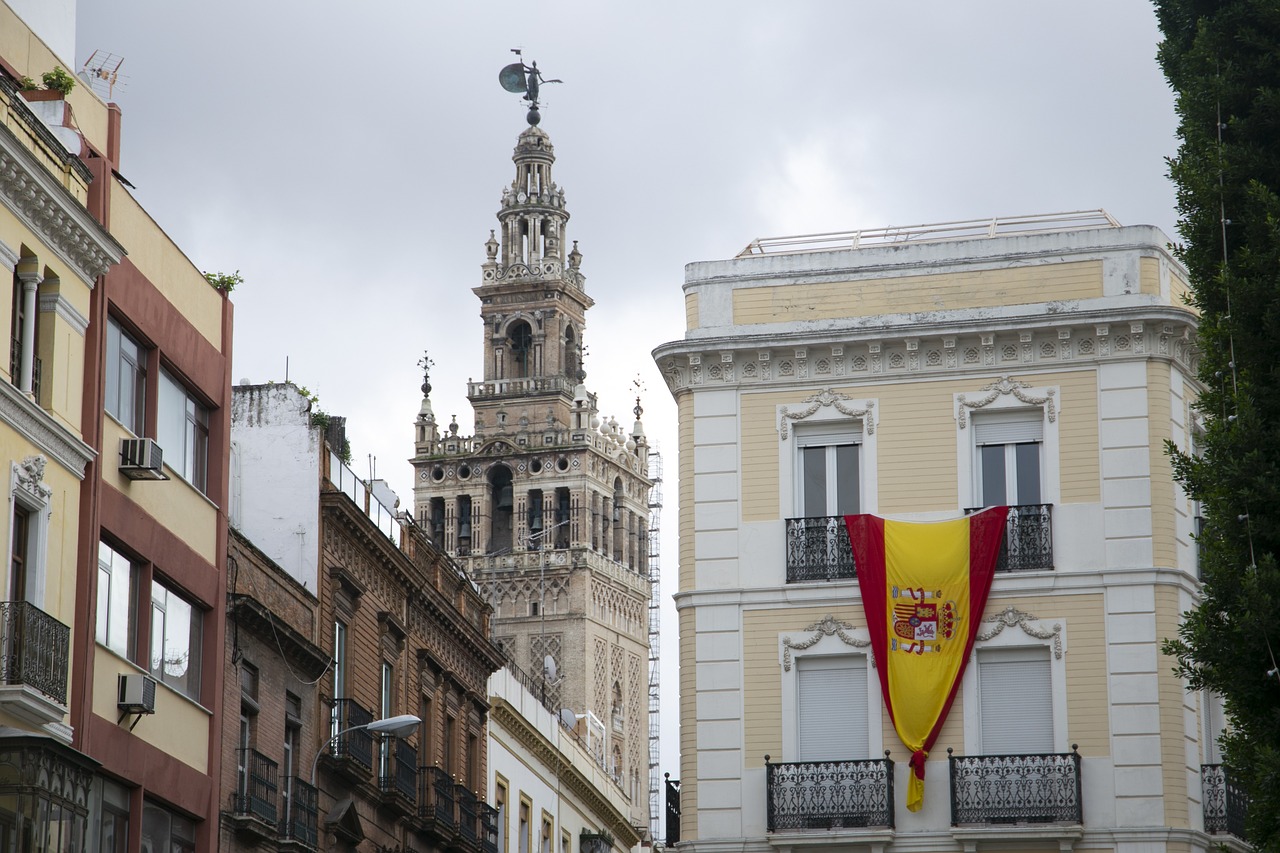
The minaret that once belonged to the Ishiliye Mosque underwent a conversion into a bell tower, subsequently integrated into the cathedral’s architecture completed in 1507. Notably, in 1568, the addition of a rotating statue atop the minaret led to its popular designation as the Giralda.
Facts
- Rising to a height of 343 feet (104.1 metres), the Giralda was one of the tallest structures of its time and still dominates the skyline of Seville.
- The Giralda was actually the minaret of the Great Mosque of Ishbiliya.
- It was originally built in the year 1171.
- The Giralda Tower is 341.5 feet (104.1 metres) in height.
- The Giralda Tower was added by UNESCO to the World Heritage List in 1987.
Design and Architecture
As stated earlier, Giralda is not actually a mosque but a 341.5 feet (104.1 metres) sky-high minaret of the Great Mosque of Ishbiliya. The lower section of the minaret is unmistakably Almohad, with its intricate brickwork patterns and horseshoe arches.
As the tower rises, the upper portion reflects Renaissance influences, featuring classical columns and a statue known as “El Giraldillo,” which represents triumph over adversity.
This amalgamation of styles symbolises the city’s diverse cultural past.
Location/Address
Avenida de la Constitucion s/n, 41004 Seville, Spain. Click here to view the location.
Capacity
The capacity of the Giralda tower is unknown.
Is It Still a Mosque, or Has It Been Converted into a Church?
The Giralda Tower is no longer a mosque. Following the Reconquista, it became part of the Seville Cathedral complex. The tower’s role transformed from a minaret to a bell tower and remains an integral part of the cathedral.
Opening Hours
- Monday: 11 am – 3:30 pm
- Tuesday – Saturday: 11 am – 5 pm
- Sunday: 2:30 pm – 6 pm
Ticket Prices
- General Ticket: €9
- Reduced Admission: €9
- Audio Guide: €3
Images
Phone Number
Opening Date
The foundation of the Giralda Tower was laid in 1171. However, it was renovated into a ring tower in 1248 and then was revamped again in the late 16th and mid-17th century.
The Mosque of Almonaster la Real
Built in the 10th century, the Mosque of Almonaster la Real is a uniquely shaped stone and built building.
Featuring the authentic Visigoth architectural design, the Mosque of Almonaster la Real is located on a hill inside a castle that overlooks the Almonaster la Real village, hence its name.
The Mosque was renovated into a church after Christians regained control of Spain.
History
The history of the Mosque of Almonaster la Real traces back to the 10th century when the region was under the rule of the Umayyad Caliphate of Córdoba.
At this time, the Mosque was constructed as a worship centre for the Muslim community residing in the city.
This period marked the zenith of Islamic rule in the Iberian Peninsula, bringing with it a flourishing of art, science, and architecture.
However, with the passage of centuries, the region witnessed the ebb and flow of power dynamics. As Christian forces reconquered Spain, the Mosque transformed.
In the 13th century, during the reign of King Ferdinand III, the Mosque was converted into a Christian church. This transition encapsulates the historical and religious shifts that marked the region’s complex past.
Facts
- The Mosque of Almonaster la Real was built in the 10th century during the caliphate of Abd al-Rahman III.
- Sixteen tombs were discovered in the Mosque’s oration room.
- In 1931, the Mosque of Almonaster la Real was declared a National Monument.
Design and Architecture
The Mosque of Almonaster la Real has a trapezoidal architectural structure and is divided into three distinct sections: the prayer hall, a minaret tower, and a courtyard of ablutions.
Within the prayer hall, a layout of 5 minor naves is discernible. Notably, the central nave boasts a distinctive covering comprising a hemispherical dome and intricate brick arches.
While the rock facade courtyard is still intact, the brick and stone minaret tower has undergone various expansions and extensions over time.
Location/Address
Castillo, 10, 21350 Almonaster la Real, Huelva, Spain. Click here for the location.
Capacity
The capacity of the Mosque of Almonaster la Real remains unknown.
Is It Still a Mosque, or Has It Been Converted into a Church?
Today, the Mosque of Almonaster la Real stands as a church, inviting individuals to tour the architectural marvel.
Opening Hours
Monday to Sunday: 9 am to 8:30 pm.
Ticket Prices
There is no entrance fee.
Phone Number
Opening Date
The Mosque of Almonaster la Real was open to the public in the 10th century. However, the exact date is unknown.
How Many Mosques Were Destroyed in Spain?
During the Muslim rule in al-Andalus, there existed possibly thousands of mosques in Spain.
However, a majority of the religious buildings and Masjids were converted either into churches or demolished after the Christians regained control of Spain in 1492 (Reconquista).
According to the 2018 report by the Observatory of Religious Pluralism in Spain (El Observatorio del Pluralismo Religioso en España), approximately 1588 Muslim worship places were constructed in Spain.
However, as per another source, there were over 137 mosques in Grenada and about 3,000 mosques in Cordoba alone in the 10th century. These mosques served over 1.5 million Spanish Muslims during the Umayyad Era.
Alhambra Mosque
The Alhambra’s creation was not attributed to a singular ruler, but instead, it emerged as the collaborative effort of successive leaders within the Nasrid dynasty.
History
The Alhambra is a historic building — a palace and fortress complex located in Granada City, Spain. Its history dates back to the 9th century when the original structure was constructed as a small fortress.
However, the most significant developments and expansions occurred during the Nasrid Dynasty in the 13th and 14th centuries.
The Nasrid rulers transformed the fortress into a stunning palace complex that combined Islamic architecture and art with elements of Andalusian culture.
Facts
- The name “Alhambra” is derived from the Arabic words “al-Qal’a al-Hamra,” which means “the Red Fortress” due to the colour of its walls.
- It is a UNESCO World Heritage Site, recognised for its exceptional architecture and cultural significance in 1984.
- The Alhambra is renowned for its intricate tilework, geometric patterns, and lush gardens.
Design and Architecture
The architecture and design of the Alhambra Palace stand as a captivating fusion of Islamic artistry, Moorish craftsmanship, and Andalusian aesthetics.
The Nasrid Palaces, at the heart of the complex, are a testament to the mastery of architectural geometry and spatial arrangement.
The Palacio de los Leones (Palace of the Lions) boasts a central courtyard adorned with a breathtaking fountain supported by intricately sculpted marble lions – an emblem of the harmony between human ingenuity and the natural world.
Wooden ceilings adorned with intricate designs add to the allure, while the Generalife gardens extend an invitation to serenity with their terraced layout, bubbling water channels, and meticulously cultivated flora.
Location/Address
The Alhambra is located on Calle Real de la Alhambra, s/n, 18009 Granada, Spain.
If you want to travel to the Alhambra, click here to see the location on Google Maps.
Capacity
The capacity of the Alhambra varies based on the specific areas visitors are allowed to access. It receives a large number of visitors annually.
Is It Still a Mosque, or Has It Been Converted into a Church?
The Alhambra was originally built by the Nasrid Dynasty as a Muslim palace and fortress.
However, after the Reconquista (the Christian reconquest of Spain), the building was not converted into a church.
Instead, some parts were repurposed for Christian use, but the majority of the architectural and artistic features of the Nasrid period were preserved.
Today, Santa Maira de le Alhambra, a catholic church, stands on the site of Alhambra Mosque.
Opening Hours
1st April to 14th October
- Monday – Sunday: 8:30 am to 8 pm
- Ticket Office: 8 am to 8 pm
15th October to 31st March
- Monday – Sunday: 8:30 am to 6 pm
- Ticket Office: 8 am to 6 pm
Ticket Prices
- Adults: 19.09€
- Children between 12 and 15 years old: 12.73 €
- Children under 12: Free admission
Images
Phone Number
+34 677 417 790 or +34 958 027 971
informacion.alhambra.pag@juntadeandalucia.es.
Opening Date
The exact opening date of the Alhambra Mosque is unknown.
Great Mosque of Almeria
The Great Mosque of Almeria, also known as the Mezquita de Almería, is a historic architectural gem in Almeria, Spain.
This famous Mosque holds a significant place in the region’s history, reflecting the cultural and architectural influences of various civilisations that have shaped its evolution.
Mezquita de Almería was transformed into a San Juan church after Christians regained power in Spain.
History
The Great Mosque of Almeria was originally constructed during the 10th century when Almería was under the rule of the Umayyad Caliphate of Córdoba.
The Mosque was built during the reign of Caliph Abd ar-Rahman III.
It served as a place of worship and a centre of learning for the Muslim community in the region.
After being converted into a church, the Great Mosque of Almeria was destroyed in the 1522 earthquake, and all that remained was the mihrab alcove and the qibla wall.
Facts
- The Great Mosque of Almeria was established in the 10th
- The Great Mosque of Almeria was built during the reign of Abd ar-Rahman III.
- After being converted into a church, the name of the Mosque was changed to Church of San Juan.
Design and Architecture
The Mosque’s architecture showcases a rectangular layout with a prayer hall featuring a central nave flanked by aisles.
The Great Mosque of Almeria also featured a quadrangular mihrab, a lemon-plated patio, and a central fountain.
According to Islamic history, Mezquita de Almería was a part of Alcazaba of Almeria, a larger fortified complex that contained a palace, homes, and public baths.
Location/Address
The Great Mosque of Almeria is located on Plaza de la Constitución, s/n, 04003 Almería, Spain Almería. Click here to view the directions.
Capacity
The Great Mosque of Almeria can accommodate over 9000 worshippers.
Is It Still a Mosque, or Has It Been Converted into a Church?
The Great Mosque of Almeria has undergone various transformations over the centuries.
Following the Reconquista, the Christian conquest of the Iberian Peninsula, the Mosque was converted into the Church of San Juan.
The building was consecrated as the Cathedral of the Incarnation (Catedral de la Encarnación) and underwent subsequent modifications to align with Christian architectural styles.
Opening Hours
- Summer (April to October): 9 pm to 2 pm.
- Winter (November to March): 9 pm to 6 pm.
Ticket Prices
- Standard Ticket: 3-5 €
- Group Ticket (10 people): 2-5 €
- Reduced Ticket: 1-5 €
Images
Phone Number
Unfortunately, there’s no valid email address to contact the Great Mosque of Almeria.
Opening Date
The original Great Mosque of Almería was likely constructed in the 10th century. Following its conversion into the Cathedral of the Incarnation, it underwent modifications and renovations over the centuries.
The conversion into a cathedral marked a significant transition in its history after the Reconquista.
Alcazar of Jerez de la Frontera Mosque
An illustrious and commanding monument deeply ingrained in Spain’s historical narrative, the Moorish rulers of Andalusia originally erected the Alcazar Jerez de la Frontera during the 11th century.
Distinguished by its grand towers and formidable 4000-metre walls, the balcony of the Alcazar Jerez de la Frontera Mosque offers a panoramic view of the town below.
History
The Alcazar of Jerez de la Frontera Mosque traces its origins back to the 11th century during the rule of the Almoravid dynasty.
This famous Mosque was constructed during a time when the Iberian Peninsula was under Islamic rule, a period known for its remarkable architectural achievements.
The Mosque served as a place of worship and spiritual reflection for the Muslim community in Jerez de la Frontera.
Following the 13th-century Christian conquest, the Mosque went through various renovations to align with the Christian architectural styles.
Facts
- Alcazar of Jerez de la Frontera Mosque is one of the first Islamic monuments built in the 11th
- After the Christian Reconquista, the Mosque served as a residential space for the Cadiz governors.
- In 1931, Alcazar of Jerez de la Frontera Mosque was marked by UNESCO as a world heritage site.
- Alcazar of Jerez de la Frontera Mosque is the region’s only Masjid that is preserved in its original state out of 18 others.
Design and Architecture
The 4000-metre-wide Mezquita, or Mosque, stands as a remarkable survivor among the 18 mosques that once graced the Moorish Jerez.
Originally a small private oratory, it boasts a minaret, a courtyard with a central fountain for ablutions, and a prayer hall crowned by a mihrab, indicating its orientation towards Mecca.
While the Mosque underwent a transformation into a Christian chapel dedicated to Saint Mary, its architectural elements, including the octagonal dome and the intimate atmosphere, still exude a sense of spiritual sanctity.
The Alcázar’s structures reflect its diverse history. Islamic remnants, such as the Puerta del Campo gateway and the Torre Octógonal watchtower, harken back to the rule of the Almohad Dynasty.
Location/Address
Alcazar of Jerez de la Frontera Mosque is located within the Alcazar of Jerez de la Frontera complex. Address: Alameda Vieja, s/n, 11408 Jerez de la Frontera, Cádiz, Spain.
Capacity
Having a 4000-metre ground space, the Alcazar of Jerez de la Frontera Mosque can easily accommodate hundreds of worshippers.
Is It Still a Mosque or Has It Been Converted into a Church?
Today, hundreds of years later, the former Mosque remains a significant cultural landmark that reflects the city’s complex history. The architecture is a visual chronicle of the successive civilisations that have shaped the region.
Visitors to the site can explore the remnants of the Mosque’s Islamic origins while also experiencing the subsequent Christian modifications that have left an indelible mark on its design.
Opening Hours
October 1st to June 30th:
- Monday – Friday: 09:30 am – 02:30 pm
July 1st to September 30th:
- Monday – Friday: 09:30 am – 05:30 pm
- Saturday – Sunday: 09:30 am – 02:30 pm
Ticket Prices
- General Ticket: 5 €
- Group Ticket: 4 € per person
Images
Phone Number
The only way to contact the Alcazar of Jerez de la Frontera Mosque management is through the aforementioned phone number.
Opening Date
The Alcazar of Jerez de la Frontera Mosque was inaugurated in the 11th century. However, the exact date remains unknown.
List of Former Mosques in Spain
Below, you will find a list of former masjids in Al-Andalus that have been identified with original buildings or still have ruins of the existing Mosque on the premises:
- Great Mosque of Cordoba
- Mezquita Bab-al-Mardum
- Great Mosque of Seville
- Mezquita de Almonaster la Real
- Mosque of las Tornerías
- Mezquita del Alcázar de Jerez la Frontera
- Aljama Masjid of Madinat al-Zahra
- Mezquita de Tortoles
- Al-Dabbagin Masjid
- Small Royal Mosque inside Aljaferia Palace
- Iglesia de El Salvador, Toledo
- Masjid al-Ta ibin, Mezquita de los Conversos
- San Sebastian Minaret (Alminar De San Sebastian)
- Iglesia de Santigo del Arrabal, Toledo
- Alminar de San Juan
- Church of Nuestra Señora de la Encarnacion
Listed below are the mosques in Spain that were completely destroyed, and the ruins remained undiscovered to date:
- Great Mosque of Zaragoza (Aljama de Saraqusta, Mezquita Mayor de Zaragoz)
- Mosque of Ibn Abbas
- Aljama Mosque of Mayrit
- Nasrid Great Mosque of Granada
- Basílica de Santa María de la Asunción
- Baza Cathedral
- Guadix Cathedral
- Valencia Cathedral
- Santa Catalina, Valencia
- Old Cathedral of Lleida
- Iglesia de San Román, Toledo
- Mimbar de Alfacar
- Church of Santa Maria de Tarifa
- Iglesia de San Mateo
Summary – Mosques in Spain
Conquered by Muslims in the year 711 CE, Spain underwent a transformative journey religiously, economically, and socially.
Despite the challenges posed by the Reconquista, several mosques and churches remain a reminder of Islam and Arab architecture.
If you are planning a halal travel or vacation vacation, visit any of the aforementioned mosques in Spain.
Use the opportunity to learn and explore Islamic history and reflect on how the religion has shaped the nation’s identity
]]>- The young Umayyad king Abd al-Rahman I tactfully offered to buy the building (bucking the medieval trend of smashing everything to bits), and separated it into two sections – one side mosque, one side church – in 786 CE. Purchasing the other half not long afterwards in response to the growing Muslim population of Cordoba, he ordered the reconstruction of the building.
- Best known for its infinity of red and white arches, the mosque was constructed with as many as a thousand columns of onyx, jasper, granite and marble, of which 856 now remain. Its emphasis on geometry hints at a connection with North African architecture.
- The main entrance is now the Puerto del Perdón (Gate of Forgiveness) a 14th century Mudéjar arched doorway that opens onto the Patio de los Naranjos (Orange Tree Court). Originally, however, all nineteen rows of columns ended with doors that opened onto the patio, allowing daylight and worshippers to enter freely and continuing the rhythm of the arches.
- Beside the Puerta del Perdón is the 17th century belltower or Alminar, which was built around the original minaret. This structure built of ashlar (cut stone) and reaching 100 cubits or about 46 metres, dated back to about 950 CE and was ascended via two parallel vaulted staircases, accessed from doorways on either side.
- One strange quirk is that the mihrab points not to Mecca but to Ghana, as the homesick Syrian caliph faithfully tried to recreate Damascus in Spain, even in the direction of prayer. Imitating to some extent the Umayyad mosque of Damascus as well as the Dome of the Rock in Jerusalem, it’s unique style influences other mosques built in Al-Andalus.
- Also built under the orders of Abd al-Rahman I was the oldest existing door to the mosque, the Bab al-Wuzara (Viziers’ Gate), now called the St. Stephen’s Gate (Puerta de San Esteban) on the western side of the mosque.
- Over the course of 200 years, the Mezquita was extended several times with each extension named after the ruler who added to it (Abd al-Rahman I, Abd ar-Rahman II, Al-Hakam II and Al-Mansur) and each reflecting the growth of Cordoba in size and prosperity.
- The entire front wall of the mosque was demolished by Al-Hakam II in order to expand it, and in 961 CE he replaced the previous plain mihrab with an ornate heptagonal niche with a scalloped dome fronted by a low horseshoe arch encrusted with 1600kg of gold mosaic cubes. It is thought that the emperor of Byzantine sent these mosaic tiles, called tesserae, along with an expert mosaicist – who was soon surpassed by the slaves assigned to study under him. The alfiz is delicately carved with arabesques, sculpted marble friezes of geometric patterns and gold Kufic calligraphic inscriptions of Qur’anic passages and references to Al-Hakam II.
- The eastern porch features an arched door (now closed in with a brass door) dating back to the time of Al-Mansur, vizier and de facto ruler of the dying caliphate. This is surrounded by a beautiful alfiz (rectangular surround) composed of three-lobed windows, red and white geometric tile friezes and subtle vegetal designs that echo the designs of Al-Hakam’s mihrab.
- The three bays in front of the mihrab are the Maqsura (Royal Enclosure) where the caliph and his family would pray. Designed to complement the mihrab as a ‘mosque within a mosque’, this area would have been fenced in by a tall carved wooden fence with doors embellished with gold, silver and ebony.
- There are five chambers each to the right and left of the mihrab; those on the eastern side were originally used as a treasury, while those on the western side served as a passage to the palace. Only the central and eastern bays have retained their sumptuous domes, the western one having been destroyed to create the Capilla de Villaviciosa (see below). The aisle leading up to the mihrab was slightly wider than the rest from the beginning: this subtle alteration breaks the monotony of the column spacing and emphasises the mihrab.
- After the fall of Islamic Cordoba, Christian worship was introduced in the building. The Capilla de la Villaviciosa, built in the mid-to-late 13th century, was the first chapel to be used for Christian worship after Reconquista and features a scalloped cupola, corresponding to the Mudéjar period in which Muslim art still held a certain influence even in the construction of Christian buildings – many of the craftsmen were probably Muslims living under Christian rule.
- The biggest alteration, a towering cruciform basilica at the heart of the building in a riot of Renaissance plasterwork, was not built until 1523 CE once the Muslims of Spain had been overthrown. But, not everyone in the new Christian Spain was happy with the changes brought upon the Mezquita-Catedral. Upon seeing the damage done, King Carlos, who had never given the command for the building work to take place, reputedly said, ‘You have destroyed something that was unique to the world.’ Fortunately, the mihrab and the maqsura were largely left untouched. Some commentators have noted that by embedding the cathedral into the mosque it actually preserved the building for future generations, unlike many mosques which were razed completely.
- A recent online petition, interestingly begun by some of Cordoba’s non-Muslim residents, calls for the diocese in charge of running the Mezquita to allow it to be partly used as a Muslim place of worship again and to remove the growing number of statues, shrines and displays that have been added to the stucture of the mosque or accumulated inside the building, hindering views of the mihrab.
- The complex has ceased to be used as a mosque for hundreds of years and anyone attempting to perform the Islamic prayer in the Mezquita-Catedral will be stopped by officials and quickly escorted out of the complex. There is a long-running campaign led by Junta Islamica to allow Muslims to pray here again. The regional government of Andalusia, and particularly its tourist board, are critical of the management of the Mezquita; it generates approximately nine million euros from ticket sales, yet relegates its historic function as a mosque to a secondary role.
Reference: HUMA’s Travel guide to Islamic Spain
]]>- By the 10th century, Cordoba had mushroomed in size and importance so much so that Caliph Abd ar-Rahman III moved his headquarters to this specially built palace city. One theory is that the self-declared Amir al-Mu’minin (Prince of the Believers) built Madinat Az-Zahrah to prove his caliphate’s glory to his rivals, the Fatimids of Ifriqiya in North Africa.
- Staggeringly opulent, its walls and pillars were encrusted with amber, coral and jewels, while its mosque was known as the ‘little sister’ of the Mezquita of Cordoba. The complex not only included the caliph’s private residence but also the court, viziers quarters, army barracks, schools, gardens. In short, it was an entire, self-sustaining town independent of Cordoba.
- This palace complex was once so magnificent that courtiers from around Europe flocked to visit it. According to one contemporary writer, foreign ambassadors were led on their horses from Cordoba under a double row of soldiers that stretched the full twelve kilometres between the city and the palaces, all holding their swords high to form an arch over their heads. Once inside the palace complex, they were led (probably with some relief at having escaped the swords) past a mercury pool that shimmered with every breeze, then from one magnificent room to another, all filled with sumptuously dressed Moorish dignitaries, before finally meeting the Caliph.
- This palatine city epitomises the hubris of the time barely eighty years after this dazzling place was constructed, it was sacked by angry unpaid soldiers in 1010 CE and left in ruins during a civil war that marked the end of the caliphate and the beginning of the second taifa period of Al-Andalus.
Reference: HUMA’s Travel guide to Islamic Spain
]]>- The Alhambra Palace was built on the Sabika Hill, where other fortresses and palaces existed before. The location provides a strategic view of the city of Granada.
- The palace was initially built in 889 CE, but it was restored and remodelled in the 13th century by Mohammed ben Al-Ahmar, the creator of the Nasrid dynasty of the Emirate of Granada. During the Nasrid period, Alhambra became a self-contained Muslim royal city and citadel with six major palaces and two towers. Containing all the amenities required to function as a city or medina including a water system, houses, roads, mosque and hammam.
- From the mid-13th century onward the Alhambra Palace was expanded and embellished to its current grandeur over the course of the next century and a half. These improvements included the famous Patio of the Lions, the Baths and extension of some of the towers. The aim of the architectural detailing was to resemble paradise on earth.
- The palace was neglected for centuries until it was rediscovered by European explorers and work began to restore it to its glorious past.
- Video on the history of the Alhambra by Hikma History
Reference: Hikma History, Wikipedia
]]>- Built at the Caliphate’s peak in 999 CE, the Mesquita is unique, both in Western and Eastern Islamic art, for its Kufic inscription made of ordinary brick – a reflection of relative austerity of Toledo’s medieval architecture. The inscription reads: “In the name of Allah, Ahmad ibn Hadidi raised this mosque with his own money, seeking by it the reward of Allah in the next world. And it was concluded with the aid of Allah, under the direction of the architect Musa ibn Ali, and of Saada, being finished in Muharram of the year 390 Al (999 CE)”.
- The unusual shape is down to the 12 century extension and addition of a semi-circular apse at the back, considered to be the oldest existing example of Roman-Mudéjar art.
- The original 9×9 metres that constituted the mosque are distributed into nine vaulted spaces, each one crowned with a ribbed cupola featuring geometric decorations.
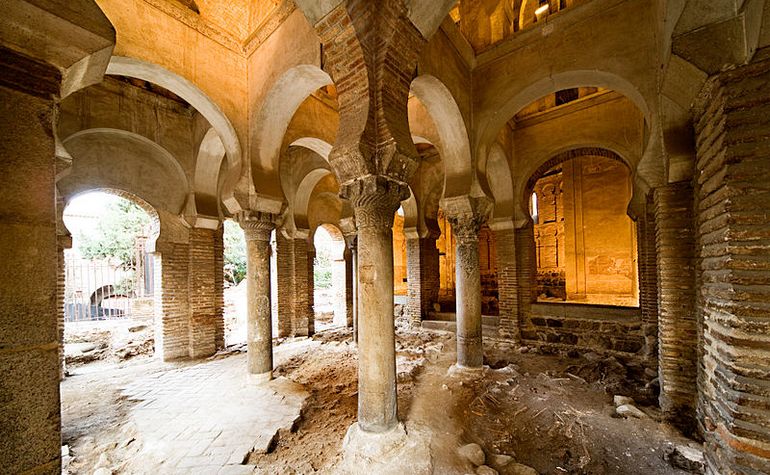
- Worshippers would enter through three arches at the front, each in a different style: maltifoil, rounded and horseshoe. Above these are interlocking brick arches, a frieze of sebqa (diamonds or rhombuses) and Kufic inscription – all typical early Moorish architectural features.
- On the sides of the mosque, the façade is decorated with multifoil arches framing small red and white striped arches, a visual reference to the Mezquita of Cordoba, which had just been built. A patio accessed from the Western entrance features a well called chart-bagh after the Persian custom that it was borrowed from, around which notches worn by the ropes that pulled up buckets of water can still be seen. This was most likely where ablutions were made before prayer.
- Elements of the Visigothic temple that once stood on this site are also still visible in the capitals supported by the horseshoe arches in the prayer space, offering a harmonious example of how the different civilisations that ruled Toledo continued to exert an influence.
- The nearby Puerta de Bab al-Mardum also dates back to the 10th century and is probably the oldest city gate in Toledo. The church has now been decentralised, and is commonly referred to as a Mezquita.
Reference: HUMA’s Travel guide to Islamic Spain
]]>- Inside are 35 inclined platforms, wide enough to allow the muezzin (caller to prayer) to ride up to the top on his horse five times a day and call the faithful to prayer.
- Built in the 1180s, shortly after the minaret of the Kutubiyya mosque in Marrakesh, and to the same design, by Almohad architects, the minaret originally stood 76 metres tall and was once topped by four orbs, covered with 41 grams of gold. The sun shining on the orbs would dazzle travellers from miles away.
- The orbs were destroyed in a 1356 CE earthquake, which the minaret survived and have been replaced by the Christian addition of a belfry, bringing it to a height of 100 metres. A statue symbolising faith that also acts as a weather vane (giraldilla) from which we get the name Giralda.
- Even without the golden orbs, the Giralda is a sight to behold. Austere yet beautiful, seba (rhombus) friezes are worked in brick relief along the four sides, with mullioned windows in pointed arch and lattice frames, giving the impression of lace made solid.
Reference: HUMA’s Travel guide to Islamic Spain
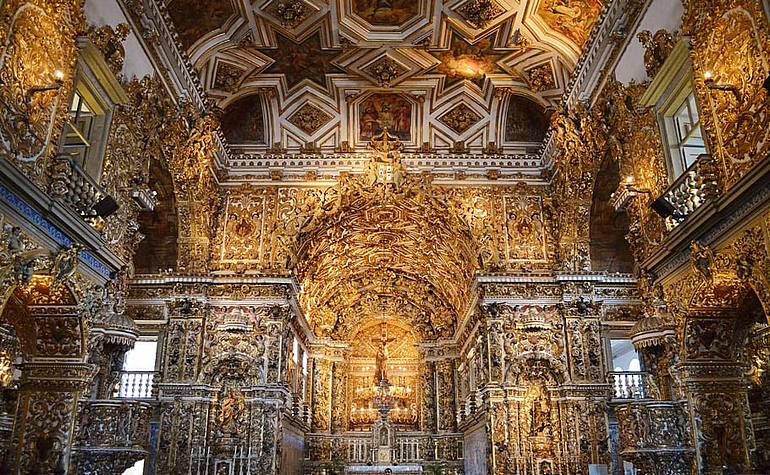
]]>- After the fall of Islamic Seville Muslims were allowed to continue using this mosque as such up until 1340 CE, when it was converted into a church. After falling into a dilapidated state, restoration work began in 1674 and was finished by 1712. Remnants of the mosque are still present, however: look for the columns, the ablutions courtyard and the original minaret, embedded in the Baroque tower.
Reference: HUMA’s Travel guide to Islamic Spain
]]>- Sitting directly beside the Cathedral and the Archivo de los Indios, the Alcázar is surprisingly central; with its high curtain walls, crenellations and turrets, from the outside it looks like a medieval fortress taken from the top of a lonely hill and plonked down in the middle of a metropolis.
- The result of a thousand years of successive demolitions and reconstructions according to the taste of the day, it is an extraordinary mishmash of courtyards, rooms and gardens in different styles and from different periods.
- King Pedro the Cruel (who earmt the name for murdering all the half-siblings standing between him and the throne) hired Muslim builders and craftsmen from the Nasrid court of Granada to create the finest examples of Mudéjar art in Spain. These craftsmen apparently without the king even realising, repeatedly carved the Nasrid motto ‘Wa la ghaliba illa Allah’ (‘And none is victor save Allah’) all over the palace complex, adding small crosses to the Arabic, perhaps to disguise the meaning. Elsewhere there are oft-repeated praises of Allah, sometimes coupled with praises to King Pedro.
- The gate to the Dar al-Imarah palace has been bricked up, but visitors can plainly see the original sandstone horseshoe arch, while the turrets of this defensive fortress are visible from the Plaza del Triunfo.
- This leads to the Patio de las Banderas (Courtyard of the Flags), which was originally a parade ground for the city’s troops. This part of the palace features rough walls that date back to the original construction of the nearby Sala de la Justicia (Chamber of Justice). Inscribed on the walls of the Chamber are the Arabic words “Allah is (our) Refuge, Bliss, (and) continual prosperity: Praise be to Allah for His goodness”.
- The Patio de Yeso (Stucco Courtyard) is a beautiful example of Almohad architecture, especially due to the triple arches and sebqa (rhombus mesh) decoration, a style much repeated in other places in Spain and especially in the Alhambra.
- Under the rule of the petty kings, Seville prospered even more than before; these taifa rulers extended the Alcázar and renamed it the Qasr al-Mubarak (the Blessed Palace). However, this was demolished after the Reconquista and replaced by the Archivo de los Indios (House of Trade with the Indies), located nearby, although some parts of it remain.
- The languid poet king Al-Mu’tamid built the sumptuous formal hall known as Al-Thurayya (the Pleiades), which became King Pedro’s Patio de los Embajadores (Hall of the Ambassadors). When Al-Mu’tamid was banished to Aghmat, Morocco, he wrote a poem about his lost palace.
- The Sala de Embajadores is a majestic room, in a shape from Abbasid times, but most of it was created afresh by King Pedro’s workmen. It’s pink columns were reportedly taken from Cordoba’s ruined Madinat Az-Zahrah and its wooden doors are from the 15th century, inscribed in Arabic on one side and Gothic Castilian on the other.
- The adjacent Arco de los Pavones (Arch of the Peacocks) dates from the 1th century and shows the Persian influence in Hispano-Moorish style. An interesting footnote is that parts of the Alhambra imitated this room, only to be imitated again when King Pedro came to remodel the Alcázar in Seville!
- Next to the official area was part of the family area, now called the Patio de las Muñecas (Courtyard of the Dolls). The marble pillars are from Cordoba, and inscribed above an archway is the famous verse of the Throne (Ayat al-Kursi) from the Qur’an. The center floor-based fountain is a customary feature in old Moorish buildings, vital in areas like Seville-located in what is known as the frying pan of Spain, where temperatures easily go up to 47 degrees centigrade or higher in summer.
- The Dormitorio de los Reyes Moros (Bedroom of the Moorish Kings), with its sleeping alcoves that were once hidden by tapestries, offers a peek into the private lives of Muslim royalty living in an 11th century palace. And although they are not open to the public, the rooms used by the Spanish royal family in the Alcázar are of sumptuous Mudéjar decorations, right down to the furniture.
- The style of the Moorish gardens has been greatly changed and is now more Renaissance than Moorish; Renaissance practice was to create gardens that mirrored the interiors. For Muslims, gardens were more important than the houses or palaces they accompanied. They often had sunken orchards, so that one could easily pick oranges from trees without needing a ladder as in the original Patio of Oranges next to the Jamaa (congregational) mosque. They usually had a central feature with four pathways leading to it, and four irrigation channels, to remind the passersby of the four rivers of Paradise. The premise behind all ornamental garden design was to remind one of the heavenly delights to come.
- The Moors were also very practical people, whose dedication to agriculture and botany made huge leaps forward for Spanish livelihoods, so this palace complex originally had two large huertas (vegetable/fruit patches) as well. These were called the Huerta della Alcoba (from the Arabic al-qubba after a beautiful pavilion erected by Felipe I – the Arabic word stuck even after Al-Andalus fell) and Huerta del Retiro, both lying between the palaces and the Tagarete stream.
- As the Alcazar was largely rebuilt under a Christian king during a time when Al-Andalus was already heavily subdued, this is where the newer Northern European styles took centre stage.
- The Real Alcázar’s fabulous gardens include some extraordinary specimens of exotic trees. The Pool Garden (Jardin de Estanque) was the old cistern used for irrigation, and the Almahad wall has been covered with mythological paintings from the 18th and 20th centuries. The Moorish aqueduct can still be seen on a Callejòn del Agua (Water Alley). One of the gardens, Jardin de Troya, still has Moorish lion head fountains. Look out for the late 12th century Almohad Torre de la Alcoba in the wonderful Jardin Ingles, and for the peacocks that scuttle about the lawns quite oblivious to the presence of so many tourists.
- A statue dedicated to King AI-Mu’tamid stands in Jardin de la Galera (the Garden of the Galley) alongside quotes from one of his poems: “Allah grant that I may die in Seville and that our graves be opened there on the Day of) Resurrection”. A poignant memorial for a king whose life after the fall of his beloved city was so impoverished that his wife and daughters had to become seamstresses.
Reference: HUMA’s Travel guide to Islamic Spain
]]>