There are many ahadith, sayings of the Prophet (ﷺ), concerning the importance of Jerusalem. Here are a selection:
- Zaid Ibn Thabit (رضي الله عنه) reports that the Prophet (ﷺ) said, “How blessed is Al-Sham!” .The Companions (رضي الله عنهم) asked, “Why is that?”. The Messenger (ﷺ) replied, “I see the Angels of Allah spreading their wings over Al-Sham”. Ibn Abbas (رضي الله عنه) added, “And the Prophets lived therein. There is not a single inch in Al-Quds (Jerusalem) where a Prophet has not prayed or an Angel not stood”. [Tirmidhi, Ahmad]
- Abu Hurayrah (رضي الله عنه) narrates that the Prophet (ﷺ) said, “On the night journey Allah’s Apostle (ﷺ) was taken on a night journey (Al-Isra and Al-Miraj), two cups, one containing wine and the other containing milk were presented to him at Al-Quds (Jerusalem). He looked at them and took the cup of milk. Angel Gabriel said, “Praise be to Allah, who guided you to Al-Fitrah (the right path); if you had taken (the cup of) wine, your Ummah would have gone astray”.” [Bukhari]
- Maymunah Bint Sa’d (رضي الله عنها) reports that she asked the Prophet (ﷺ), “O Messenger of Allah, give us a pronouncement about Al-Quds (Jerusalem)”. The Prophet (ﷺ) replied, “It is the land where they will be raised (Al-Hashr) and gathered (Al-Mahshar)”. [Ahmad, Tabarani]
- Umamah Al-Bahili (رضي الله عنه) reports that the Prophet (ﷺ) said, “A group of my Ummah will remain on truth, they will vanquish their enemy and those who disagree with them will not be able to harm them until Allah commands”. “Where are these people?”, the companions (رضي الله عنهم) asked. The Prophet (ﷺ) said, “In and around Al-Quds (Jerusalem)”. [Ahmad]
- Abdullah bin Umar (رضي الله عنه) reports that the Prophet (ﷺ) said, “There will be migration upon migration. The best of the inhabitants of earth will reside where Prophet Ebrahim (Abraham) migrated (Jerusalem)”. [Abu Dawud]
- Abu Umama (رضي الله عنه) reports that the Prophet (ﷺ) said, “Prophethood descended upon me in three places: Makkah, Madinah and Al-Sham. Once it is brought out from any of them, it shall never return to it” (Abu Dawud). In another narration it states, “The Quran was revealed in three places – Makkah, Madinah and Al-Sham” (Tabarani). Ibn Kathir, the great scholar of Islam, said, “Al-Sham here means Bayt Al-Maqdis (Jerusalem)”. [Abu Dawud, Tabarani]
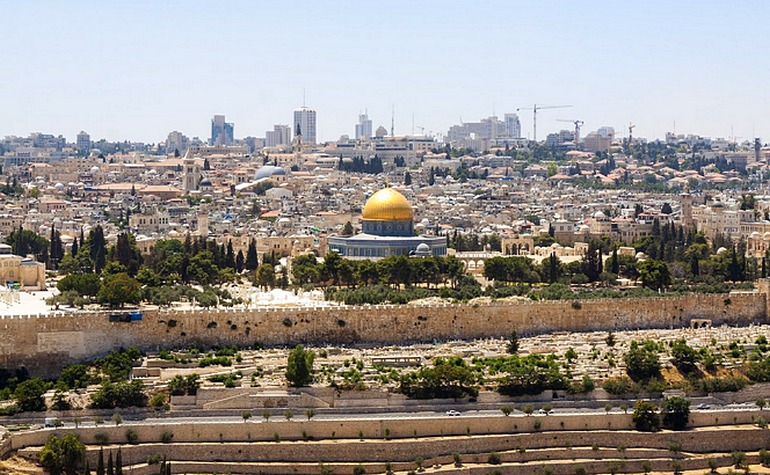
Brief historical timeline of Jerusalem:
- Jerusalem has a long history. It has been destroyed at least twice, besieged 23 times, attacked 52 times, and captured and recaptured 44 times.
- It was captured by the Muslims in 637 CE during the reign of Caliph Umar (رضي الله عنه). This occurred within five years of the death of the Prophet (ﷺ).
- The city was taken by the Christian Crusaders in 1099 and the Muslim and Jewish inhabitants were massacred. In 1187, the city was recaptured by Salahuddin Ayyubi. He not only let the surviving Crusaders free to leave the city, but also gave many of them provisions for their journey home.
- Between 1229 and 1244, the city was peacefully given to Christian control as a result of a treaty agreed between the crusading Roman Emperor Frederick II and al-Kamil, the Ayyubid sultan of Egypt.
- In 1244, Jerusalem was sacked by the Tatars, who annihilated the Christian population. They were driven out by the Ayyubids (descendents of Salahuddin Ayyubi) in 1247. Between 1260 and 1517, the city was ruled by the Mamluks. They were former slaves brought up as Muslim soldiers and played a pivotal role in checking the Mongol advance.
- From 1517 right up to 1917, the city came under the control of the Ottomans. They brought great prosperity to the city, particularly Sulayman the Magnificent, under whose rule were built the walls around the Old City.
- Jerusalem came under the control of the British between 1917 to 1948. Following civil war, the city was divided into two. The eastern half (including the Old City) became part of Jordan, while the western half became part of the newly established state of Israel.
- Following the 1967 ‘Six Day’, the whole of Jerusalem came under the control of the Israelis. They claim sovereignty of the site of Masjid al-Aqsa but custodianship is held by the Islamic waqf trust. However, Israeli forces are permitted to patrol and conduct searches within al-Aqsa.
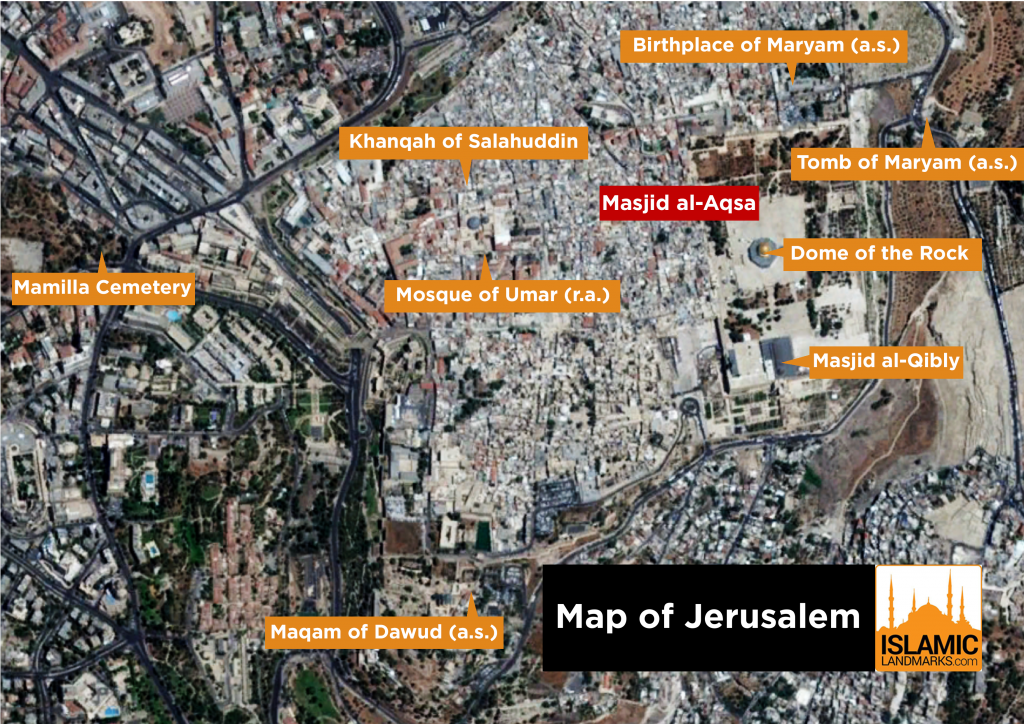
References: A history of Jerusalem – Karen Armstrong, Al-Quds – Mohammed Abdul Hameed Al-Khateeb, Forty Ahadith concerning Masjid al-Aqsa – Ismail Adam Patel, Wikipedia.
]]>(more to follow)
]]>
- Her father’s name was Imran ibn Mathan. Her mother’s full name was Hannah bint Faqudh. They were both very religious and held a high status in the eyes of Allah (ﷻ). Hannah was deprived of a child until she reached old age.
- It so happened that once she was seated under the shade of a tree when she saw a bird feeding her little baby. She was moved by this sight, and wept supplicating to Allah (ﷻ) for a child of her own. She vowed that if she were to be gifted with one, she would offer the child for the services of the sanctuary, Bayt al-Maqdis.
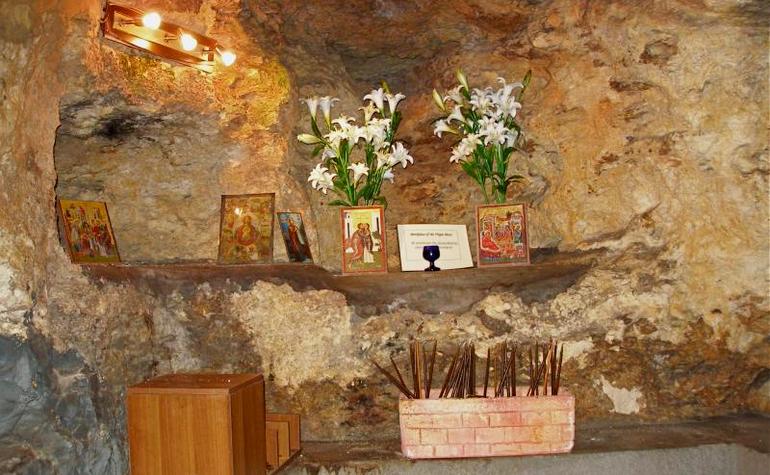
- She fell pregnant. Her husband, Imran, died before her delivery, therefore Maryam (عليها السلام) was born as a yatim (an orphan). Hannah took good care of her until she grew up, and to fulfill her oath, she offered her to the sanctuary.
- The normal custom was that only males were offered in the service of the Bayt al-Maqdis. However, Maryam (عليها السلام) was accepted. All the worshippers wanted to look after her but Prophet Zakariyya (عليه السلام) was chosen to be her guardian because he was her uncle.
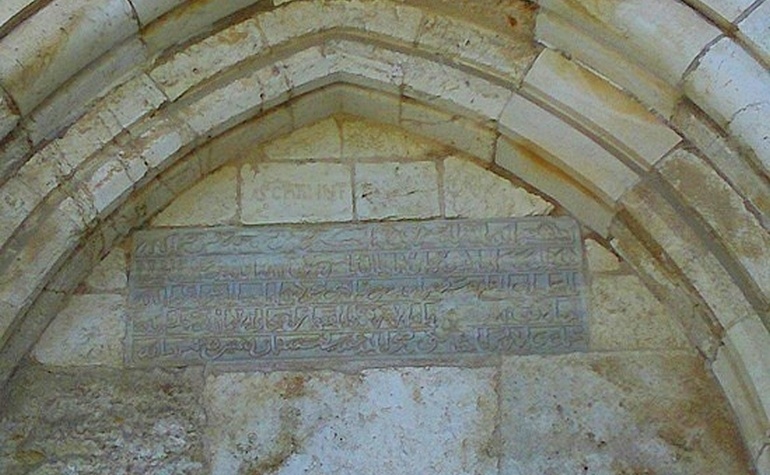
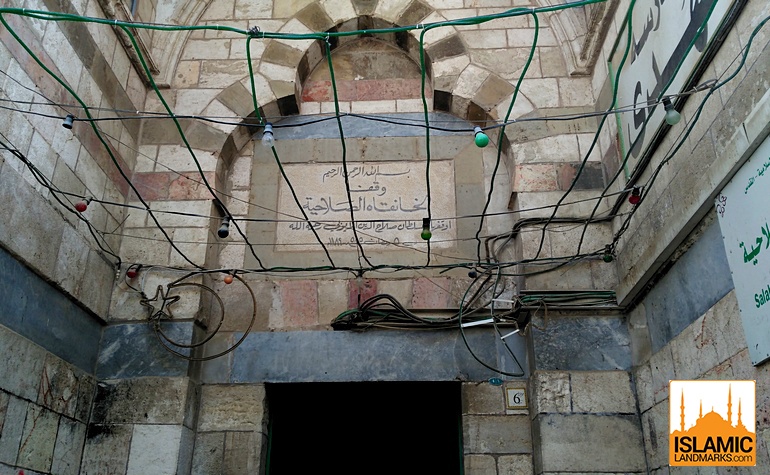
- The present structure of the church was built by the Crusaders in 1140 AD. When the Muslims took over Jerusalem in 1189 AD the church was not destroyed but converted into a madressa (seminary) by Salahuddin Ayyubi called al-Madrasa as-Salahiyya. His name is in the Arabic inscription above the main entrance.
References: The Tafsir of Surah Maryam – Sheikh Abdur Raheem Limbada, Wikipedia.
]]>- In Islam, Maryam (عليها السلام) is venerated as a righteous woman and is the only woman mentioned by name in the Quran. The 19th surah of the Quran is named after her and she is mentioned more times in the Quran than in the entire New Testament.
- Maryam (عليها السلام)’s story in the Quran, begins while she is still in her mother’s womb. The mother of Mary said, “O my Lord! I do dedicate into Thee what is in my womb for Thy special service. So accept this of me for Thou hearest and knowest all things.” [3:35]. When Mary was delivered, she said, “O my Lord! Behold! I am delivered of a female child!” [3:36]. She had expected her baby to be a boy who would grow up to be a scholar or religious leader. The verse continues “…and God knew best what she brought forth — ‘And no wise is the male like the female. I have named her Maryam, and I commend her and her offspring to Thy protection from Satan, the Rejected.’“
- The Quran further mentions the qualities of Maryam (عليه السلام), declaring her (uniquely along with Isa a.s.) to be a Sign of God to mankind [23:50]; as one who “guarded her chastity” [66:20]; “an obedient one” [66:12]; “a Chosen One” [3:42]; “a Purified One” [3:42]; “a Truthful one” [5:75]; her child conceived through “a Word from God” [3:45]; and “exalted above all women of The Worlds/Universes” [3:42].
- She remained unmarried and passed away long after Isa (عليه السلام) was raised to the heavens. Some Mufassireen have said that as unmarried women will be married in Jannah (Paradise) to the person of their choice, Maryam (عليها السلام) will marry our beloved Prophet Muhammed (ﷺ) in Jannah.
- The first tomb was cut in the hillside here in the 1st century CE. By the 5th century, an upper chapel had also been built. This was destroyed by the Persians in 614, rebuilt by the Crusaders but again destroyed by Salahuddin Ayyubi in 1187. He left the crypt, however, largely intact.
- In the south western wall beside the tomb is a mihrab (indicating the direction of Makkah) that was installed after the conquest of Jerusalem by Salahuddin Ayyubi.
References: Wikipedia, Jerusalem & the Holy Land – Dorling Kindersley, The Tafsir of Surah Maryam – Sheikh Abdur Raheem
Note that this entry has been shown for information purposes only. On no account should anybody pray to a grave or seek supplication through them as this is tantamount to committing shirk, associating partners with Allah (ﷻ)
]]>- Dawud (عليه السلام) is mentioned by name 16 times in the Holy Quran.
- Dawud (عليه السلام) ruled the Children of Israel [Banu Israil] for forty years, seven years in Hebron (al-Khalil) and thirty-three in Jerusalem, which became known as the City of Dawud.
- According to Jewish and Christian belief (ref: Who’s Who in the Bible by Peter Calvocoressi), Dawud (عليه السلام) [David] committed adultery with Bathsheba, the wife of Uriah the Hittite. Bathsheba became pregnant and David sent for Uriah, who was with the Israelite army at the siege of Rabbah, so that he might lie with his wife and so conceal the identity of the child’s father. Uriah refused to do so while his companions were in the field of battle and David sent him back to Joab, the commander, with a message instructing him to abandon Uriah on the battlefield, “that he may be struck down, and die.“ In Islam, Dawud (عليه السلام) is regarded as one of the great Prophets, to whom the Zabur (Psalms) were revealed by Allah (ﷻ). The Islamic tradition includes many elements from the Jewish/Christian history of David, such as his battle with the giant Goliath, but completely rejects the Biblical portrayal of him as an adulterer and murderer.
- Dawud (عليه السلام) was the first person skilled in making armour from iron. Allah (ﷻ) mentions in Surah Saba in the Holy Quran:“And certainly We gave Dawud bounty from Us (and said), ‘O mountains! Repeat Our praises with him, and the birds you too’. And we softened for him iron, (saying) ‘Make wide coats of mail, and measure well the links and do righteous deeds. Surely I am Seer of what you do.” [34:10-11]
- The Prophet (ﷺ) said, “The most loved Salat (prayer) in the sight of Allah is the Salat of Dawud and the most loved of Saum (fasting) in the sight of Allah is the Saum of Dawud. He used to sleep for the first half of the night and offer prayer for one-third of it and sleep (again) for one-sixth of it. And he used to observe fast on alternate days. And when he encountered an enemy he never fled.” [Bukhari]
- Allah (ﷻ) had given him a very sweet voice such as not had been given to anyone before. When he used to recite the Zabur (Psalms) human beings, jinn, birds and animals stood devotedly listening to him.
References: Atlas of the Quran – Dr. Shauqi Abu Khalili, Al-Quds – Mohammed Abdul Hameed Al-Khateeb, Stories of the Prophets – Ibn Kathir
Note that this entry has been shown for information purposes only. On no account should anybody pray to a grave or seek supplication through them as this is tantamount to committing shirk, associating partners with Allah (ﷻ)
]]>- Allah (ﷻ) tells us in the Quran in Surah Nisa: “That they said (in boast), ‘We killed Isa, son of Mary, The Messenger of Allah.; But they killed him not, nor crucified him. Only a likeness of that was shown to them. And those who differ therein are full of doubts, with no knowledge, but only conjecture to follow, for a surety they killed him not. Nay, Allah raised him unto Himself, and Allah is Exalted in Power, Wise.” [4:157-158]
- Muslims peacefully took control over the city of Jerusalem from the Byzantines in February 638 CE. Caliph Umar (رضي الله عنه) accepted the city’s surrender from Sophronius, the Patriarch of Jerusalem. He was shown around the church during which the time for salah occurred. The Patriarch offered a place for him to pray in the church and laid out a straw mat but Umar (رضي الله عنه) refused, explaining to the Patriarch, “Had I prayed inside the church, the Muslims coming after me would take possession of it, saying that I had prayed in it.” Tradition has it that he picked up a stone, threw it outside and prayed at the spot it landed. The present Mosque of Umar was built over this place by Salahuddin Ayyubi’s son Afdhal Ali in 1193 CE.
- The earliest known Christian church on this site dates from before 66 CE, but the area was levelled by the Roman Emperor Hadrian, who then raised a temple to Aphrodite here in 135 CE, following the Second Jewish Revolt. After his conversion to Christianity, the Emperor Constantine dispatched his mother Helena to the Holy Land in 326 CE to establish the true locations of Christian holy sites. Since it was standard practice to build temples on sites held sacred to other religions, especially subversive ones, Hadrian’s construction of the temple to Aphrodite here led Helena to identify the site as the location of the supposed crucifixion and burial.
- The church is built on Golgotha, the Hill of Cavalry where the crucifixion was to be carried out. In the time of Isa (عليه السلام) this site was actually outside Jerusalem’s walls.
- Over the centuries the church has been destroyed several times and its present day appearance has been attributed to Emperor Monomac and twelfth century Crusaders.
- The Church of the Holy Sepulchre has long been the subject of interdenominational disputes. Six Christian denominations – the Latins (Roman Catholics), Greek Orthodox, Armenian Orthodox, Syrian Orthodox (Jacobites), Ethiopians and Copts own different parts of the church and there are regular, and sometimes violent skirmishes as each vies to maintain their territory. Repairs are especially problematic; the restoration work following the 1927 earthquake wasn’t completed until 1988, after thirty years of arguments and a further thirty years of construction. 11 people were hospitalised in 2002 when a fire broke out after the Coptic monk who is stationed on the roof of the church to symbolize Coptic claims to the site moved his chair from its agreed spot into the shade, which was interpreted as a hostile act. Two years later another altercation occurred when a Franciscan chapel door was left open, which was interpreted as a sign of disrespect by Orthodox Christian worshippers.
- None of the denominations own the main entrance. In 1192, Salahuddin Ayyubi assigned responsibility for it to two neighbouring Muslim families. The Joudeh were entrusted with the key, and the Nusseibeh, who had been the custodians of the church since the days of Caliph Umar (رضي الله عنه) retained the position of opening the door. This arrangement has persisted into modern times as no Christian sect will trust the others with the key. Every morning and evening two armed Israeli soldiers accompany a member of the Joudeh family, who brings the door’s great key to a member of the Nusseibeh family, who unlocks or locks the door. The video below shows the church being locked.
References: Wikipedia, Palestine: Beginner’s guide – Ismail Adam Patel, The Rough Guide to Jerusalem, Sacred Places – Philip Carr-Gomm, HUMA Travel guide to Palestine.
]]>- The Patriarch of Jerusalem was showing Umar (رضي الله عنه) around the Church of the Holy Sepulchre during which the time for salah occurred. The Patriarch offered a place for him to pray in the church but Umar (رضي الله عنه) refused, explaining to the Patriarch, “Had I prayed inside the church, the Muslims coming after me would take possession of it, saying that I had prayed in it.” Tradition has it that he picked up a stone, threw it outside and prayed at the spot it landed. The present Mosque of Umar (or Masjid-e-Umar) was built over this place by Salahuddin Ayyubi’s son Afdhal Ali in 1193 CE.
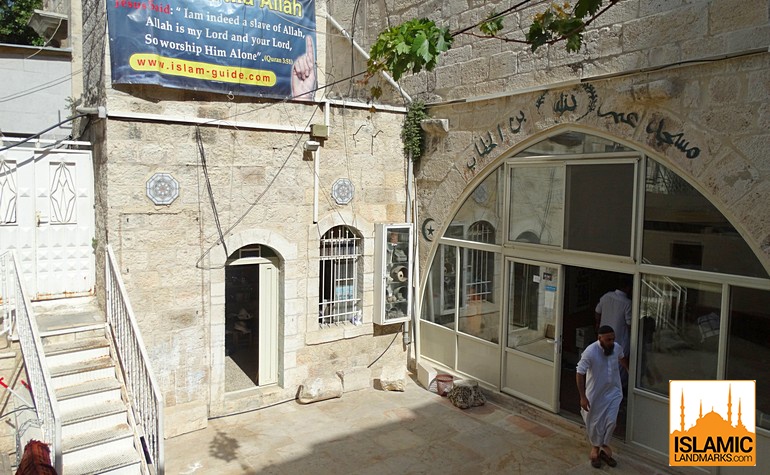
- At the time when the Muslims first conquered Jerusalem, the Jews had long been banned from Jerusalem and the surrounding areas by the Christian rulers. Umar (رضي الله عنه) agreed with Sophronius (the Patriarch of Jerusalem) that the Jews would not be permitted to reside but later revoked this arrangement. Umar (رضي الله عنه) invited 70 Jewish families from Tiberias to settle in Jerusalem, allowing them to also build a synagogue.
- Several eminent Companions of the Prophet (ﷺ) also settled in Jerusalem, drawn by the holiness of the city. Ubadah-bin-Samit (رضي الله عنه), one of the leading experts in the Quran, became the first qadi (Islamic judge) of Jerusalem.
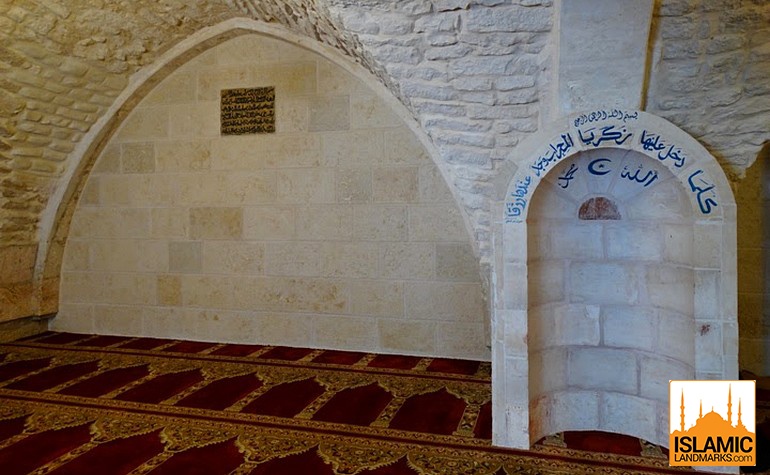
- A copy of the Covenant which Umar (رضي الله عنه) had drawn up giving assurances of safety to the (non-Muslim) people of Jerusalem is displayed outside the mosque.
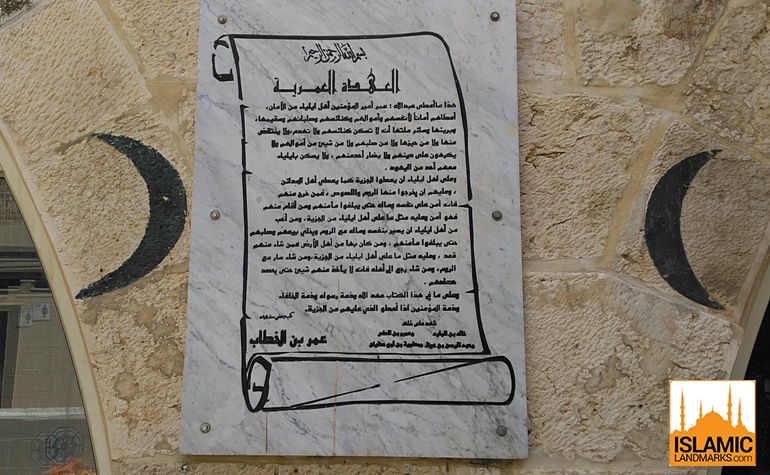
- This mosque is not to be confused with the Dome of the Rock which is sometimes mistakenly referred to as the Mosque of Umar. There is also a small mosque adjacent to the Al-Aqsa Mosque known as the Mosque of Umar.
- Video of the outside of the mosque:
References: A history of Jerusalem – Karen Armstrong, Wikipedia, The Rough Guide to Jerusalem
]]>- Salman Farsi (رضي الله عنه) grew up in Isfahan in Persia into a very rich and respectable family. He was initially a devotee of the Magian religion (fire worshippers).One day his father sent him to a village. On the way he passed by a church from which he heard the Christians praying. He was astonished and remarked to himself, “This is better than our religion”. He asked the Christians about the origins of their faith and was told that it was in ash-Sham (Greater Syria). Upon returning he narrated his experience to his father who became upset and imprisoned him in the house.
- He managed to escape and joined a caravan to Syria where he sought out the leading bishop, became a Christian and entered into his service in the church. He however, found the bishop to be corrupt and exposed his practises after the bishop’s death. The bishop was replaced by a pious man who was greatly devoted to worship day and night. After his death, Salman attached himself to various Christian religious figures, in Mosul, Nisibis and elsewhere. The last one had told him about the appearance of a Prophet in the land of the Arabs who would have a reputation for strict honesty, one who would accept a gift but would never consume charity (sadaqah) for himself. He would also have the seal of the Prophets on his back.
- Salman paid money to join a group of Arabs back to their homeland but was betrayed by them and sold into slavery to a Jew who in turn sold him again to another Jew of the Banu Quraiza. He was taken to Yathrib (Madinah) which he recognized to be the place where the awaited Prophet would come. He was put to work there, cultivating and taking care of the palm trees.
- One day Salman was on top of a palm tree when he heard someone talking with his master below about the emigration from Makkah of a man who claimed to be a Prophet. Salman was excited by the news and asked his master to tell him more but his master violently hit him and told him to get back to work.
- That evening Salman took some dates and went to Quba, where the Prophet (ﷺ) was staying and offered the dates as sadaqah. The Prophet ordered his companions to eat but he himself did not eat of it. Salman gathered some more dates and when the Prophet (ﷺ) left Quba for Madinah he went to him and said: “I noticed that you did not eat of the sadaqah I gave. This however is a gift for you.” Of this gift of dates, both he and his companions ate.
- Salman left and returned soon after where he found the Prophet (ﷺ) in al-Baqi. He greeted him and turned to see up his back. The Prophet (ﷺ), knowing what he wanted threw his garment over his shoulder and Salman saw the seal of the Prophets, exactly as it had been described to him. Salman kissed him and embraced Islam.
References: Men around the Messenger – Khalid Mohammed Khalid, Works of Ibn Kathir
Note that this entry has been shown for information purposes only. On no account should anybody pray to a grave or seek supplication through them as this is tantamount to committing shirk, associating partners with Allah (ﷻ)
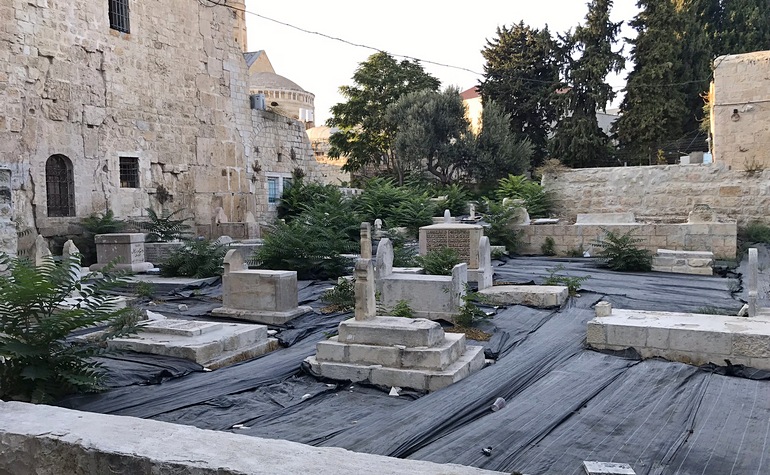
]]>- The cemetery contains the tombs of two of the companions (Sahabah) of the Prophet (peace and blessings of Allah be upon him), Ubadah-bin-Samit and Shaddad-bin-Aus (رضي الله عنهم).
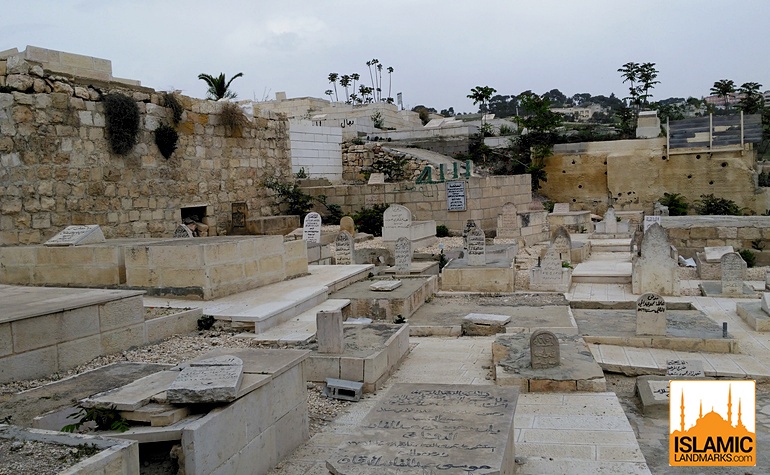
Reference: Local guides
]]>- Ubadah bin Samit (رضي الله عنه) was from the Ansar and one of the twelve Sahabah (رضي الله عنهم) who accepted Islam at Aqabah.
- He participated in the Battle of Badr and fought in every battle with the Prophet (ﷺ).
- He was amongst the five Ansari Sahabah who had gained mastery over the Quran in the time of the Prophet (ﷺ).
- He has been described as being tall, well built and handsome. He was extremely bold and openly engaged in enjoining the good and forbidding evil. His wife was Umme Haram (رضي الله عنها).
- Caliph Umar (رضي الله عنه) sent him to Palestine as a judge. He passed away in Palestine in the year 34 AH at the age of 72.
References: In the Blessed Lands: Jamiatul Ulama KZN
]]>